
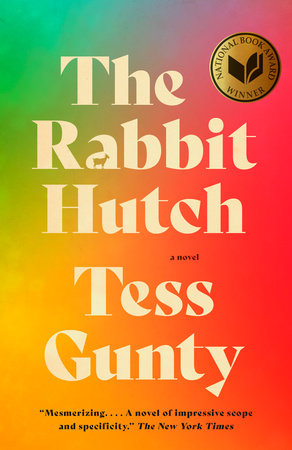
The Rabbit Hutch
In the declining Indiana city of Vacca Vale, Blandine Watkins lives in an affordable apartment complex with three teenage boys who have recently aged out of foster care.
About
Spoiler notice: Discusses the opening situation, major character relationships, setting, thematic concerns and narrative form without revealing the ending or the central late-novel violence.
The Rabbit Hutch opens with Blandine Watkins experiencing what she has spent much of her life imagining: an escape from her body. The scene is startling, but Tess Gunty quickly widens the frame beyond one young woman in crisis. Blandine lives in La Lapinière, an affordable housing complex in Vacca Vale, a fictional Indiana city diminished by the departure of its automobile industry. Around her are three boys who, like her, have recently aged out of foster care, along with neighbors whose private troubles rarely stay private for long. The building gives the book a close physical center, while its many residents let Gunty trace how loneliness, need and harm can travel through walls and across a whole town.
Blandine’s inward life is unusually expansive. She reads about Christian mystics, especially Hildegard of Bingen, and is drawn to the possibility that the self might reach beyond the limits of the body. That spiritual longing exists beside practical anger at the structures that have failed or exploited her. Gunty does not present these sides as a tidy opposition between lofty ideas and ordinary hardship. Blandine’s questions about transcendence emerge from the same vulnerable body that must move through work, housing and other people’s expectations. Her private reading gives her language for experiences that the town’s routines cannot easily contain, while her attention to injustice pulls those ideas back toward the lives around her.
The novel’s setting gives those lives a shared pressure. Vacca Vale carries the remains of a company town: a landscape shaped by manufacturing, now marked by abandoned industry and a poisoned river. The Rabbit Hutch itself is a repurposed building with a past connected to factory workers. Gunty’s portrait holds onto the city’s texture and history while showing how economic decline affects people unevenly. Residents inherit a built environment they did not choose, and outside plans for renewal raise a question familiar to places facing redevelopment: who benefits when a neighborhood is remade, and who is asked to leave? Blandine’s resistance to a proposed project grows from attachment to the valley and concern for those with little power over its future.
Gunty moves among residents rather than treating the apartment block as a backdrop for Blandine alone. Joan, who screens comments on an online obituary site, encounters strangers through the words they leave after death. Hope, a young mother, is frightened by the difficulty of feeling close to her baby. Elsewhere, an older couple and other tenants carry losses and frustrations that do not resolve simply because they share an address. These strands create a social portrait built from mismatched points of view. People can live close together and remain opaque to one another; the book keeps returning to that distance, while showing how even partial knowledge can alter what someone notices or chooses to do.
The form reflects this many-sided attention. The central story does not proceed in a straight line, and the narrative shifts between characters, recollection and different kinds of text. Obituaries and letters sit alongside more conventional scenes; one section is told through drawings. These changes make the novel feel alert to the different ways people record a life, explain themselves or fail to understand one another. They also ask the reader to assemble connections instead of receiving one settled account. The shifts can be disorienting, but they suit a book about a community whose members experience the same place from sharply different positions. Vacca Vale becomes legible through these partial views, not through a single authoritative voice.
Dark humor moves through the book’s serious material. Its residents face isolation, histories of foster care, precarious housing and a town’s exhausted prospects, yet their lives are not reduced to examples of social problems. Gunty gives them peculiar habits, beliefs and ways of speaking, and the novel can turn from a neighbor’s ordinary routine toward spiritual intensity or grotesque comedy. That tonal movement keeps the book from offering an easy consoling message. Compassion here requires looking directly at pain and contradiction, including the ways people can injure one another while seeking connection. The result is a community portrait that is both intimate and unsettled: the apartment block contains private worlds, but none is sealed off from the others.
At its center, The Rabbit Hutch asks what freedom might mean for people whose choices have been narrowed by institutions, poverty or the expectations attached to their bodies. Blandine’s desire for transcendence gives that question an almost mystical dimension, while the story’s attention to housing and redevelopment keeps it grounded in place. The book ranges across neighbors’ lives, but its focus returns to the fragile ties that make people responsible to one another, whether they recognize those ties or not. Gunty’s debut is formally playful and crowded with ideas, yet its deepest concern is concrete: how to see other people as fully real within a city that has learned to overlook them.
Book details
- Author
- Tess Gunty
- First published
- 2022
- Series
- No series listed
- Subgenre
- Literary fiction, Social realism, Experimental fiction
- Primary genre
- Literary Fiction
- Tags
- No tags for this book.
Review
Editor profile
Baby Bat
Goodreads and social links will be added soon.
- Goodreads — link coming soon
- Social media — link coming soon