
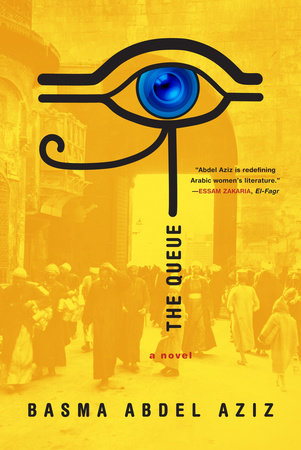
The Queue
In an unnamed city after the failed Disgraceful Events, the Gate controls access to ordinary services while remaining closed to the people waiting outside.
About
Spoiler notice: Spoilers for the premise and early-to-middle developments involving Yehya’s injury, his medical file and the growing queue; the ending is not described.
The Queue begins in an unnamed Middle Eastern city after a failed popular uprising called the Disgraceful Events. In its aftermath, authority gathers around the Gate, a centralized institution that issues rules and permissions for ordinary life. The building itself remains closed to the people who need it, while its decrees continue to shape what they may do. As citizens arrive to seek approvals, the line outside grows into a public space with its own routines, disputes and fragile exchanges. The premise makes waiting a concrete condition: people give time, work and attention to a system that withholds an answer, even as their needs continue to change. People wait for documents, signatures and permission to make choices that should belong to them. The Gate’s distance is part of its power, though people in line still notice one another’s needs and share small necessities. The crowd is formed by ordinary errands as well as political crisis: people need treatment, paperwork, and access to daily necessities, so leaving the line can carry its own cost.
Yehya, a young man who passed near the protest, was shot during the Disgraceful Events. He survives with a bullet lodged in his pelvis, but the authorities deny that gunfire took place and the official account recasts protest injuries as something else. His case connects the street violence to the machinery that follows it. A medical image disappears from his file, records become uncertain, and statements from the Gate press against what witnesses and doctors have seen. The injury is physically specific, but its treatment depends on recognition: without the institution acknowledging what happened, even a basic request for care becomes a contested claim. Each missing or revised record puts more pressure on people who remember the event, while the danger to Yehya’s body does not wait for an official ruling.
Dr Tarek Fahmy is the physician responsible for Yehya’s care. He understands the danger of the wound and the possibility that the bullet may threaten vital organs, yet permission to operate is entangled in procedures and political risk. Tarek has worked within the rules for years, and his hesitation grows from more than indifference: he must weigh his medical duty against the threat of breaking regulations enforced by the Gate. His position gives the novel a second pressure point. Yehya needs an operation, while Tarek needs to decide whether professional judgment can survive inside an institution that controls both the available paperwork and the accepted account of reality. Notes in Yehya’s medical record keep the declining condition beside the bureaucracy’s delays, showing what obedience may cost.
Yehya’s girlfriend, Amani, tries to secure the care he needs, and his friend Nagy remains closely tied to his fate. Their efforts unfold among many other people gathered in the queue. Ines, a teacher, attracts official attention after praising a pupil’s essay about living conditions; Um Mabrouk makes a practical living by selling tea and snacks to those waiting. The line includes people with different work, beliefs and resources, including the brother of a security officer killed in the clashes. Their presence gives the setting social texture: people share heat, news and small services while the Gate’s delays reorganize their days and pull separate lives into contact. The queue becomes a temporary neighborhood, although nobody has chosen the conditions that brought them there.
The Gate’s authority operates through both paperwork and language. New certificates and approvals appear to be required for tasks that were previously ordinary, and the rules can shift while citizens attempt to meet them. Official statements deny the evidence of violence, while elaborate assurances promise that public needs will soon be addressed. That gap between reassuring announcements and lived conditions creates the novel’s darkly comic strain. The bureaucracy does not merely slow people down; it can define which experiences count, who qualifies as a proper citizen and whether a need is legitimate. The queue therefore becomes a place where information, status and access are continuously negotiated. Its cheerful public language sits beside consequences for patients, workers and people trying to help.
The Gate's presence extends beyond the line through decrees, official broadcasts and rules that reach into communication, treatment and public reputation. Abdel Aziz’s story draws on a recognizable post-uprising atmosphere while placing its action in a fictional city rather than naming it as Egypt. Its focus stays close to the people trying to navigate the Gate: a wounded patient, a doctor caught between protocol and care, a partner seeking help, and neighbors building small forms of support as the line lengthens. The resulting dystopia is made from ordinary acts—waiting, filing, treating, selling refreshments and repeating official language—whose consequences grow as access to the institution remains out of reach. The author has described seeing a real line outside a closed Cairo government building before imagining how such a queue might connect otherwise unconnected lives. The result keeps the political conflict grounded in individual choices and material needs.
Book details
- Author
- Basma Abdel Aziz
- First published
- 2013
- Series
- No series listed
- Subgenre
- Dystopian, Translated literary fiction
- Primary genre
- Literary Fiction
- Tags
- No tags for this book.
Review
Editor profile
Baby Bat
Goodreads and social links will be added soon.
- Goodreads — link coming soon
- Social media — link coming soon