
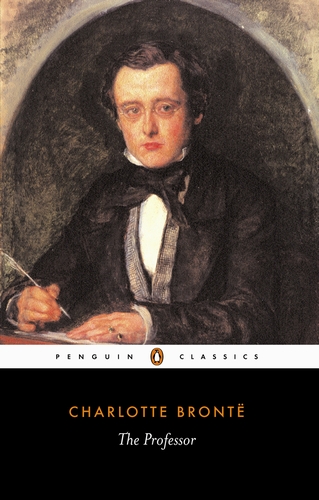
The Professor
After rejecting a church living and a family-arranged marriage, William Crimsworth leaves an unhappy clerkship in his brother's Yorkshire mill and goes to Brussels to find work as a teacher.
About
Spoiler notice: This overview discusses Reuter and Pelet’s engagement, William and Frances’s marriage, their school and the family life described in the final chapter.
William Crimsworth introduces himself through a letter to an old school acquaintance, recalling choices that have left him without the comfortable future his relations proposed. His uncles offered him a church living and suggested marriage to one of his cousins, but neither prospect appealed to him. The Professor follows the consequences of choosing another way, with William telling his own story and judging the people who help or obstruct him. Brontë's preface describes an intention to make advancement depend on work instead of a miraculous change of fortune. That principle shapes a novel concerned with earning a living, finding a useful occupation and deciding how much independence a person can preserve when employment places them under someone else's authority.
William's first attempt takes him into his older brother Edward's mill business. The industrial landscape appears active and prosperous, yet he has to force himself to regard it as a promising scene for his career. Edward's attitude makes the difficulty personal: the family relationship does not bring warmth into the arrangement, and William feels the distance between a powerful employer and the clerk he has taken on. His education and abilities give him resources, but they cannot make an uncongenial position satisfying simply because it is available. The opening establishes an uncomfortable form of dependence in which salary, status and family pride are entangled. Leaving it will require him to risk unfamiliar circumstances rather than accept resentment as the permanent condition of work.
Yorke Hunsden helps direct that risk towards Brussels. His introduction leads William to Mr Brown and then to employment with M. Pelet as a teacher of English and Latin. The title's professor belongs to this school setting, where language and instruction provide a route to earning his way abroad. William enters a society he must learn to interpret while also trying to establish authority over pupils. Pelet's boys' school and the neighbouring establishment run by Zoraïde Reuter create overlapping circles of professional and personal acquaintance. The move therefore changes more than the country around him. It gives him work better connected to his abilities while exposing him to relationships whose apparent friendliness may conceal competing intentions.
Reuter attracts his attention through a manner he initially reads more favourably than he will later. Overhearing her conversation with Pelet reveals their engagement and exposes his supposed admiration as a subject of discussion between them. William's first-person account makes the embarrassment immediate, but it also gives the reader a particular viewpoint rather than an impartial verdict on everyone involved. He is sensitive to being underestimated, manipulated or placed in a foolish position, and he scrutinises motives accordingly. The school environment offers ample opportunity for that scrutiny because employment, courtship and control meet within a small social world. The person who directs an institution can also influence who receives encouragement, who remains visible and whose ambitions are allowed to develop.
Frances Henri experiences those limits from a less secure position. A Swiss lace-mender, she has paid for lessons and books through her own earnings, hoping to improve her English and eventually teach French in England. Her manual work enables the education that others may use as a reason to look down on her. William's interest in her ability therefore connects affection with the practical struggle to become qualified for another life. Reuter's handling of Frances and her ambitions complicates that progress, and Frances leaves the establishment. When William later finds her in modest lodgings after her aunt's death, independence is accompanied by bereavement and material uncertainty. Their growing attachment develops among these pressures rather than outside them.
Marriage does not bring the work of advancement to a halt. After their wedding, William and Frances return to occupied days, and Frances becomes dissatisfied with the limited return on her efforts. Her determination helps lead towards a school of their own, whose increasing success changes their circumstances over years. William describes her authority as a directress alongside the private qualities he knows at home. She can be exacting with pupils while showing particular tenderness towards children who are sick, homesick or poorly provided for. Their partnership joins affection to sustained labour, although William's account continues to reveal expectations about deference and consultation within marriage. The prosperity they achieve grows from daily effort rather than replacing work with an effortless reward.
The final chapter carries them back to England with their son Victor and revisits the household through William's continued friendship with Hunsden. Parenthood adds another debate about education and temperament: the adults disagree over the boy's strong feelings, the need for discipline and the protection offered by affection. Victor's grief after the loss of his dog makes those differences especially painful. William also anticipates sending him to Eton, a future separation that neither parent welcomes easily. The novel closes with Frances calling him away from his manuscript to tea, bringing the act of narration back into family life. Independence has created a home, but it has not removed the responsibility of deciding how to live within it.
Book details
- Author
- Charlotte Brontë
- First published
- 1857
- Series
- No series listed
- Subgenre
- Coming-of-age, Modern classics
- Primary genre
- Literary Fiction, Romance
- Tags
- No tags for this book.
Review
Editor profile
Baby Bat
Goodreads and social links will be added soon.
- Goodreads — link coming soon
- Social media — link coming soon