
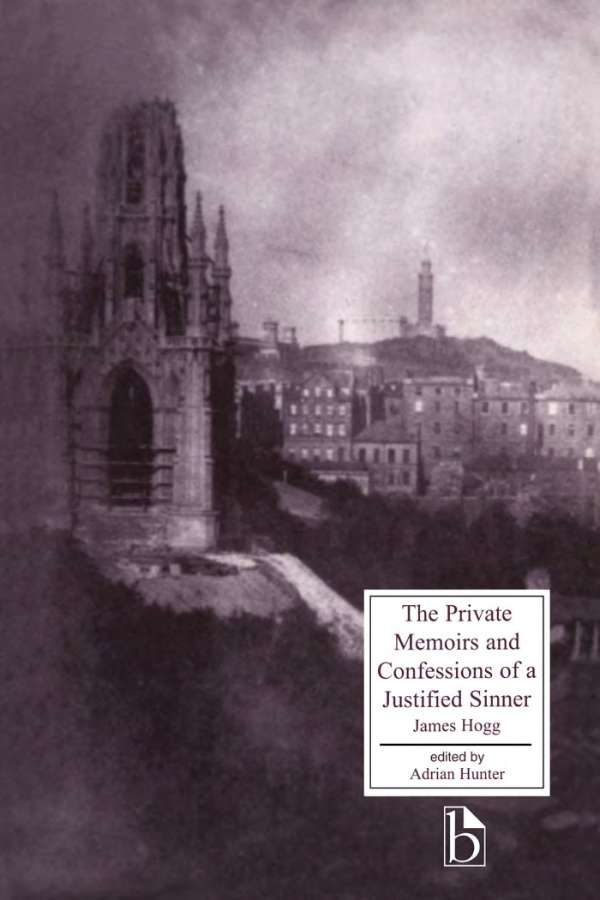
The Private Memoirs and Confessions of a Justified Sinner
Two accounts of a divided Scottish family draw the reader into the violent estrangement of George Colwan and Robert Wringhim.
About
Spoiler notice: Full-plot spoilers, including George’s death, Robert’s final entries and the discovery of the memoir.
The Private Memoirs and Confessions of a Justified Sinner opens as a family history assembled by an editor, then becomes something much harder to establish. Its first account follows the Colwans of Dalcastle in Scotland, beginning with a marriage divided by religious conviction and personal dislike. George Colwan’s wife regards her husband’s conduct through a severe religious framework that he does not share. Their household produces two boys who grow up under sharply different influences, and the account carries doubts about Robert’s parentage into the hostility between them. Hogg makes these private disagreements part of a world of ministers, property, public reputation and local stories. Before a mysterious companion enters the narrative, the family already has competing ways of explaining who belongs and who deserves condemnation.
The elder boy, George, grows up with the laird, while Robert is raised under the influence of the minister Mr Wringhim and his mother. The editor calls them brothers in law while qualifying what can be said about their biological relationship; the book never supplies a simple, uncontested family tree. Robert’s education encourages him to divide humanity between those chosen for salvation and those destined for destruction. His intellectual accomplishments do not make him more generous towards the people placed outside that favoured group. He learns to regard his reputed father and brother with hostility, while George develops into a sociable young man. Their estrangement therefore has a history before they confront one another directly. Robert has been given a language in which hatred can resemble religious duty.
In Edinburgh, the brothers’ conflict becomes an invasion of George’s ordinary life. Robert’s presence disrupts his movements and pleasures, making it difficult for him to find a place beyond the quarrel. An excursion to Arthur’s Seat, undertaken for fresh air and the sunrise, turns the landscape into another setting for disturbing appearances and confrontation. The editor’s narrative moves through encounters, accusations and evidence supplied by other people, rather than offering direct access to every event. When George dies violently, the question of who killed him becomes entangled with sightings and testimony that cannot be made into a perfectly stable account. The family history has acquired the shape of a crime story, but the voices explaining it do not give the reader a securely solved case.
Robert’s private memoir then returns to the same world from inside his own convictions. He describes being assured that he belongs among the elect, an assurance that prepares him to receive the stranger Gil-Martin as a companion in faith. Their relationship depends on praise and deference that conceal a growing imbalance. Gil-Martin seems to respect Robert’s religious understanding, yet increasingly becomes the person who supplies his arguments and directs his choices. Robert describes finding relief when they part and longing to see him again soon afterwards. The attraction is personal as well as doctrinal: he is flattered by the prospect of an exceptional mission. What begins as recognition by someone apparently like himself develops into dependence on someone whose identity he cannot explain.
Gil-Martin’s reasoning turns the promise of salvation into a licence for violence against people labelled wicked. Robert’s account of George’s death is especially revealing because it undercuts itself while trying to justify his actions. He describes coming out of concealment during a fight and taking up his sword against his brother, but then admits that his immediate impressions differed from the version he has supplied. He relies on Gil-Martin’s later explanation instead, treating the companion’s testimony as more trustworthy than his own disturbed senses. This is not a confession that settles every disputed detail simply by naming an offender. The memoir shows how a person can surrender the interpretation of his conduct to the very influence encouraging it, then present that borrowed interpretation as proof of righteousness.
As the memoir continues, Robert’s certainty is increasingly accompanied by fear and gaps in awareness. He cannot account for substantial portions of his time and wonders whether someone acts in his likeness or his body is subject to another power. Gil-Martin’s presence, once a source of pride, becomes oppressive, yet Robert feels unable to separate himself from his companion. His subsequent flight and efforts to find shelter do not produce a dependable escape from that relationship. The final dated entries bring the account to despair: Robert says he has pledged to die alongside his tormentor and prepares to seal his writing as a threatening figure approaches. The memoir stops at this expectation. It does not give an independently witnessed account of the death that local tradition will subsequently describe.
The editor returns through a story about an old grave and an investigation that is itself full of disagreements. A letter attributed to James Hogg prompts a journey, but a local guide disputes important details of its account. Excavating the remains eventually produces the wrapped tract that the editor identifies as the memoir already presented to the reader. Finding a document supplies an origin for the text without proving that everything written inside it happened. The editor openly doubts Robert’s responsibility for George’s death and considers explanations involving delusion, allegory and a religious parable. His resistance to a literal devil does not conclusively remove the supernatural possibility either. Hogg ends with material evidence and unresolved interpretation together, leaving the reader to weigh a narrator’s certainty against the conflicting stories surrounding it.
Book details
- Author
- James Hogg
- First published
- 1824
- Series
- No series listed
- Subgenre
- Gothic horror, Psychological horror, Literary fiction
- Primary genre
- Literary Fiction
- Tags
- No tags for this book.
Review
Editor profile
Baby Bat
Goodreads and social links will be added soon.
- Goodreads — link coming soon
- Social media — link coming soon