
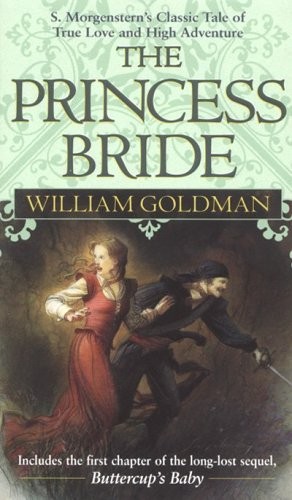
The Princess Bride
Goldman presents the book as an abridgement of a much longer novel by the fictional Florinese author S.
About
Spoiler notice: Full-book spoilers below, including major deaths and the ending.
William Goldman introduces The Princess Bride as the abridgement of an older book by S. Morgenstern, but that older book and its author are part of the invention. So is much of the personal history told by the Goldman who appears on the page. This narrator remembers a father reading an adventure aloud while he was ill, then tries to pass the same experience to his own son. Finding that the supposed original contains material his father skipped, he decides to preserve the exciting parts. His interruptions remain alongside the tale, explaining omissions and arguing with the imagined earlier author. The frame makes reading itself part of the adventure: the grown man is trying to recover what a childhood story meant, and discovers that telling it again requires choices his younger self never noticed.
Within that invented book, Buttercup begins as a farm girl whose beauty attracts attention she does not always welcome or understand. Her feelings for the farmhand Westley become clear when jealousy prompts a declaration of love. He leaves to seek the money that would let them marry, but news that his ship has fallen to the Dread Pirate Roberts persuades her he is dead. Prince Humperdinck offers another future, treating a beautiful wife as a royal requirement rather than someone he must love. His earlier proposed match with Guilder has collapsed, worsening relations with the neighbouring country. Buttercup agrees to marry without pretending affection. Becoming suitable for the court involves a manufactured title and education in princesshood, material the abridging narrator dismisses while preserving the conditions that brought her into the prince's plans.
The three men who kidnap her have abilities and needs that do not fit neatly into their employment as villains. Vizzini supplies the direction that Inigo Montoya has lost after years spent preparing to avenge his father. Inigo's achievement as a swordsman cannot solve the problem of not knowing where his enemy is, and drinking fills the space left by that failure. Fezzik's strength similarly conceals someone anxious about decisions and being abandoned. Others have used his size to determine what he should do, starting with the parents who pushed him into wrestling. Rhymes are a source of comfort and a skill he can exercise without the pressures attached to fighting. Their later friendship matters because it gives both men a relationship beyond being useful to the person currently issuing orders.
A man in black follows the kidnappers towards the Cliffs of Insanity, where the encounters test one speciality at a time. Inigo helps his pursuer complete the climb before beginning a duel, and discovers that the stranger can match the tricks with which he first holds back his own best technique. Fezzik next tries physical combat and loses, while Vizzini's supposed intellectual superiority fails in a poisoned-wine contest whose real conditions he has not understood. The rescuer is Westley, returned from the life Buttercup believed had ended. Their reunion leads into the Fire Swamp, with its flame bursts, sinking Snow Sand and huge carnivorous rats. Getting through those dangers does not deliver them into safety. Humperdinck catches them outside, and Buttercup returns with him in exchange for a promise that Westley will not be harmed.
The prince's Zoo of Death explains why that promise is worthless. Its underground levels turn hunting into a controlled arrangement of creatures chosen to satisfy him, with an empty final level reserved for a challenge worthy of his imagined supremacy. The place expresses the same urge to dominate that governs his political plans. Rugen's torture machine gives that impulse another form, treating pain as a subject to perfect and measure. Against those designed cruelties, the six-fingered sword carries a different relationship between a maker and his craft. Domingo Montoya spent his skill on a unique commission, and his murder made the weapon part of Inigo's responsibility to his father. It remains a reminder of what he is fighting for even though its unusual grip was designed for another hand. The objects keep their owners' purposes present throughout the adventure.
Humperdinck intends to murder Buttercup and blame Guilder, turning his marriage into a pretext for war. He also kills Westley with Rugen's machine. Inigo and Fezzik retrieve the body and seek a miracle from Max, whose pill offers only a limited return to activity rather than instant, permanent recovery. They enter the palace with a plan that depends on frightening the guards as well as fighting them. Inigo finds Rugen, survives a dagger wound and completes his revenge. Westley reaches Buttercup but remains too weak for the straightforward duel Humperdinck expects. His threat of terrible mutilation is a bluff strong enough to make the prince surrender. Buttercup binds him, and Fezzik supplies stolen royal horses for the escape. Each companion contributes something the others cannot provide, bringing the isolated specialities from the earlier confrontations into a shared rescue.
The four ride away, but Goldman refuses to make the stopping point identical with guaranteed happiness. His narrator explains that the father's version ended at the escape, while the supposed original continued into new difficulties that threaten it. The reader is left with the difference between an ending that satisfies and a world that has not stopped creating trouble. That uncertainty does not remove the love or the loyalty that made the escape possible. It questions the promise that earning a victory will protect the victors from everything afterwards. The same tension runs through the adult narrator's attempt to recover his childhood delight: he can preserve an adventure without fully recovering the innocence with which he first heard it. The novel lets the rescue remain joyful while leaving room for a less comfortable continuation beyond the last page.
Book details
- Author
- William Goldman
- Published
- 1973 (earliest confirmed edition)
- Series
- No series listed
- Subgenre
- Classic fantasy
- Primary genre
- Fantasy
- Tags
- No tags for this book.
Review
Editor profile
Baby Bat
Goodreads and social links will be added soon.
- Goodreads — link coming soon
- Social media — link coming soon