
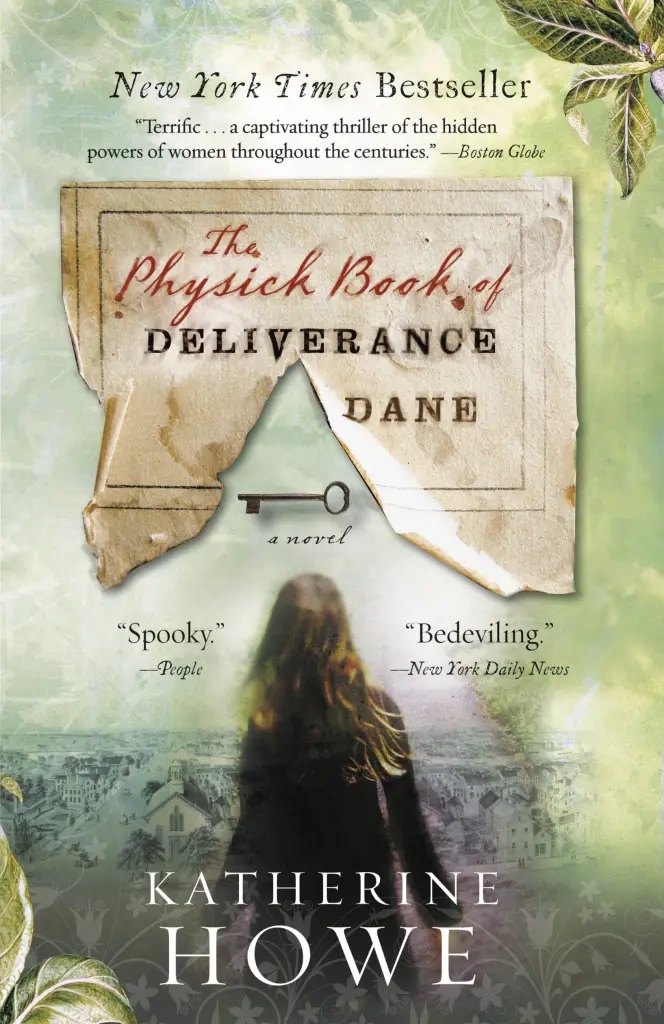
The Physick Book of Deliverance Dane
In 1991, Harvard history graduate student Connie Goodwin is asked to prepare her grandmother’s long-abandoned home near Salem for sale.
About
Spoiler notice: This overview discusses Connie Goodwin’s 1991 investigation, the discovery that sets it in motion, her academic mentor’s interest, and the novel’s alternating colonial interludes about Deliverance Dane and her descendants. It avoids later revelations and the ending.
Katherine Howe’s novel builds its mystery around a collision between archival history and the possibility of supernatural knowledge. Its contemporary strand begins in 1991 with Connie Goodwin, a Harvard graduate student in colonial American history who has passed her doctoral oral exams and needs to develop a dissertation topic. Her summer takes an unexpected turn when her mother asks her to prepare a long-vacant family house near Salem for sale. The house is both a practical burden and a place dense with inherited traces: Connie has not known it as a lived-in home, yet its neglected rooms contain evidence that redirects her scholarly attention toward a name from the seventeenth century.
While sorting through the house, Connie finds an old key concealed in a family Bible. A tiny scrap of parchment inside it bears the name Deliverance Dane. For Connie, the clue is not simply an invitation to believe a ghost story. She approaches it as a historian, asking what the name might mean, where it might appear in surviving records, and how it relates to the people who once lived in the region. The trail points toward a rare physick book, a kind of household medical text associated with women’s knowledge. In the novel, however, this object carries a more ambiguous possibility: it may also preserve forms of power that cannot be reduced to ordinary historical evidence.
That ambiguity gives the book its central tension. Connie’s work depends on documents, context and careful interpretation, while the story asks whether the material she is pursuing can have consequences beyond what academic method can explain. The title’s old-fashioned word, “physick,” gestures toward a world in which healing, practical household knowledge and beliefs about magic were not separated by the same boundaries readers might expect today. The novel does not present the Salem witch trials as a puzzle with a simple answer. Instead, the historical setting raises questions about who was permitted to hold knowledge, how that knowledge was recorded, and what might vanish when women’s experience survives only in fragments.
The narrative moves between Connie’s 1991 search and colonial-era passages about Deliverance Dane and the women connected to her. These interludes do more than supply background for an investigation: they allow the past to become a story in its own right, with its own dangers and uncertainty. Historical Novel Society’s review describes the book as alternating between Connie’s early-1990s life and the Salem area of the early 1690s, including glimpses of Deliverance, her daughter and her granddaughter. The different periods create a pattern of echoes rather than a straightforward line of descent. What Connie can learn about the past is shaped by what earlier generations were able, or unable, to leave behind.
The present-day plot also gives the search an academic and personal setting. Connie is trying to identify a dissertation subject, and Professor Manning Chilton, her mentor, becomes interested in the same elusive book. His attention complicates the assumption that the investigation is only a private scholarly pursuit. A source of historical evidence can also become an object of ambition, especially when its discovery promises professional distinction or access to knowledge that others cannot command. Kirkus’s review notes the pressure Connie feels from Chilton and the parallel pursuit of the book; those details establish a contest over interpretation and possession without resolving its later turns here.
The neglected house anchors these questions in a physical place. Connie is asked to ready it for sale, but the work of clearing and examining it becomes inseparable from learning what the family has kept, forgotten or left unexplained. The house’s age and isolation give the contemporary scenes an atmosphere that sits close to the novel’s supernatural premise, while the archival investigation keeps Connie’s curiosity active and grounded. A clue discovered among ordinary belongings can alter the direction of her research, but it cannot by itself explain the people who made or hid it. The distinction between an object and the story attached to it is part of the mystery’s appeal. This setting also joins a practical task to a historical one: preparing a property for a buyer means confronting the traces that make the place more than real estate.
The novel brings together historical fiction, academic detection and witchcraft, using the Salem setting to explore how knowledge is transmitted and judged. Its two timelines let Connie’s modern investigation approach a past that remains incomplete, while the colonial episodes give that past a human scale beyond the name in a document. The physick book stands at the crossing point: a possible record of women’s healing practice, a source sought by scholars, and an object surrounded by claims of unusual power. That arrangement makes research itself part of the suspense: each new clue can narrow a question while opening another about the people who produced the evidence. Howe leaves the reader with a mystery shaped as much by gaps in the record as by what can be recovered from it.
Book details
- Author
- Katherine Howe
- First published
- 2009
- Series
- No series listed
- Subgenre
- Historical mystery, Historical fantasy, Witch and magic
- Primary genre
- Historical Fiction, Mystery & Thriller, Fantasy
- Tags
- No tags for this book.
Review
Editor profile
Baby Bat
Goodreads and social links will be added soon.
- Goodreads — link coming soon
- Social media — link coming soon