
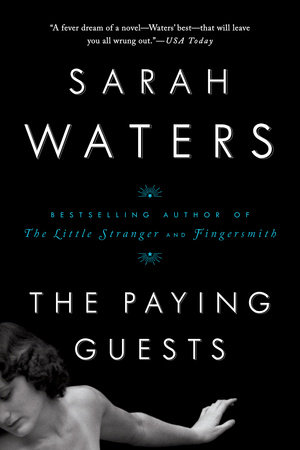
The Paying Guests
In 1922, reduced circumstances force Frances Wray and her widowed mother to take in a young married couple at their South London home.
About
Spoiler notice: Spoilers cover the setup, Frances and Lilian's growing intimacy, and the novel's shift toward a criminal crisis; the outcome, testimony and ending are not disclosed.
The Paying Guests opens in a South London home that has become too large for the family left inside it. It is 1922, and Frances Wray lives with her widowed mother in a genteel Camberwell villa whose former household has been thinned by death and financial decline. To keep the house, they take in Lilian and Leonard Barber, a young married couple described as belonging to the clerk class. The arrangement begins as a practical exchange: spare rooms for needed income. Yet a lodger is never only a source of money. New people bring new habits into the rooms, change what can be said at the table, and make the private home a place where social differences have to be negotiated at close range.
Frances is an unmarried woman in her mid-twenties, living within expectations that offer her little room to shape an independent life. Her days are organised around her mother, the house and the limited possibilities available to a woman of her class after the First World War. She is neither simply rebellious nor content with the role she has inherited. Her judgments can be sharp, and her view of the Barbers carries the assumptions of the household she was raised in. As the story gives her time to observe and reconsider, those habits meet feelings she has not planned for. The novel makes this inner movement part of its social portrait: private longing develops alongside everyday obligations, rather than in a space safely removed from them.
Lilian's arrival alters the atmosphere of the villa. Her marriage, manner and presence mark her as different from Frances, but the two women have to share corridors, rooms and repeated domestic routines. Their connection grows by degrees through these ordinary encounters. Sarah Waters has said that she wanted to write a love story complicated by crime, and that emphasis helps describe the novel's emotional centre without reducing it to a conventional romance. Frances and Lilian are not abstract symbols of freedom. They are people learning what they can risk, what they owe one another, and how much their choices are shaped by money, gender and the watchful presence of others. The tension comes partly from the closeness of the setting: a look or conversation can matter because the household makes privacy difficult to secure.
The house also gives the book a way to measure class. The Wrays and the Barbers do not enter the arrangement as equals, even though each party depends on it. The older family retains the language and manners of gentility, while the need to rent rooms exposes how fragile that status has become. Their paying guests bring different expectations about work, leisure and the use of domestic space. Waters is attentive to how such distinctions appear in practical details: who occupies which room, whose routines take precedence, and who is expected to accommodate whom. Rather than treating class as a label that explains everyone, the novel shows it operating through daily negotiations, moments of awkwardness and shifting judgments about respectability.
Waters's account of researching the novel makes clear how closely its intimate story is tied to its period. She drew on newspapers, diaries, letters, fiction, maps and photographs to understand interwar domestic life, as well as research into police procedure, legal process, fashion, cookery and housework. That range is reflected in the book's movement between household observation and suspense. The early domestic rhythms establish what can be lost when the ordinary is interrupted; later, the pressure of events makes routine itself feel uncertain. The novel does not treat historical setting as decoration. It asks how a particular moment's ideas about women, class, sexuality and public respectability shape what a character can admit, what others will believe, and what choices seem possible.
As Frances's relationship with Lilian deepens, the novel changes its balance. What begins as a close study of shared rooms and quiet emotional shifts acquires the forward pull of a thriller. Waters has described wanting moral complexity and the tension of a thriller without a generic effect; that combination matters because the story's suspense depends on human decisions rather than on an impersonal puzzle. The reader is asked to keep attending to the characters even as the stakes rise. Affection, fear, self-interest and loyalty can coexist, and an act made under pressure may alter how earlier moments look. This makes the book's suspense less a question of simply identifying what happened than of following the consequences that private choices bring into public view.
The Paying Guests is historical fiction built from domestic scale: a family home, a precarious income, a set of social rules and a relationship that changes the meaning of each. Its attention to queer desire is inseparable from the period's constraints, while its crime elements test the difference between outward respectability and inward motive. Readers looking for a romance untouched by danger may find the book's later movement toward criminal and legal crisis a substantial shift. Readers drawn to richly observed historical fiction and emotionally complicated suspense will find that the two modes keep pressing on one another. The title's guests are paying for rooms, but the arrangement asks larger questions about who belongs in a home, who has the power to name what happens there, and how far love can be carried through a world that demands secrecy.
Book details
- Author
- Sarah Waters
- First published
- 2014
- Series
- No series listed
- Subgenre
- Literary historical fiction, Post-war fiction, Queer romance
- Primary genre
- Historical Fiction, Literary Fiction
- Tags
- No tags for this book.
Review
Editor profile
Baby Bat
Goodreads and social links will be added soon.
- Goodreads — link coming soon
- Social media — link coming soon