
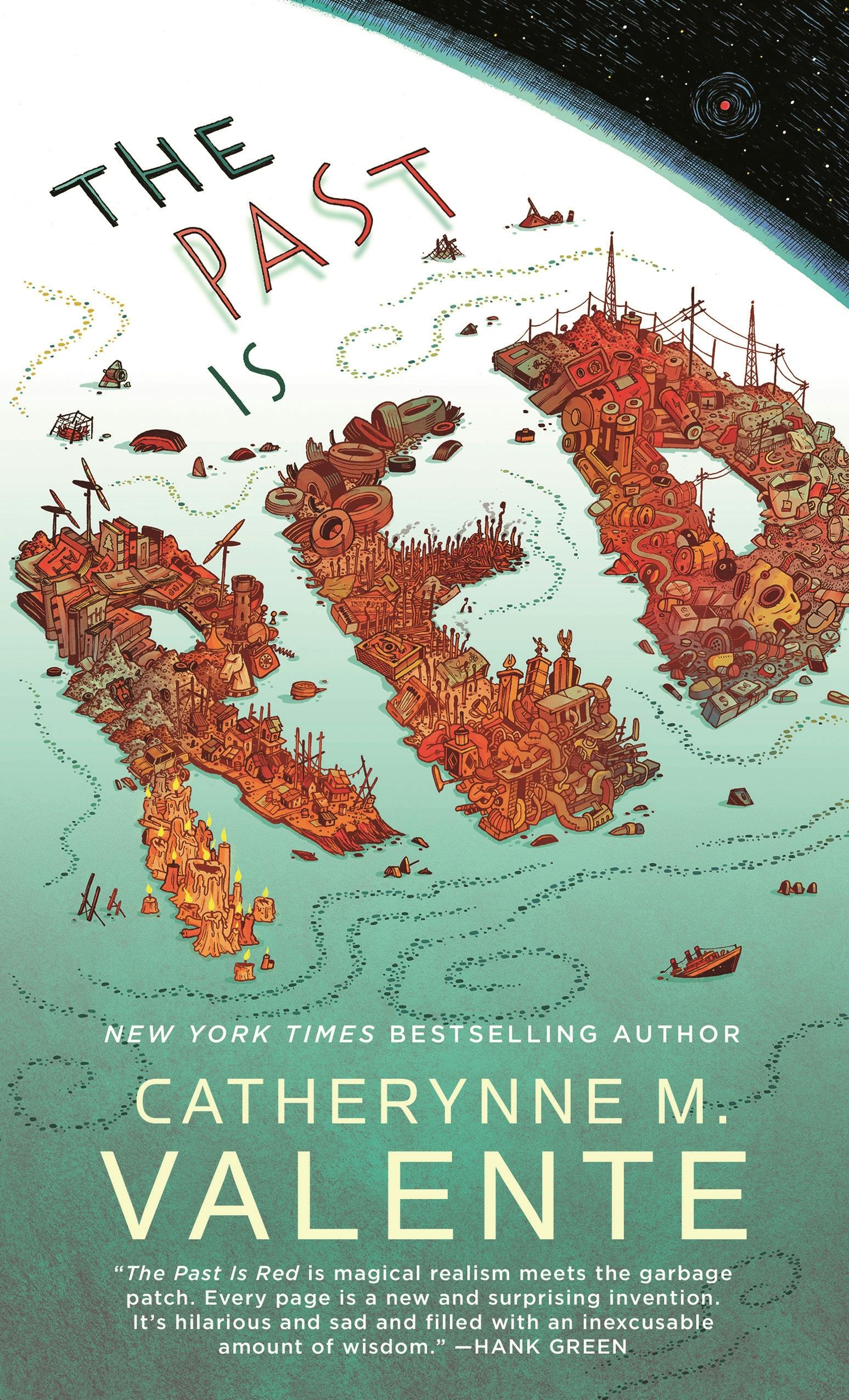
The Past Is Red
After the world's dry land disappears beneath the ocean, survivors make a home from the Great Pacific Garbage Patch in a settlement called Garbagetown.
About
Spoiler notice: Spoilers for Tetley's early history, the cause of her ostracism, and the discovery that reshapes her understanding of Garbagetown; the ending is not summarized.
The Past Is Red imagines a future in which the ocean has swallowed the world's dry land and human survivors live on the Great Pacific Garbage Patch. Their home, Garbagetown, is assembled from the discarded objects of an earlier age. The landscape has become both geography and inheritance: neighbourhoods form around particular heaps of rubbish, and residents make lives from materials whose original uses have been forgotten. Catherynne M. Valente treats this premise with a mix of absurdity and ecological unease. The place can be grotesque, funny and beautiful at once, while the catastrophe behind it remains the consequence of human choices rather than a distant, impersonal disaster.
The book is made of two connected parts. The first revisits “The Future Is Blue,” following Tetley Abednego at nineteen as she recalls how she became known as Garbagetown's most hated girl. The second moves forward to Tetley at twenty-nine, still living apart from much of the community and still attached to the place that has rejected her. This structure gives the story a life-spanning shape without turning it into a conventional quest. The present keeps opening onto memories, and those memories gradually explain why Tetley holds her ground when others see only a damaged home that should be left behind.
Tetley narrates in a voice that insists on finding reasons for delight. She loves the refuse-built districts, the animal companions she names, the things she salvages and the people who matter to her, even when her circumstances invite despair. That brightness does not erase the cruelty around her. Her account includes neglect, ostracism and physical danger, and the gap between her affectionate descriptions and the treatment she receives gives the comedy its edge. Tetley can be funny without making the world harmless. Her optimism reads as a stubborn practice of attention: she notices what is worth keeping in a place shaped by what another generation threw away.
Garbagetown's social order makes that attachment political. Its residents have built a functioning settlement out of the detritus of the so-called Fuckwits, but they also carry forward arguments about what the settlement should become. Some people dream of a more comfortable life modelled on the lost civilisation; Tetley believes the existing community and its fragile stability matter. When she refuses to support a plan that would risk that stability in pursuit of dry land, her position deepens the conflict that first made her notorious. The disagreement is not a simple choice between progress and stagnation. It asks who gets to define a better future, and what people may be asked to sacrifice for an appealing promise.
In the later part, Tetley's wandering brings her into contact with a new companion: an artificial-intelligence data-storage device she calls Mister. The encounter gives the story a relationship built from parallel forms of isolation. Mister belongs to a vanished technological world and has been cut off from the network that once gave it context; Tetley belongs to a society that knows its history through objects left behind. Their developing friendship adds intimacy to a narrative already concerned with the afterlife of things. Technology here is neither an easy solution nor a magic authority. It is another remnant with a voice, a history and a need for connection.
Valente's speculative setting works through vivid, specific fragments rather than a technical account of how a floating city operates. Names, salvaged goods and neighbourhood customs make the patch feel culturally inhabited. That approach keeps the story close to Tetley's perspective: readers learn what matters to her as she moves through a world she calls home. The result is less focused on explaining every mechanism than on showing how people make meaning from what survives. It also keeps the old world present in an unsettling way. Its objects remain useful and sometimes lovely, but their abundance is evidence of the habits that helped make the new world necessary.
The novella's movement is episodic, accumulating memories, encounters and revelations rather than driving toward a single uncomplicated victory. Tetley's cheerful certainty can be difficult to separate from the pain she has endured, and the story allows both to remain visible. Love for a damaged place does not repair its injustices; accepting reality does not require declaring that reality good. The tension between those truths gives the title its force. Red suggests a past that is still materially present, embedded in the debris around Tetley, while the future she inhabits remains an expanse of water and uncertainty.
The Past Is Red joins climate fiction with a character study of stubborn belonging. Its central question is not whether Garbagetown can be mistaken for the world that disappeared, but whether a person can value an imperfect home without denying the harm that shaped it. Tetley answers through attention, attachment and resistance, even as her history complicates each choice. The book's humour makes its world strange and memorable; its loneliness keeps that strangeness from becoming merely decorative. What remains is a story about survival as more than staying alive: it is also the difficult work of finding connection and reasons to care amid the consequences left by the past.
Book details
- Author
- Catherynne M. Valente
- First published
- 2021
- Series
- No series listed
- Subgenre
- Climate fiction, Post-apocalyptic
- Primary genre
- Sci-Fi
- Tags
- No tags for this book.
Review
Editor profile
Baby Bat
Goodreads and social links will be added soon.
- Goodreads — link coming soon
- Social media — link coming soon