
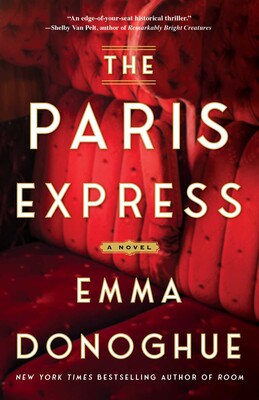
The Paris Express
On a steam train travelling toward Paris in 1895, members of parliament, railway workers, a medical student, a secretary and other passengers carry private plans and urgent concerns.
About
Spoiler notice: Spoilers for the premise and its known historical endpoint: the 1895 Montparnasse rail disaster. Individual outcomes and the novel's ending are not detailed.
The Paris Express takes an image of catastrophe as its point of departure: the 1895 train disaster at Paris’s Montparnasse station, remembered through surreal photographs. Emma Donoghue places the reader aboard a steam train travelling toward Paris before that public image becomes history. The setting gives the novel an unusually clear horizon. The passengers are moving toward a known event, while each of them experiences the journey through private plans, worries and desires. Suspense comes from the distance between the ordinary minutes of travel and the disaster that history has fixed at the end of the line.
The train gathers people whose differences make the journey a cross-section of late nineteenth-century life. Passengers and workers have connections to Brittany, Russia, Ireland, Algeria, Pennsylvania and Cambodia. Members of parliament hurry back to vote; a medical student worries that a girl may be dying; a secretary tries to persuade her employer that moving pictures matter. The ensemble does not simply supply a parade of period types. Each person boards with an immediate concern, so the moving carriage becomes a temporary meeting place for people whose lives would otherwise remain separate. Donoghue’s choice to distribute attention across this group also changes the scale of the disaster: its stakes belong to many distinct lives rather than to a single central hero.
That variety makes social position visible without reducing the book to a diagram of classes. Political representatives travel alongside crew members and people whose origins stretch across continents. Real and invented characters, rich and poor, share the same train. A carriage is both a practical shared space and a social arrangement: people may travel toward the same destination while carrying unequal power, security and freedom. The historical setting allows the narrative to notice who can make decisions, whose work keeps the journey running, and whose prospects are shaped by institutions beyond the carriage. The train links these lives for a few hours without making their circumstances identical.
The novel also sets new technologies beside old assumptions. Moving pictures appear as a possibility a secretary wants a sceptical employer to take seriously; the train itself embodies the confidence and speed of modern engineering. Yet the known disaster prevents technological progress from seeming smooth or inevitable. Politics, glamour, chaos and speed all belong to this nineteenth-century world, while an opening epigraph raises the human cost of invention. That context gives the journey a double motion: the passengers travel physically toward Paris, while their world is moving toward forms of modern life whose benefits and dangers are not distributed evenly. The question is not simply whether a machine works, but what people are willing to risk in the name of progress.
Confinement is central to the novel’s design. The train supplies motion, but its passengers cannot step outside the journey whenever they wish. They share corridors, timetables and the knowledge that events are advancing whether or not they feel ready. This enclosed setting can bring strangers into contact and make small choices matter; it can also intensify the separation between what a person feels and what they can tell others. The story carries both broad social range and the momentum of a train nearing disaster. That combination helps explain why the form suits its subject: an ensemble can widen the view from one carriage to a society, while the fixed route keeps the pressure of time in the foreground.
The mixture of documented history and invention asks readers to hold two kinds of attention at once. The Montparnasse disaster and its photographs provide a historical anchor; the passengers’ private lives create the novel’s imaginative field. Henry Ossawa Tanner and Alice Guy-Blaché are among the historical figures connected with the book, placing the journey within histories of art, migration and emerging film as well as railway travel. They also make clear that historical fiction is more than a way to reconstruct scenery. It can place individual choices beside the larger forces that make a period recognizable, while preserving room for characters whose interior lives the archive cannot fully record.
Knowing the disaster gives the journey an unusual relationship with suspense. The destination is not a mystery in the ordinary sense; tension grows through the question of how an approaching public event intersects with the different futures each passenger imagines. The book’s many perspectives keep that question human and specific. A vote, an illness, a new invention, a private attempt to build a life, or a plan formed in secrecy can each feel urgent on its own terms. As the train carries this varied company toward Paris, the historical endpoint presses against their present-tense concerns. The result is a novel about speed and vulnerability, but also about how a brief shared passage can expose the distance between strangers and the unexpected connections that make their fates matter to one another.
Book details
- Author
- Emma Donoghue
- First published
- 2025
- Series
- No series listed
- Subgenre
- Historical fiction, Literary historical fiction
- Primary genre
- Historical Fiction, Literary Fiction
- Tags
- No tags for this book.
Review
Editor profile
Baby Bat
Goodreads and social links will be added soon.
- Goodreads — link coming soon
- Social media — link coming soon