
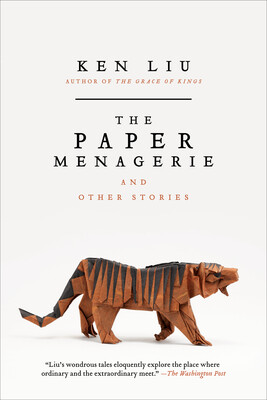
The Paper Menagerie and Other Stories
This collection brings together fifteen stories that move across speculative modes, from alternate history and fantasy to science fiction and noir.
About
Spoiler notice: This overview discusses story premises and recurring concerns, including the title story’s family and cultural tensions; it avoids late revelations and endings.
The Paper Menagerie and Other Stories gathers fifteen pieces of speculative fiction by Ken Liu, moving among science fiction, fantasy, alternate history, magical realism and noir. That range is part of the collection’s design. A story may begin with an impossible premise, a changed historical record or a society organized around unfamiliar rules, yet the human questions remain recognizable: how people understand one another, what they inherit from the past, and what is lost when relationships are strained. Rather than connecting through one cast or a single plot, the stories form a varied sequence. Their recurring subjects create echoes between otherwise distinct worlds.
The title story gives the book one of its most intimate points of entry. A boy’s Chinese-born mother makes origami animals that come alive, and their relationship is shaped by the distance between her cultural world and the one he wants to inhabit. The fantastic element makes affection visible, but it also brings questions of identity and assimilation into the family’s private life. The story’s emotional center is not simply the wonder of animated paper; it is the difficulty of receiving another person’s love when embarrassment, social pressure and the wish to belong interfere. Liu’s use of speculative invention lets an everyday family tension take on a physical form without reducing it to a lesson.
Other stories widen the frame from family to communities and historical memory. “All the Flavors” and “The Man Who Ended History: A Documentary” approach history through different speculative structures, while “The Literomancer” draws on Chinese culture and history. In the reading guide, the publisher groups these works around questions of how fact and fiction can be distinguished and who has the right to carry or interpret the past. Those questions give the collection a serious historical dimension. The imaginative premises do not erase real histories; they make the acts of remembering, recording and retelling more visible. The stories ask what a record can preserve, what it can distort, and how people are changed by the versions of the past available to them.
Communication itself becomes a recurring concern. The collection’s preface, as described in the publisher’s guide, frames communication as an act of translation, and the stories test that idea through language, technology, memory and unfamiliar forms of life. “The Bookmaking Habits of Select Species” imagines several civilizations with radically different ways of making and reading books. Its playful speculative conceit opens onto questions of authorship, preservation and interpretation: a record can outlast its maker, but later readers may not agree on what it means. Elsewhere, communication occurs between people whose cultural assumptions differ, or between beings separated by radically different ways of experiencing the world. Understanding is possible, but never automatic.
The collection’s genre shifts also let Liu examine how people adapt when their surroundings change. In “Good Hunting,” Liang and Yan encounter a world transformed from the one they knew; the reading guide places their experience beside Jack’s struggle with cultural identity in the title story. “Mono no Aware” follows a protagonist shaped by Japanese ideals in a future setting, while “The Perfect Match” considers the consequences of allowing intelligent devices to make everyday decisions. These premises are not interchangeable, and the book does not flatten them into one account of progress. Together, they make adaptation a broad question: what must a person change to survive or belong, and what parts of a self or a culture should remain one's own?
Liu also moves between intimate emotional stakes and large-scale ideas. Family bonds, love, betrayal and belonging sit beside political choices, technology and the long sweep of history. The publisher’s story list includes award-recognized work such as “Mono No Aware,” “The Man Who Ended History: A Documentary,” and the title story; it identifies the title story as the first to win the Hugo, Nebula and World Fantasy awards. That recognition points to the collection’s place in contemporary speculative fiction, but the stories’ variety is equally important. Some begin from recognizably human conflicts, while others build elaborate alien societies or altered futures. In both modes, invention serves as a way to look again at familiar assumptions.
The result is a collection that rewards attention to both contrast and recurrence. Readers encounter different characters, narrative forms and imagined settings, then notice how often the stories return to the fragile work of carrying meaning between people and generations. History can be inherited but contested; identity can be shaped by family and by the pressure to assimilate; a new technology can solve one problem while changing the terms of human choice. Because the pieces remain distinct, the book leaves room for those ideas to take different shapes instead of forcing them into a single conclusion. The reader moves from a mother and son trying to understand each other to civilizations deciding how to preserve their thoughts, and from intimate choices to contested accounts of history. Across that range, the collection keeps asking how a story can travel from one person, culture or era to another, and what may change along the way.
Book details
- Author
- Ken Liu
- First published
- 2016
- Series
- No series listed
- Subgenre
- Science fantasy, Magical realism, Literary fiction
- Primary genre
- Sci-Fi, Fantasy, Literary Fiction
- Tags
- No tags for this book.
Review
Editor profile
Baby Bat
Goodreads and social links will be added soon.
- Goodreads — link coming soon
- Social media — link coming soon