
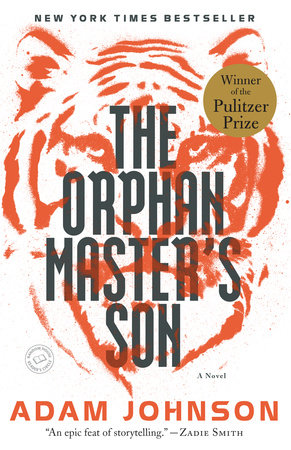
The Orphan Master's Son
Raised in a North Korean orphanage run by his father, Pak Jun Do learns to survive by reading people and following orders.
About
Spoiler notice: This overview covers Jun Do’s childhood, state assignments, and the early setup of his connection with Sun Moon. It discusses the novel’s shifting narrative structure without revealing its final turns or ending.
Adam Johnson’s The Orphan Master’s Son follows Pak Jun Do from a childhood in a North Korean orphanage into the unstable adult world of a state that claims authority over its citizens’ names, work, and public stories. Jun Do is the son of the orphanage’s director, a powerful man whose position does not protect the boy from hardship. His mother, a singer, has been taken to Pyongyang and exists for him largely as an absence and an image. The contrast between those distant parents shapes Jun Do’s early understanding of loyalty: affection is scarce, while obedience and usefulness can offer a narrow chance of survival. Johnson builds the novel around this fictional life rather than presenting a documentary account of the country.
Jun Do’s name recalls the placeholder “John Doe,” and he is treated by the state as someone whose identity can be reassigned as circumstances require. He learns to notice what others expect from him and to perform the role that seems safest. The government’s demands carry him from military training into work involving surveillance, communication, and abduction. These assignments expand his view of the country without granting him secure knowledge of it. Orders arrive from above, explanations remain partial, and a person can be praised or punished according to shifting priorities. The novel uses that uncertainty to make survival a practical skill: Jun Do listens, adapts, and tries to understand which version of events he is being asked to inhabit.
The first part of the book moves episodically through Jun Do’s rise, with each new post bringing a different vantage on the state and the people caught inside it. A sea voyage, for instance, places him among sailors and radio operators handling intercepted voices from beyond the country. The work makes distance tangible: strangers become fragments of speech to be transcribed, while the person listening remains constrained by what can safely be said aloud. Johnson balances the oddity of Jun Do’s assignments with moments of ordinary companionship and attention. People joke, improvise, share small kindnesses, or find beauty in a bleak setting. Those moments matter because the official language of collective glory leaves little space for an individual life.
The novel then changes its narrative frame. A state interrogator’s first-person account, presented as an attempt to assemble a biography, sits alongside the earlier third-person story and the regime’s public version of events. This structure makes the making of truth part of the plot. The interrogator wants a coherent account, but his testimony reflects both professional pressure and a growing distance from official certainty. Meanwhile, the state’s announcements turn private events into material for public myth. Readers must compare what the narrative says, what its characters can know, and what the authorities want citizens to believe. Johnson uses this tension for dark comedy as well as unease, while leaving room for the possibility that no single account is complete.
At the centre of the later movement is Sun Moon, a famous actress whose public image is closely managed. Jun Do becomes involved with her as the political story draws him into the orbit of Kim Jong Il and a celebrated military figure. The publisher’s description frames this as a dangerous romantic rivalry, but the novel’s interest extends beyond a contest for one woman. Sun Moon has been made into a symbol for other people’s purposes, and Jun Do’s feelings develop inside a world where personal attachment can be appropriated by power. Their connection asks what it means to care for someone whose life is watched and narrated by the state, and what forms of action remain possible when even private loyalties can attract political consequences.
Johnson mixes political thriller, adventure, satire, and love story, allowing the tone to shift with Jun Do’s changing circumstances. The sharp absurdity of official propaganda can sit beside hunger, violence, and fear; humour does not make the danger harmless. The Guardian’s review praised details in the early sections while warning that later inventions and grotesque episodes should not be confused with reporting about North Korea. That distinction is important to how the book should be read. Johnson constructs a fictional state and a heightened narrative, drawing on recognizable political pressures but also using imaginative exaggeration. The story can prompt questions about propaganda and power, yet it cannot stand in for testimony by North Koreans or for researched nonfiction about their lives.
The Orphan Master’s Son is finally concerned with the struggle to keep a human identity intact when institutions try to define it from outside. Jun Do’s path is shaped by the state’s categories, but the novel repeatedly turns attention to the stories people tell one another and to the gaps those stories cannot close. Its shifts in narrator make every version of a life feel vulnerable to revision, while its suspense comes from watching Jun Do navigate rules that can change without warning. Readers looking for a direct report on contemporary North Korea should turn to nonfiction sources; readers of the novel encounter Johnson’s ambitious work of political fiction, where love, performance, survival, and the control of public memory meet.
Book details
- Author
- Adam Johnson
- First published
- 2012
- Series
- No series listed
- Subgenre
- Literary fiction, Dystopian
- Primary genre
- Literary Fiction
- Tags
- No tags for this book.
Review
Editor profile
Baby Bat
Goodreads and social links will be added soon.
- Goodreads — link coming soon
- Social media — link coming soon