
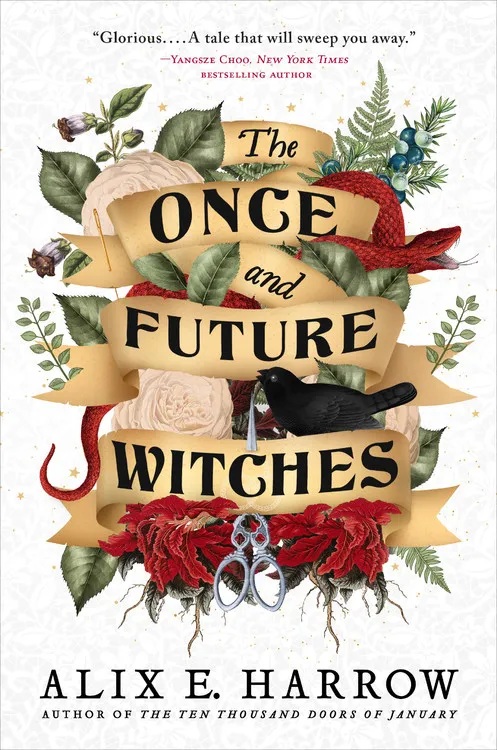
The Once and Future Witches
In an alternate 1893, estranged sisters Juniper, Agnes, and Beatrice Eastwood reunite in New Salem around a mysterious rose-covered tower.
About
Spoiler notice: This overview discusses the Eastwood sisters’ reunion, the recovery of witchcraft, and the political backlash that follows their early actions. It avoids the final confrontations and ending.
The Once and Future Witches places three estranged sisters in an alternate 1893, where witchcraft has nearly vanished from public life and women are organizing for the vote. In New Salem, magic survives in fragments: old rhymes, remembered stories, and small practices dismissed as harmless superstition. James Juniper, Agnes Amaranth, and Beatrice Belladonna have been separated for years, each carrying a different account of their family’s painful past. Their paths converge around a mysterious rose-covered tower, an event that opens a way back to the craft their world has tried to erase. Harrow’s premise joins two struggles, the suffragist movement and the recovery of women’s magic, while keeping the sisters’ damaged relationship at the centre of both.
The three Eastwood sisters arrive at that conflict with sharply different temperaments. Juniper is impulsive and defiant, quick to turn anger into action; Agnes has learned to value security and fears what another upheaval might cost; Beatrice is studious and precise, drawn to books and patterns. Their differences come from more than personality. Each has survived the same abusive childhood by finding a separate way out, and the years apart have left them with grievances as well as longing. Their reunion therefore does not instantly make them a working family or coven. They must decide whether blood ties are enough to rebuild trust, especially when the magic they pursue asks them to depend on one another. The novel treats sisterhood as an effort that has to be renewed under pressure.
New Salem gives the story a public arena for that private repair. Women campaign for political rights in a society where their influence is constrained, and the Eastwoods’ encounter with witchcraft changes what resistance might mean. The sisters begin by following clues to practices that have been hidden or reduced to children’s rhymes. As they test those fragments, magic becomes collective knowledge: words and actions carried between people, adapted, and kept alive. The effort draws in others beyond the family, widening the coven and bringing the sisters into contact with people who have their own reasons to resist control. Harrow ties the question of who can wield power to the question of who gets to define the rules, whether those rules govern a ballot, a household, or the use of magic.
The book’s spells draw on folklore, nursery rhymes, and fairy-tale language, reshaping familiar material into ways of acting in the present. A rhyme can hold instructions; a story can preserve something that official histories have ignored. This gives the magic a different texture from a private talent possessed by a chosen few. The practices in the novel depend on learning, memory, and transmission, so recovery means finding who kept a piece of knowledge and what it takes to use it. The contrast between small charms and political organizing is deliberately porous: both involve shared words, repeated acts, and people deciding to make a possibility real. That approach also makes the sisters’ reading and research part of the action, especially for Beatrice, whose careful attention helps turn scraps into something they can work with.
Harrow sets the Eastwoods’ campaign against forces that seek to preserve the existing order. The danger grows as their actions gain attention and the political struggle moves beyond demonstrations into New Salem’s halls of influence. Their attempt to revive witching has consequences they cannot fully control, and the movement they hope to strengthen becomes entangled with a backlash. The novel does not frame resistance as a clean sequence in which brave acts automatically produce progress. The sisters make mistakes, misread one another, and face opponents willing to exploit fear. Those pressures give the plot a widening shape: a family’s reunion becomes a question about how much change a community can bear, who pays for it, and how easily calls for order can be turned against the people asking for freedom.
The alternate-history setting is Harrow’s imaginative world rather than a record of actual witchcraft or a literal account of one historical town. Its 1893 suffrage backdrop meets invented New Salem, where political organizing sits beside an impossible return of magic. The novel also brings in working-class and Black communities as participants in that struggle. What remains central is the Eastwood sisters’ attempt to build a form of power that can travel beyond a single family. The story’s view of witching is not based on inherited blood alone; it emphasizes the choices, methods, and words that people pass on. That makes the recovery of magic inseparable from the question of who is allowed to learn it.
The Once and Future Witches moves between family drama, political fantasy, and a retelling of folklore motifs. Its central tension is not simply whether the Eastwoods can bring witchcraft back, but whether they can act together without repeating the harms that drove them apart. Their campaign asks for public power, while their personal history demands a more intimate kind of change: listening, admitting injury, and choosing what obligations they owe each other. Harrow’s world gives that question a fantastical scale, but the sisters’ competing fears and loyalties keep it grounded in relationships. As a hidden practice becomes a visible movement, the sisters have to reckon with the risks their decisions create for one another and for the allies who join them.
Book details
- Author
- Alix E. Harrow
- First published
- 2020
- Series
- No series listed
- Subgenre
- Historical fantasy, Witch and magic, Fairytale retelling
- Primary genre
- Fantasy
- Tags
- No tags for this book.
Review
Editor profile
Baby Bat
Goodreads and social links will be added soon.
- Goodreads — link coming soon
- Social media — link coming soon