
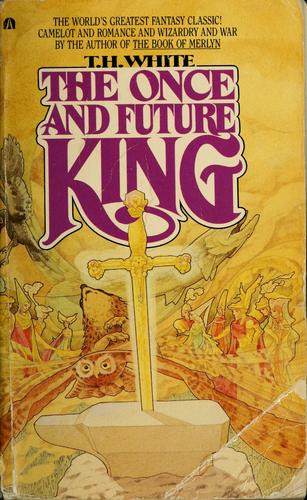
The Once and Future King
The Wart is a boy in a castle who is not important enough to be educated properly, and Merlyn is his tutor, a wizard living backwards through time.
About
Spoiler notice: Full-volume spoilers below, including major deaths, revelations and the ending.
T. H. White follows Arthur from an overlooked boy to a ruler facing the collapse of the order he tried to create. The four parts of The Once and Future King change their emphasis as he grows: education gives way to government, the conflicts within Lancelot's life and the final breakdown of Camelot. Arthur's friendship with Lancelot makes the knight's love for Guenever more than a political problem, while family history puts an old grievance inside the court itself. The governing question is what strength should be used for, and whether a society organised around fighting can turn its strongest members into dependable protectors.
Before the crown, Arthur is the Wart, growing up in Sir Ector's household alongside Kay. Merlyn's education moves beyond preparation for a knight's career and makes him experience other forms of life. The geese provide a particularly direct challenge to human assumptions. Learning to fly and travel with them, the Wart encounters a society whose leadership depends on navigation and whose members find the idea of fighting their own species absurd. Boundaries in the air do not work like the territorial claims humans defend below. Around those lessons, the castle continues its feasts and hunts, and King Pellinore's pursuit of the Questing Beast turns unexpectedly tender when he nurses the creature back to health.
Growing older seems at first to confirm the Wart's subordinate position. Kay is being prepared for knighthood, and the Wart expects to serve him as a squire. A last lesson as a badger raises the question of whether humanity's dominion over other creatures has become tyranny. Then Uther Pendragon dies, and a sword set through an anvil into stone offers a test of the rightful succession. The Wart encounters it while trying to find a replacement for Kay's forgotten sword. Pulling it free changes the errand into the discovery of his identity. Kay briefly claims the achievement before admitting the truth, and the Wart is distressed when the people he considers family kneel to him. Merlyn explains that Uther was his father.
Kingship begins amid rebellion, including the resistance of King Lot. At Bedegraine, Arthur attacks the armoured knights instead of allowing the customary slaughter of their less protected followers, using surprise and the assistance of the French kings Ban and Bors. Victory does not end the dangers travelling through family relationships. Morgause arrives under the appearance of reconciliation, while Merlyn fails to deliver a warning about her parentage in time. She is Arthur's half-sister, a fact he does not know when she uses enchantment to draw him into a sexual relationship. Their son is Mordred. The episode places a future enemy inside Arthur's own family before the king understands what has happened.
Lancelot comes to Arthur's court through a different education in power. Fierce training under Uncle Dap prepares him to become an exceptional fighter, while his sense of being physically ugly encourages loneliness and dissatisfaction. His dedication to Arthur's project is sincere; the king has asked whether he will help replace the rule of superior force with something juster. When he reaches Camelot, Lancelot initially resents Guenever as an intrusion upon that friendship. Recognising that he has hurt her changes his response, and closeness grows into the attraction he had not intended. Arthur takes him campaigning, but distance cannot settle the conflict. Lancelot eventually leaves on quests to escape feelings that threaten his loyalty. His achievements therefore carry an uncomfortable private motive: the knight becoming famous for service is also trying to avoid a betrayal he cannot simply stop wanting.
Later, Camelot's prosperity shows that Arthur's efforts have changed daily life. Safer roads, scholars and hospitals suggest a real achievement, but the Round Table still contains men whose loyalties belong to family vengeance. The killing of Morgause and Lamorak makes that continuing violence impossible to dismiss as a distant problem. Arthur sends the knights in search of the Holy Grail, hoping to give their energies another purpose. The returning accounts reveal how poorly ordinary prowess prepares some of them for a spiritual test. Gawaine is criticised for killing and failing to repent; Bors faces choices in which refusing violence and resisting temptation matter more than winning a fight. The quest exposes a limit in directing strong men towards approved enemies.
Lancelot and Guenever's relationship continues to produce consequences for people outside their private bond. Elaine, who loves Lancelot, takes her own life when she accepts that he will not return to her. Her arrival at Camelot in a funeral barge forces Guenever to confront the loss of the woman she had regarded as a rival. Later, Lancelot rescues Guenever from Meliagrance, and her defence depends on the precise terms of an accusation as well as the superior strength of her champion. When Sir Urre arrives with wounds that cannot heal, Lancelot succeeds where the other knights have failed, despite fearing his own unworthiness. The miracle leaves a man troubled by the distance between what he can accomplish and the moral life he hoped to lead.
Mordred and Agravaine finally force the affair into a legal crisis. Lancelot escapes their armed confrontation and later rescues Guenever from execution, but Gareth and Gaheris die during that rescue. Gawaine's grief turns him against Lancelot, and even a Church-mediated settlement cannot end his demand for vengeance. Arthur follows Lancelot to France, leaving Mordred the opportunity to seize power and claim the absent king is dead. Guenever resists him, while news of the betrayal brings Arthur home. The volume closes before the final battle rather than narrating the familiar deaths from other Arthurian tellings. In his tent, Arthur sends a young Thomas Malory away with the responsibility of preserving the idea that power should serve justice. His project has failed to hold its people together, yet the ending allows its purpose to survive through a story someone else will carry.
Book details
- Author
- T. H. White
- First published
- 1958
- Series
- No series listed
- Subgenre
- Classic fantasy, Myth retelling
- Primary genre
- Fantasy
- Tags
- No tags for this book.
Review
Editor profile
Baby Bat
Goodreads and social links will be added soon.
- Goodreads — link coming soon
- Social media — link coming soon