
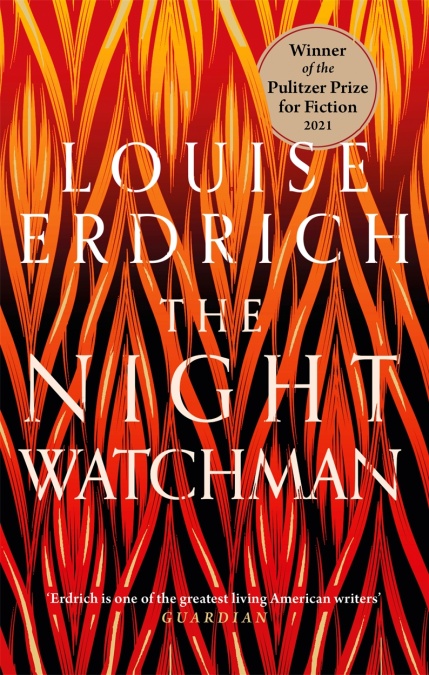
The Night Watchman
In 1953, Thomas Wazhushk works nights at a jewel-bearing plant near the Turtle Mountain Reservation and serves on the Chippewa Council, where he confronts a federal proposal that threatens tribal land and identity.
About
Spoiler notice: Spoilers cover the novel’s central perspectives, Patrice’s search for Vera, and the community’s response to the proposed termination measure. The final outcomes are withheld.
Set in 1953 near the Turtle Mountain Reservation in North Dakota, The Night Watchman follows a community facing a federal proposal that its members understand as a threat to tribal land, rights and political identity. Thomas Wazhushk works nights as a watchman at a jewel-bearing plant, then spends his days attending to the responsibilities of a Chippewa Council member. The two roles give the title its practical meaning: Thomas keeps watch over a factory after dark and over a political danger that is still taking shape. The novel’s main conflict grows through letters, meetings and efforts to make people outside the reservation understand what the measure could mean. Erdrich keeps that public struggle close to the rhythms of work, kinship and daily life.
The historical policy at the novel’s center belongs to the real termination era, when federal lawmakers pursued measures to end recognition of tribal nations and to shift land and responsibility away from the federal government. The publisher calls the proposal an ‘emancipation’ bill, language that Thomas and other council members question because it obscures the consequences they fear. Erdrich’s afterword and interviews connect the novel to her grandfather Patrick Gourneau, who chaired the Turtle Mountain community and opposed termination. Thomas is a fictional character shaped by that family history; the novel is not a documentary transcript. Keeping those categories distinct helps the historical stakes remain clear while leaving room for the invented people, scenes and relationships through which Erdrich tells the story.
A second major strand follows Patrice Paranteau, who works at the same plant and helps support her mother and younger brother. She is often called Pixie, but insists on Patrice, a small act of naming that signals how deliberately she thinks about the life expected of her. Her older sister Vera has gone to Minneapolis and stopped communicating with the family. Patrice wants to find her, and saving money for the journey competes with the immediate demands of home. Her storyline takes the book beyond the reservation without turning the city into an abstract opposite to it: movement between places brings its own risks, dependence and uncertainty. The search gives Patrice a goal of her own, while the family ties behind it make her choices consequential to others.
The narrative also moves among relatives, friends and neighbours whose lives touch Thomas’s work or Patrice’s search. Wood Mountain, a young boxer, brings athletic ambition into the community’s everyday exchanges; his mother Juggie Blue and Patrice’s friend Valentine have their own concerns and attachments. Stack Barnes, a white teacher and boxing coach, occupies a different position in the town and in Patrice’s life. These perspectives make the novel broader than a single hero’s account, but the cast is not a sample meant to represent every Native person or every reservation. Erdrich gives each character particular pressures, loyalties and limits. Their different responses to work, family, love and responsibility create the sense of a place made by people who know one another, disagree and continue sharing space.
The factory is important because it offers paid work, especially for women, while also placing the characters within a larger economy that does not resolve the community’s financial insecurity. Patrice’s wages help meet household needs, but they do not make her independent of family demands or give her unlimited freedom. Thomas’s night shifts likewise leave him tired as he takes on political work. The book notices how action is constrained by time, money and access: attending a meeting or travelling to make a case requires resources that are scarce. This material detail prevents the threat to land and sovereignty from feeling remote. Policy enters kitchens, workplaces and family decisions, even when it is described in the language of administrative reform. At the same time, the characters remain more than examples of hardship; they make plans, joke, argue, care for one another and pursue desires not reducible to the political crisis.
Erdrich’s storytelling moves between community life, political organizing, family history and strands of humor, letting tension share space with tenderness and absurdity. Because the book shifts attention among characters, its scale feels collective: Thomas’s effort matters, but so do the lives that continue around it and the younger generation whose future is at stake. The novel’s relation to its historical source is personal as well as political. Erdrich has described returning to her grandfather’s letters to understand his work, and has identified herself as an enrolled citizen of the Turtle Mountain Band of Chippewa. That context explains the family connection behind the fiction without making the novel interchangeable with historical testimony. The Night Watchman is both a story about resistance to dispossession and an attentive portrait of people whose lives include far more than resistance. Its focus stays with how a community understands what is being threatened and how its members try to answer together.
Book details
- Author
- Louise Erdrich
- First published
- 2020
- Series
- No series listed
- Subgenre
- Literary fiction, Literary historical fiction
- Primary genre
- Historical Fiction, Literary Fiction
- Tags
- No tags for this book.
Review
Editor profile
Baby Bat
Goodreads and social links will be added soon.
- Goodreads — link coming soon
- Social media — link coming soon