
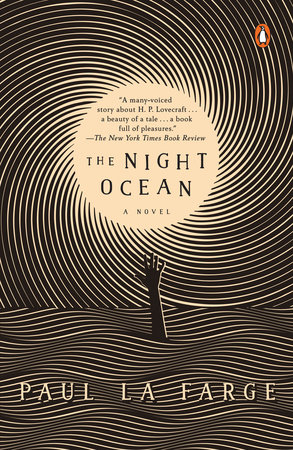
The Night Ocean
Psychiatrist Marina Willett does not accept the police verdict that her missing husband, Charlie, died by suicide.
About
Spoiler notice: Spoilers below for Charlie’s disappearance, the disputed diary, and the novel’s layered investigations; the final resolution is not disclosed.
Marina Willett is a psychiatrist whose husband, Charlie, has disappeared after becoming absorbed in H. P. Lovecraft. The police call his disappearance a suicide; Marina refuses to accept that conclusion and follows the evidence he left behind. Charlie had been investigating a little-known period in Lovecraft’s life: the summer of 1934, when the horror writer stayed with Robert Barlow, a teenage fan in Florida. A new scandal has interrupted Charlie’s research, and Marina must work out whether it explains his absence or has sent her looking in the wrong direction. Her search begins as a personal emergency and opens into a literary mystery. The hunt also forces her to decide whether she is tracing an event or the version of it Charlie assembled for himself.
The historical starting point is real: Lovecraft visited Barlow in Florida, and later named him literary executor. Barlow hosted Lovecraft on two Florida visits, in 1934 and 1935; the novel focuses on the earlier stay. La Farge turns that documented connection into a question his novel can pursue, asking what the relationship meant to each man. The novel’s answer is not a recovered historical fact. Its characters build possibilities from letters, memories and gaps, and the story invites readers to notice how desire can shape an interpretation. That distinction gives the book its particular tension. The reader is not simply asked to solve a puzzle about the past, but to watch people decide what they want the puzzle to prove.
One of Charlie’s most consequential discoveries is the Erotonomicon, a book that claims to be Lovecraft’s private erotic diary. Its existence belongs to La Farge’s fiction, not to the historical record. Inside the novel it promises an intimate key to a writer whose public stories and correspondence have left people arguing over how to understand him. Charlie’s interest in the document becomes a path into the lives of Barlow, Lovecraft and the people who preserve or reinterpret their work. The supposed diary matters both as possible evidence and as a story attractive enough to make evidence seem settled before it is. Because its origins remain disputed within the story, each reader must weigh who might benefit from believing it.
Marina’s point of view holds this material at a slight distance. She is neither an expert on Lovecraft nor one of the enthusiasts who have built their lives around him; she is a working psychiatrist trying to find her husband. Her steady voice provides a level-headed frame for a world of obsessive researchers. That balance lets the novel move among biographies, old texts, newspaper trails and personal testimony without granting any one account automatic authority. Marina’s professional habit of listening also has limits: knowing how people explain themselves does not guarantee that she can know Charlie, or discover what he was hiding from her. She can follow the clues without sharing the researchers’ reverence for their subject or their appetite for a revelation.
The investigation travels from Ontario through New York and Florida to Mexico City, following connections that cross decades as well as borders. Historical figures, including Lovecraft, Barlow and the young William S. Burroughs, appear beside invented characters such as Marina, Charlie and L. C. Spinks. La Farge draws on the real literary and scholarly worlds around Lovecraft, then invents encounters, papers and motives for the novel. Its archive is part of the design: a plausible-looking document can still be a novelist’s device, and the presence of a famous name does not turn every surrounding claim into biography. The movement between places gives the story a physical trail as well as a paper one, with Marina’s search drawing her beyond the reading room and into other people’s histories.
That layering makes the novel a mystery about intimacy as much as a search for a missing person. Charlie writes profiles of difficult, compelling people, and his pursuit of Lovecraft and Barlow reflects a wish to make fractured lives coherent. His own childhood includes the loss of his father and a changed understanding of the man he had been; that history helps explain his urge to reconstruct other people. Marina, meanwhile, has to consider what she knew about her own husband and what their marriage left unasked. The book keeps returning to the gap between the story someone tells and the person another believes they have understood. Its central suspense comes from that gap: each new account may offer a clue, but it may also reveal the teller’s need for a particular answer.
The Night Ocean uses Lovecraftian unease without making a supernatural explanation its destination. Books and records open doors here, but the danger lies in the human uses of what people read: obsession, exploitation, loyalty and the wish to make uncertainty disappear. Its ominous atmosphere grows from ordinary traces—correspondence, memoir and newspaper clippings—and from the urge to fill in what they leave blank. La Farge’s nested narratives let one account recast another, so the reader repeatedly has to reconsider what seemed trustworthy. The novel is attentive to Lovecraft’s lasting influence and to the racist views that complicate his legacy, while resisting a simple verdict that would resolve either a historical relationship or a marriage. Its final question is about the stories people need in order to live with what they cannot know.
Book details
- Author
- Paul La Farge
- First published
- 2017
- Series
- No series listed
- Subgenre
- Literary fiction, Historical fiction, Epistolary novel
- Primary genre
- Literary Fiction, Historical Fiction, Mystery & Thriller
- Tags
- No tags for this book.
Review
Editor profile
Baby Bat
Goodreads and social links will be added soon.
- Goodreads — link coming soon
- Social media — link coming soon