
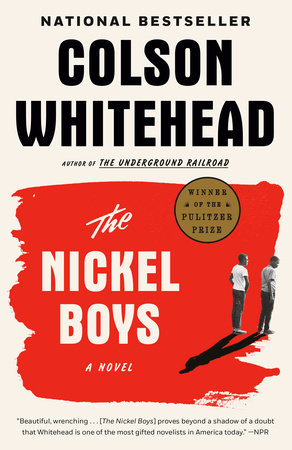
The Nickel Boys
In 1960s Tallahassee, Black teenager Elwood Curtis is wrongly sentenced to Nickel Academy, a juvenile reformatory whose official promise of correction hides a dangerous reality.
About
Spoiler notice: This discussion covers Elwood’s wrongful commitment, the conditions at Nickel Academy, his friendship with Turner and the novel’s historical inspiration. It avoids the later revelations and ending.
The Nickel Boys begins with a boy whose faith in justice is shaped by the civil rights movement. Elwood Curtis is growing up in Tallahassee in the 1960s, and he sees education and discipline as ways to make a life beyond the restrictions imposed on Black Americans. A chance encounter with injustice overturns the future he expects: Elwood is wrongly sentenced to Nickel Academy, a juvenile reformatory in Florida. The institution presents itself as a place of correction, yet its reality is perilous and violent. Whitehead’s premise places a young person’s convictions inside a system built to deny him control over his own fate. The novel follows what happens when the language of reform conceals the exercise of power, and when an idealistic teenager has to decide what parts of himself he can preserve.
Nickel Academy is the center of the novel’s world, but its meaning reaches beyond its grounds. The school’s official promise of discipline and opportunity conflicts with the treatment of the boys in its care. Elwood arrives with a belief that hard work, learning and moral conduct matter; the institution makes those principles difficult to practise safely. Its rules do not operate as neutral standards applied equally to everyone. In the context of Jim Crow Florida, race shapes the conditions Elwood encounters and the vulnerability of the students around him. Whitehead writes historical fiction about a specific period while keeping the story with individual boys and their choices. The reformatory’s routines become a way to examine how authority can rename coercion as correction, and how systems survive when their public claims differ so sharply from the experience of the people confined within them.
At Nickel, Elwood forms a friendship with Turner, whose practical outlook differs from his own. Turner believes the world is crooked and that avoiding trouble is the surest path to survival; Elwood holds on to a more hopeful view, influenced by the movement for civil rights and by the example of people who have challenged injustice. Their disagreement is not a simple contest between courage and cowardice. Each boy is trying to understand the dangers around him, and each has reasons for the way he reads the institution. Their conversations bring the novel’s moral questions close to the ground: what does resistance mean when a young person has little power, and when can staying alive require compromise? The friendship gives those questions a human scale. The boys’ different strategies test their assumptions while connecting them in circumstances neither chose.
Elwood’s principles are not presented as a guarantee that events will reward him. His commitment to fairness meets an environment in which the rules are shaped by people with power over the students, and where doing what is right can carry a cost. Turner’s skepticism, meanwhile, is more than cynicism for its own sake; it reflects a calculation about immediate danger. By placing these outlooks beside one another, Whitehead examines the distance between believing that justice ought to exist and having to act within an unjust system. The novel does not reduce its characters to illustrations of an argument. Elwood and Turner remain young people with individual temperaments, histories and loyalties. Their efforts to make sense of Nickel show how political ideas are lived through ordinary decisions about trust, risk, friendship and the next day.
The real Arthur G. Dozier School for Boys in Marianna, Florida, informs the novel, but Nickel Academy and its students are fictional. A University of South Florida investigation describes Dozier as opening in 1900 and records that its white and Black students lived on separate campuses until 1968. The report also documents longstanding allegations of severe mistreatment, as well as an institutional history whose public purpose of reform sat alongside racial segregation and coercive practices. Those findings provide historical context for Whitehead’s invention; they do not make the novel a transcript of particular people’s lives or establish that its events happened exactly as written. Keeping that distinction clear matters. Fiction can shape a story around researched realities, but the fictional names, characters and academy remain part of the author’s construction, while Dozier’s documented history belongs to the record assembled by investigators and former students’ testimony.
The book’s scope moves between the boys’ time at Nickel and later consequences, placing a private friendship against the longer reach of institutional harm. Its structure asks how a place can continue to shape people after they leave it, and what is preserved or obscured when painful histories enter public memory. This movement through time also broadens the question of justice: a closed institution does not automatically settle what happened there or what survivors and families are owed. The story’s historical frame is therefore not backdrop alone. It connects the choices of two teenagers to a society organized by racial inequality and to the ways that past structures remain legible in later lives.
Whitehead published The Nickel Boys in 2019, and the novel received the Pulitzer Prize for Fiction in 2020. Those facts locate the book in its literary history, while its narrative focus remains on Elwood, Turner and the reformatory that brings their lives together. The setting lets Whitehead explore the clash between ideals and self-protection without making either boy’s response the only possible one. It also asks readers to distinguish a fictional representation from the historical evidence that gives it force: Dozier was real, with a documented record of racial segregation and abuse; Nickel Academy is the novel’s invented institution. The result is a work of historical literary fiction concerned with how people endure systems designed to diminish them, how friendship forms under pressure, and how a country’s claims about fairness can be tested against the lives of those it excludes.
Book details
- Author
- Colson Whitehead
- First published
- 2019
- Series
- No series listed
- Subgenre
- Literary historical fiction, Coming-of-age
- Primary genre
- Historical Fiction, Literary Fiction
- Tags
- No tags for this book.
Review
Editor profile
Baby Bat
Goodreads and social links will be added soon.
- Goodreads — link coming soon
- Social media — link coming soon