
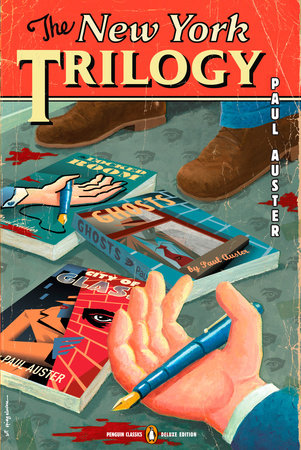
The New York Trilogy
A strange late-night call draws Daniel Quinn, a writer of detective stories, into a case that unsettles the boundary between writer and investigator.
About
Spoiler notice: Spoilers below for the opening situations and central investigations of all three novels; the final fates are not disclosed.
The New York Trilogy brings together three detective novels that first appeared separately. City of Glass was published in 1985; Ghosts and The Locked Room followed in 1986. Their collected volume appeared in 1987, which is why that year belongs to the trilogy as a book rather than to all three stories individually. Across the collection, a case begins as a familiar invitation to watch, follow or explain. Auster uses that invitation to keep the reader curious while changing what an investigation can deliver. Each story has a person trying to understand someone else, but the work of looking also changes the one who looks.
City of Glass starts with an unexpected late-night call. Quinn, a writer of detective stories, is drawn into a case more puzzling than the ones he creates on the page. The setup places an imaginative worker of mysteries inside a mystery of his own, where the role of storyteller offers no special protection from confusion. A conventional detective plot teaches the reader to collect clues and expect them to gather around an answer. Quinn’s case unsettles that expectation from the start: its central attraction is the gap between the form of a mystery and the assurance that a mystery can be solved.
That crossing between writer and investigator gives the first novel a precise source of tension. Quinn knows how detective stories are made, but knowing their patterns cannot guarantee control over a case he did not invent. Auster can therefore make uncertainty active rather than vague: the question is not simply what happened, but what kind of account can be trusted to explain it. City of Glass keeps the pressure of a case in motion while turning attention toward the choices behind any narrative. Who selects the significant detail? What happens when an observer mistakes a convincing story for a settled truth?
Ghosts strips its cast to colour names and gives it a sharply defined arrangement. Blue is hired by White to spy on Black from a rented room on Orange Street. Blue watches from one window while Black looks out of the window across the street. The job sounds simple enough to state, but the symmetry makes it hard to say where observation stops and becomes a story about the observer. There is no complicated cast list to distract from the basic positions: one person commissions a watch, another carries it out and a third is watched.
The mirrored windows give Ghosts an immediate visual idea: looking across at another person can also expose the limits of what can be seen. Blue has a defined assignment, but the publisher’s description offers no elaborate chase or crowded trail of clues. Its emphasis falls on the act of watching. The colour names make each character easy to distinguish while withholding the familiar biographical cues that would make a name feel like a whole identity. That choice invites a reader to pay attention to roles instead: who observes, who pays for observation and who becomes its object. A report can describe what happens across the street, but cannot automatically reveal what another person means.
The Locked Room shifts from a stranger under observation to a missing boyhood friend whose work and family remain behind. Fanshawe disappears, leaving his wife, their baby and a collection of novels, plays and poems. The narrator, Fanshawe’s childhood friend, is drawn obsessively into the life that has been left open. The absence is not an abstract puzzle: it reaches into a relationship formed long before the narrator begins trying to account for it. Manuscripts and family ties make Fanshawe present in practical ways even as the fact of his disappearance keeps him beyond direct explanation.
The narrator’s connection to Fanshawe matters because friendship brings its own claims to knowledge. A boyhood friend may believe he understands the person who is missing, yet familiarity is not the same as access to another mind. Here the traces that remain—family and writing—can be read, interpreted and made to stand in for a person. That creates a different kind of detective problem: instead of reconstructing an event from clues, the narrator is pulled toward a life he cannot simply take over and explain. To represent someone else is to make choices about what readers will see, and those choices can blur the boundary between preserving a life and occupying its place.
In sequence, the three novels move from a writer caught by an unexpected call, to a paid act of watching across a street, to a friend drawn into the remains of a missing man’s life. Each frames its investigation differently, but each returns to a person trying to account for another person from a partial record. City of Glass tests the authority of a mystery writer, Ghosts concentrates on a watch with no guaranteed insight, and The Locked Room brings the problem into friendship, family and another writer’s work. This Penguin Classics Deluxe paperback, published in 2006, includes an introduction by Lucy Sante and cover art by Art Spiegelman. Readers drawn by the detective setup will find the cases compelling even as the certainty they promise slips away. The trilogy keeps the reader looking while making the act of looking part of the mystery.
Book details
- Author
- Paul Auster
- First published
- 1987
- Series
- No series listed
- Subgenre
- Detective fiction, Experimental fiction
- Primary genre
- Literary Fiction, Mystery & Thriller
- Tags
- No tags for this book.
Review
Editor profile
Baby Bat
Goodreads and social links will be added soon.
- Goodreads — link coming soon
- Social media — link coming soon