
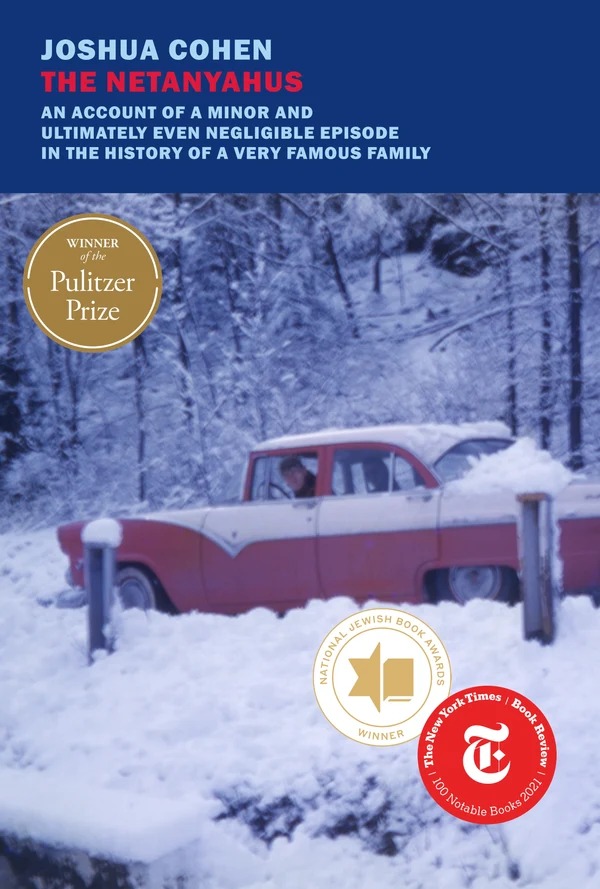
The Netanyahus
At Corbin College in 1959–1960, Jewish historian Ruben Blum is drawn onto a committee considering the application of exiled Israeli scholar Benzion Netanyahu, whose specialty is the Spanish Inquisition.
About
Spoiler notice: Spoilers limited to the premise and opening setup: Ruben Blum joins a hiring committee considering Benzion Netanyahu, and the scholar arrives with his family, whom Blum reluctantly hosts. Later events and the ending are not summarized.
The Netanyahus takes place at the fictional Corbin College during the winter of 1959–1960. Its narrator, Ruben Blum, is a Jewish historian whose academic field is tax history rather than Jewish history. He is drawn into a faculty hiring process because the department is considering an exiled Israeli scholar, Benzion Netanyahu, whose work concerns the Spanish Inquisition. That combination of campus procedure and a much longer history gives the novel its starting tension: an apparently narrow question about a university appointment opens onto arguments about scholarship, Jewish identity and the stories people tell about belonging in the United States and the institutions that shape it.
Blum’s position makes him both participant and observer. He is asked to help assess a candidate whose subject sits outside his own specialization, and he must navigate the expectations of colleagues while considering what the visit might mean for his family. The campus setting brings professional judgment into contact with private life. A hiring committee may appear to deal in credentials and departmental needs, but the questions surrounding Netanyahu’s candidacy carry historical and cultural weight. Through Blum’s perspective, the novel follows the awkwardness of being treated as a representative of a community while also trying to live as an individual with a career, a household and opinions of his own.
When Benzion Netanyahu arrives for the interview, he brings his family with him. Blum becomes their reluctant host, and the visit shifts from academic business into an extended domestic encounter. The difference between a carefully managed institutional process and the unpredictable presence of guests creates much of the book’s comic energy. The visitors unsettle Blum’s routines and challenge the assumptions he has built around his own American life. Their presence does not simply add a family subplot to the campus story: it makes the boundaries between public ideas and everyday behavior harder to maintain, as arguments about history and identity enter the home.
The novel draws on a real historical figure and a fictionalized encounter, while keeping its central events within Cohen’s invented narrative. Benzion Netanyahu was a scholar of the Spanish Inquisition; Ruben Blum is the novel’s invented narrator. That blend lets the book ask how historical accounts are made and whose perspective gives them shape. Blum’s expertise in taxation, rather than the Jewish past under discussion, also complicates his role: he is close enough to be recruited into the conversation but not positioned as its authoritative interpreter. The result considers how knowledge, family memory and public identity can overlap without becoming the same thing.
The setting in postwar America gives those questions a particular frame. Corbin College is an academic workplace, but it is also a small social world where professional ambition and assumptions about difference are visible in ordinary encounters. The novel’s attention moves between committee deliberations, conversation and the disruptions of a family visit. Cohen uses these shifts to bring intellectual debate into the texture of daily life. Because the college is fictional, its routines give Cohen room to stage these pressures without treating the scene as a documentary reconstruction. The committee offers a formal language of expertise and suitability, while the household makes the consequences of those judgments immediate and personal. As the visit unfolds, the distinction between observing an encounter and being implicated in it becomes increasingly difficult for Blum to sustain. The story’s humor often arises from mismatched expectations: an academic interview cannot contain the larger histories attached to it, and Blum’s attempts to keep events orderly meet a situation that resists being neatly managed.
Cohen also plays with form and tone. The book combines the campus novel with long stretches of discussion and reflection, moving between comic social observation and broader historical argument. Its full title promises an episode that is minor and ultimately negligible, a deliberately disproportionate label for a story that keeps expanding the significance of one visit. The framing invites attention to the gap between what institutions record as important and what individuals experience as consequential. It also leaves room for uncertainty about how much of a past event can be recovered, especially when memory has passed through storytelling and fiction.
At its centre, The Netanyahus asks what it means to negotiate identity across family, scholarship and national history. Blum is neither outside the encounter nor fully at ease within it; his uneasy hospitality becomes a way to examine the pressures of representing a group while maintaining a separate self. The visit tests his confidence in the habits and values of his American life, while the committee’s decision places personal judgments beside institutional ones. Cohen keeps these questions grounded in a sharply bounded setting and a comic series of social collisions. The novel’s interest lies in how a seemingly small episode can expose the larger stories that shape a household, a university and a sense of belonging.
Book details
- Author
- Joshua Cohen
- First published
- 2021
- Series
- No series listed
- Subgenre
- Literary historical fiction, Campus novel
- Primary genre
- Historical Fiction, Literary Fiction
- Tags
- No tags for this book.
Review
Editor profile
Baby Bat
Goodreads and social links will be added soon.
- Goodreads — link coming soon
- Social media — link coming soon