
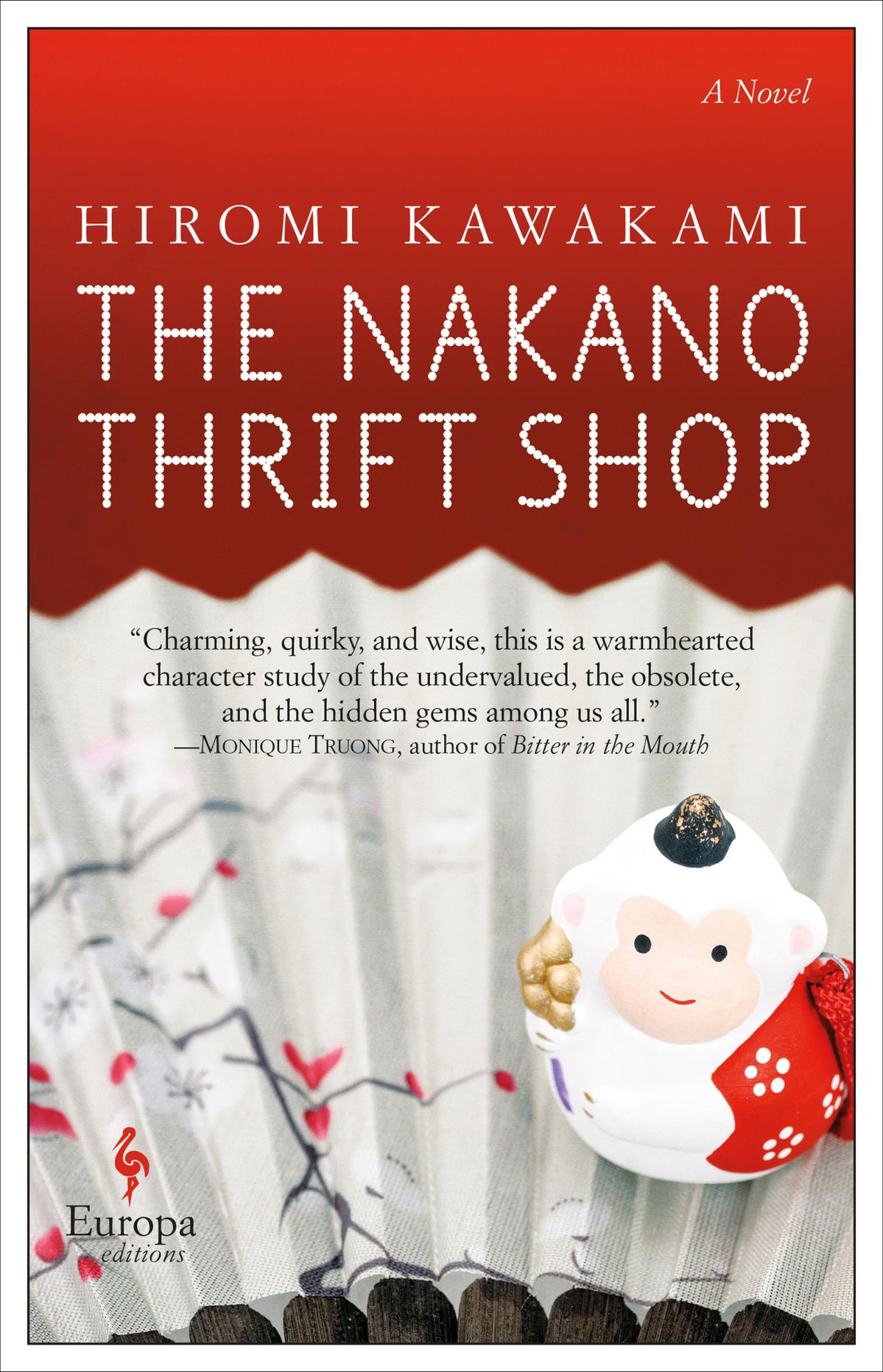
The Nakano Thrift Shop
In a second-hand shop in a western Tokyo suburb, Hitomi works the register alongside the reserved Takeo and the impulsive owner, Mr.
About
Spoiler notice: Low-level premise and opening-chapter spoilers only. This account does not reveal the later relationship outcomes or ending.
The Nakano Thrift Shop uses a neighbourhood business as the frame for a story about people who remain partly unknowable to one another. The novel is organised into twelve chapters, each named for an object, from a paperweight and letter opener to apples, gin and a punch ball. That pattern gives the book the loose shape of a collection of linked episodes: a thing may begin in the shop, pass through someone’s hands, or simply provide a way into a memory or exchange. The title objects are not a conventional series of clues leading to a single mystery. Instead, they give the narrative recurring points of contact, making the movement of ordinary things echo the uncertain movement between the people who handle them.
The shop itself is specific in its scale and trade. It sits in a western suburb of Tokyo, in an area associated with students, and sells inexpensive second-hand household goods rather than valuable antiques. Its stock includes tables, fans, air conditioners, tableware, typewriters and small decorative objects. Nakano and Takeo also collect possessions from homes, sometimes after a death, when relatives need to clear a household. The business therefore stands at a quiet meeting point between domestic life and its aftermath. Objects that one family no longer wants become merchandise for someone else, and their former use is visible even when their personal history is not. The store’s mixture of practical work and uncertain value gives the novel a setting where questions of usefulness, attachment and worth can arise without turning into abstract debate.
Hitomi tells the story from her position at the register, where she can watch the shop’s rhythms but cannot always explain what she sees. She is a young employee drawn to Takeo, the reserved co-worker who helps with pickups. Their manner of speaking leaves space between what is felt and what is said. Takeo can answer a personal question with a short, apparently simple remark, while Hitomi keeps turning over its possible meaning. The resulting tension is less a sequence of romantic declarations than a record of attention: who looks, who waits, who offers an explanation, and who stays silent. Even their working conversations move easily between casual humour and more revealing details, giving Hitomi more to wonder about without necessarily bringing her closer to an answer.
The early account of Takeo shows how the novel lets biography surface indirectly. Hitomi notices the missing tip of his little finger and learns that it was injured in a bullying incident at school, not lost through the criminal association Nakano jokingly guesses at. Takeo describes leaving school in a way that resists the reaction Hitomi expects from him. The scene does not transform him into a puzzle whose past can be solved; it leaves her with a new piece of information and the same difficulty of knowing what he thinks. His reluctance to dramatise his own experience sits beside Hitomi’s impulse to interpret it. Their difference helps establish one of the book’s recurring concerns: intimacy does not guarantee access to another person’s inner account of their life.
Nakano and his sister Masayo widen the story beyond Hitomi’s emerging relationship. Nakano runs the store with loose, impulsive habits and an ease in conversation that can be funny while concealing how little he chooses to explain. His private romantic life is one of the things Hitomi notices without fully understanding. Masayo, an artist who makes dolls, is presented as an unconventional source of counsel because her own sentimental life is complicated. She is not simply a wise guide who resolves the younger woman’s uncertainty; she is another person whose choices and feelings resist a neat summary. The four workers and family members form a small social world, yet they do not become a tidy substitute family in which everybody knows everybody else. Their closeness grows through repeated encounters, errands and observations, alongside omissions and misreadings.
The chapter titles reinforce this attention to partial knowledge. A paperweight or a pair of old glasses can be assessed by price, appearance or use, but none of those measures explains why a particular person wants it. In the shop, Nakano remarks that people may buy things precisely because they are not useful. The idea also suits the novel’s relationships: a person’s value is not reducible to an efficient role, and an awkward silence may matter more than a polished declaration. This is an interpretive thread rather than a claim that every object has one fixed symbolic meaning. The varied chapter names instead invite the reader to notice how material details and emotional encounters sit beside one another, sometimes linked directly and sometimes left in suggestive proximity.
Kawakami lets humour and melancholy share the same cramped shop. An everyday lunch, a pickup run and a customer’s repeated visits can be funny without settling the motives of anyone involved. Nakano’s verbal habit of beginning in the middle of a thought makes the others ask what he means, while his sudden changes of subject keep even casual conversation unpredictable. The small transactions provide structure for the chapters, but they do not make emotional life orderly. The shop can bring people together without making their histories transparent. Hitomi may spend a shift beside Takeo and still leave uncertain about the feelings behind a brief remark. That quiet distance, among people who see one another nearly every day, gives the character-centred portrait its pull.
Book details
- Author
- Hiromi Kawakami
- First published
- 2005
- Series
- No series listed
- Subgenre
- Literary fiction, Translated literary fiction
- Primary genre
- Literary Fiction
- Tags
- No tags for this book.
Review
Editor profile
Baby Bat
Goodreads and social links will be added soon.
- Goodreads — link coming soon
- Social media — link coming soon