
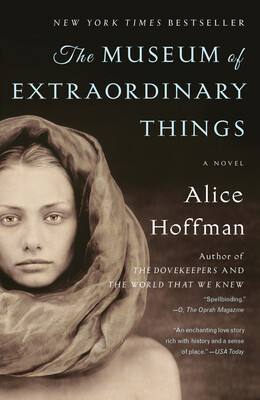
The Museum of Extraordinary Things
In early twentieth-century New York, Coralie Sardie is exhibited as a mermaid in her father’s Coney Island sideshow, while Russian immigrant and photographer Eddie Cohen has left his Orthodox community and tailoring apprenticeship.
About
Spoiler notice: Spoilers cover the opening circumstances, Coralie and Eddie’s meeting, and the Triangle fire’s role in the mystery; later revelations and the ending are withheld.
The Museum of Extraordinary Things begins with a place designed to make people stare. In early twentieth-century Coney Island, Professor Sardie runs a sideshow where unusual performers are presented to paying crowds as wonders. His daughter Coralie, an exceptional swimmer, is exhibited as the Mermaid. She has grown up inside the attraction and under her father’s control, learning to treat the boundaries he sets as the limits of her world. Yet the water offers her an element of her own, and her nightly swims become a private counterpoint to the role she performs. Alice Hoffman builds the novel around this tension between being displayed and being seen: Coralie is at once a spectacle for strangers and a young woman trying to understand what kind of life might belong to her.
The other central figure is Eddie Cohen, a Russian immigrant who has left his Orthodox community and his apprenticeship as a tailor. He is making a different kind of image, photographing the natural world around the Hudson rather than appearing before an audience. His work brings him into contact with Coralie, and the publisher describes their developing connection as an impassioned love story. They come from markedly different surroundings, but each is negotiating an inherited identity: Coralie has been shaped by her father’s enterprise, while Eddie has stepped away from family and community without becoming free of their pull. Hoffman lets romance arise from that meeting of separate worlds, rather than treating either character as a simple escape route for the other.
The historical setting gives those private choices a larger pressure. The story moves through New York in 1911, when Coney Island’s bright amusements and the Lower East Side’s immigrant neighborhoods existed alongside dangerous working conditions and stark inequalities. The Triangle Shirtwaist Factory fire enters the plot when Eddie photographs it; the event also draws him into a mystery surrounding a missing young woman. These historical events are not just scenery for a period romance. They make questions of visibility and value unavoidable: who is treated as a person, who becomes an image or a curiosity, and whose disappearance is noticed? The novel’s movement between Brooklyn and Manhattan links popular entertainment, immigrant life, and industrial labor without making them feel like separate versions of the city.
Hoffman’s Coney Island is a landscape of spectacle and contradiction. The museum promises the extraordinary, while the surrounding amusement culture sells wonder on a mass scale. Coralie’s position within it complicates the idea of performance as glamour: the crowd sees a mermaid, but the role belongs to a daughter whose choices have been circumscribed by the person who profits from the show. The book also gives attention to the performers around her, including figures known by public labels such as the Wolfman and the Butterfly Girl. Their presence invites a question about the gaze itself. Are these people strange because they are different, or because society has decided that difference should be displayed, feared, or mocked? Hoffman’s imaginative language keeps that question close to the characters’ human needs.
Eddie’s photography provides a useful counterpoint to the museum’s exhibition. Both depend on looking, selecting, and framing, but a photograph can become evidence as well as an image. When his work intersects with the factory fire and the search for the missing woman, his attention to what he sees pulls him back toward a neighborhood he had abandoned. His role as a finder gives the mystery a practical engine, while his estrangement from family and community supplies an inward one. Coralie and Eddie therefore move through the novel with different forms of unfinished business. The book does not reduce their relationship to a cure for those histories; instead, their growing bond forms amid obligations and losses that neither can simply erase.
The novel’s blend of romance, mystery, and historical fiction is held together by its interest in what people conceal and what they choose to reveal. The publisher’s reading guide notes the book’s framing through two spectacular fires and asks readers to consider how the city’s changing landscape affects its characters. That structure gives the period setting a sense of instability: entertainment districts can vanish, workplaces can become sites of catastrophe, and private lives can be reshaped by events that draw a crowd. Hoffman also lets the fantastic sit beside documented history. Coralie’s mermaid role and the sideshow’s wonders belong to the novel’s imaginative register, while the Triangle fire anchors the story in a specific public tragedy. The combination supports a fairy-tale atmosphere without making the historical danger feel weightless.
At the center is a question about freedom: whether a person can define herself when others have already made a spectacle, a worker, an outsider, or an object of desire out of her. Coralie’s swimming suggests an interior life that exceeds the part assigned to her, while Eddie’s camera records a world he has not yet learned how to re-enter. Their stories meet in a city transformed by migration, commerce, invention, and loss. First published in 2014, Hoffman’s novel uses the heightened world of a Coney Island sideshow to look closely at ordinary longings for belonging, recognition, and self-direction. Its mystery and romance move through real historical upheaval, but the book leaves the later turns and resolutions for the reader to discover.
Book details
- Author
- Alice Hoffman
- First published
- 2014
- Series
- No series listed
- Subgenre
- Literary historical fiction, Immigrant fiction
- Primary genre
- Literary Fiction, Historical Fiction
- Tags
- No tags for this book.
Review
Editor profile
Baby Bat
Goodreads and social links will be added soon.
- Goodreads — link coming soon
- Social media — link coming soon