
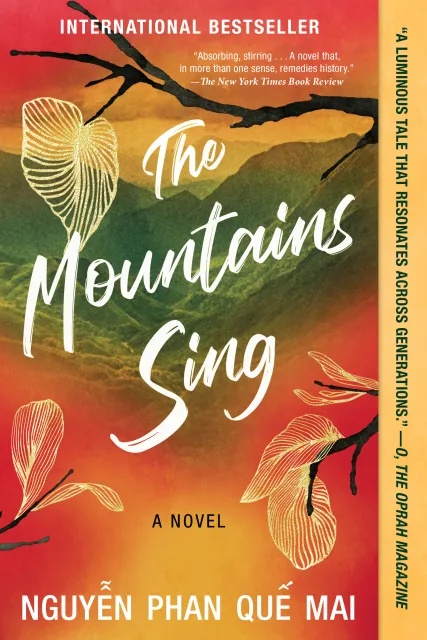
The Mountains Sing
Born in 1920, Trần Diệu Lan flees her family farm during Việt Nam’s Land Reform with her six children.
About
Spoiler notice: Spoilers cover the novel’s dual narration, the family separations at its centre and its broad movement from wartime into the postwar years. Later resolutions and the ending are withheld.
The Mountains Sing follows the Trần family across generations of Việt Nam’s twentieth century, bringing upheaval into view through the people who must live with it. Trần Diệu Lan, born in 1920, is forced to flee her family farm with six children during the Land Reform. Years later, her granddaughter Hương is growing up in Hà Nội as her parents and uncles leave to fight along the Hồ Chí Minh Trail. These two lives give the family story its broad frame: Diệu Lan has already been driven from home, while Hương is still trying to understand a conflict that draws the adults around her away. Historical events form the setting, but the novel keeps its attention on a fictional family and the consequences of displacement, separation and memory. Its span allows earlier losses to shape the life of a younger generation, linking the upheaval that changed Diệu Lan’s home with the wartime uncertainty that marks Hương’s childhood.
Diệu Lan and Hương take turns telling the story, so readers encounter events from two ages and two positions within the same family. Hương’s wartime Hà Nội is immediate and physical: she walks to school with Grandma past bomb damage, carrying the ordinary routines of childhood into streets shaped by air raids. She is also waiting for news of her mother, who has gone to find her father. Grandma calls Hương by the nickname Guava, a small gesture of care within an unstable world. Through the girl’s questions, the war is not an abstract map or a contest of armies; it is the fear that a parent may not return and the effort to understand why familiar people are gone. Diệu Lan’s voice carries an older generation’s memories beside Hương’s present tense, connecting the child’s uncertainty to a history that began before she was born.
Diệu Lan’s life reaches back to the family farm and the Land Reform that forces her to leave it with her children. Losing that home means more than changing place: it interrupts a family’s relationship with land, work and the inheritance a younger generation might have known. The novel sets her flight beside the much later disruptions Hương faces, showing how one generation’s losses become part of what the next must understand. Diệu Lan is also a keeper of family memory. Stories, lullabies and local legends give her a way to share what has happened and to help her granddaughter see beyond the immediate danger around them. That role brings tenderness into a narrative shaped by separation. The grandmother’s experiences and the child’s questions remain distinct, yet their conversations give the family a means of carrying knowledge forward when events have scattered its members.
For Hương, even an ordinary walk with her grandmother can change in an instant. On the way to school, bomb damage marks the route; a promise of phở after the air raids is interrupted when a siren warns that bombers are approaching Hà Nội. Hương wonders whether her mother has found her father, a question that reveals how much of family life is now governed by absence. Her parents and uncles have gone down the Hồ Chí Minh Trail, leaving her to come of age amid a war that divides both country and household. School, food, a grandmother’s hand and news of a missing parent occupy the same small stretch of a child’s day. Keeping the focus at that scale lets the family’s separation register through lived routines. Hương is not asked to explain the conflict; she must find her way through its uncertainty with the people who remain beside her.
The novel’s language and family life are closely tied to Vietnamese storytelling traditions. Songs, poetry and proverbs appear alongside Vietnamese names and words written with their diacritical marks, whose accents distinguish meaning. These details place the family’s speech within a particular language and culture rather than smoothing it into a generic wartime setting. They also connect to the book’s concern with what can be passed between generations. Stories help Hương approach a past she did not witness, while family memory offers Diệu Lan a way to speak about people and places changed by events. The novel gives attention to women and children whose experiences of conflict often unfold away from battle lines, even as war reaches their homes. Its movement between the grandmother’s recollections and the granddaughter’s growth makes remembrance part of the family’s continuing life.
The story extends beyond wartime separation into the years after the fighting, when the family must live with what conflict has changed. Return does not make earlier losses disappear; people who come back still have to find their place among relatives who have endured their own fears and absences. The Trần family’s experience remains fictional, set within a historical frame that includes Land Reform and war. The novel brings these events into a family narrative, rather than serving as documentary evidence about them. That distinction matters to its scale: the story attends to the ways upheaval enters relationships, memory and the possibility of making a home again. By placing Diệu Lan’s and Hương’s voices alongside each other, it connects endurance across generations while allowing each woman’s experience to remain her own. The result is a portrait of a family shaped by forces larger than itself and by the stories its members continue to share.
Book details
- Author
- Nguyễn Phan Quế Mai
- First published
- 2020
- Series
- No series listed
- Subgenre
- Literary historical fiction, Family saga
- Primary genre
- Historical Fiction, Literary Fiction
- Tags
- No tags for this book.
Review
Editor profile
Baby Bat
Goodreads and social links will be added soon.
- Goodreads — link coming soon
- Social media — link coming soon