
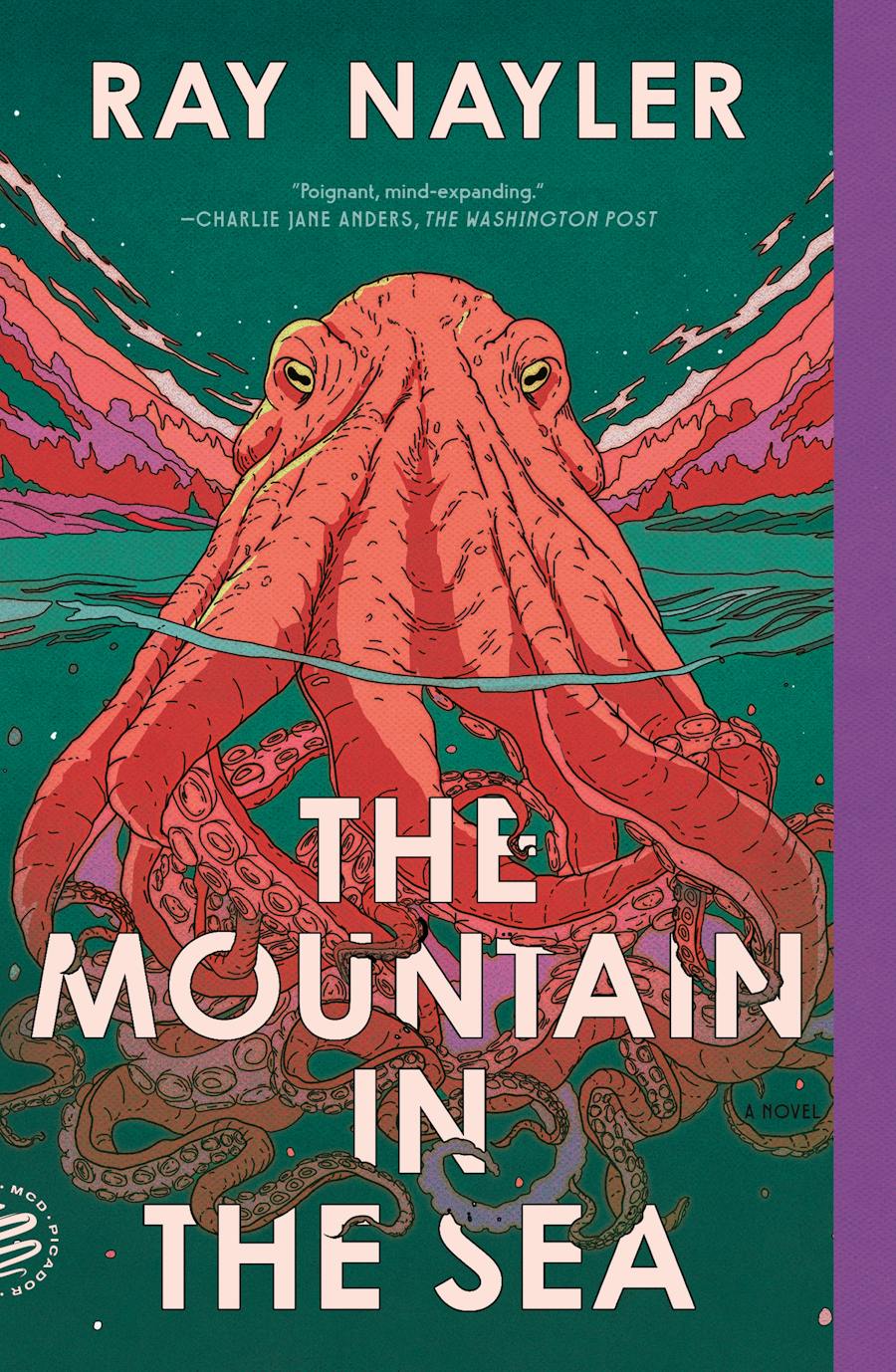
The Mountain in the Sea
Marine biologist Ha Nguyen travels to the isolated Con Dao Archipelago, where a newly discovered octopus species may have its own language and culture.
About
Spoiler notice: Contains early-novel spoilers through Ha Nguyen’s arrival on Con Dao and her first meeting with Evrim. It does not describe later developments or the ending.
Ray Nayler begins with a problem of interpretation before Dr. Ha Nguyen reaches the island at the centre of her research. In a rain-soaked café in the Ho Chi Minh Autonomous Trade Zone, a man called Lawrence recounts the death of a customer on a wreck dive. Lawrence and the diver descended into murky water off Con Dao while Lawrence’s assistant Son stayed on the boat. After losing sight of the diver, Lawrence found him trapped inside the freighter, already dead. Lawrence believes something took the diver’s mask, tank and regulator, but admits he never searched the wreck for the missing equipment. His confession is compromised by guilt, fear and the uncertainty of poor visibility. The episode introduces an ocean where a person can be watched without knowing it, and where incomplete evidence leaves room for both suspicion and self-deception. It is a tense opening, but also a concrete warning that seeing an event is not the same as understanding it.
Lawrence’s story places the archipelago inside a damaged human system. Con Dao was once a prison; its residents have since lived alongside a conservation park that exists officially across land and water, while illegal fishing and poorly paid, corrupt enforcement continue in practice. Lawrence ran a small dive business there and knew the reefs before evacuation moved him away. He supports DIANIMA’s takeover because he thinks removing people and sealing the islands may protect them. At the same time, his memories of the dead diver and the unexplained dive make the ocean feel less like a landscape to manage than a presence that resists human control. The novel does not ask the reader to treat conservation as a simple good or corporate ownership as a simple solution. The opening instead sets protection, livelihood and authority against one another, while leaving Lawrence’s account unsettled by the things he cannot verify.
Ha arrives on an island that has been emptied but not made welcoming. Rain, failing infrastructure, jungle, abandoned buildings and the difficult transfer from aircraft to armoured ground transport make the trip feel like entry into a place from which ordinary life has withdrawn. A rifle-carrying team lead, Altantsetseg, receives her at a hotel converted into a sparse working base. Ha has spent much of her career studying cephalopod intelligence, and the publisher’s synopsis explains why she has come: an octopus species here may have developed language and culture. Yet her first mental frame is personal, not triumphant. She carries a recurring, grief-laden memory of damaged cuttlefish and eggs, and cannot tell which details belong to the original event and which have changed in recollection. The uncertainty links scientific observation to memory without equating them: both demand attention, and both can be distorted when emotion and expectation press on what a person thinks they saw.
Ha’s arrival also makes the expedition’s hierarchy deliberately strange. DIANIMA has assembled people with very different relationships to the island and to the company: Ha as a marine biologist, Altantsetseg as an armed security officer, and Evrim, the team lead whom Ha recognises from public broadcasts. Evrim is an android presented as humanity’s first consciously created artificial being. Their existence has provoked legal bans and violent political responses, so they come to the island carrying consequences well beyond the laboratory. Their meeting is awkward in a useful way. Ha must reconsider the pronouns and categories she applies almost automatically, while Evrim handles the encounter with careful patience. The scene does not settle what consciousness means. It shows Ha trying to meet a person whose presence exposes how much of her own understanding depends on inherited labels. That same difficulty will matter when the object of the expedition is an intelligent life form that cannot be assumed to think or communicate as humans do.
The publisher describes the central conflict in broad terms: Ha attempts to communicate with the octopuses while powerful interests move to seize them and exploit possible advances in nonhuman intelligence. That premise gives the island’s isolation an immediate political charge. DIANIMA’s cordon may protect a vulnerable habitat, but it also places the animals inside a corporate-controlled research site; the promise of knowledge can become a claim of ownership. Ha’s scientific work therefore carries an ethical question that is present before any successful communication: what would count as listening, and who gets to decide what the encounter is for? Nayler sets that question alongside Lawrence’s unresolved account and Evrim’s contested status. Each thread concerns a boundary people want to draw—between observer and observed, human and nonhuman, tool and person—and the costs of drawing it too quickly. These connections are an interpretation of the opening and published premise, not a disclosure of how the later plot resolves them.
The title’s mountain suggests a scale larger than any single character’s viewpoint, while the sea remains a place of life, work, memory and danger. In the excerpt, water conceals a body and its missing equipment; elsewhere in the same opening, it surrounds the abandoned settlement and receives Ha’s arrival. The book’s recurring concern with communication is similarly material. Nervous systems exchange signals, animals use bodies and changing skin, and people rely on interviews, reports, masks, translators and machines. None of these channels guarantees mutual understanding. The short chapters and shifts of attention make the opening feel like several investigations beginning at once, rather than one researcher simply arriving to solve a puzzle. Macmillan classifies the novel as science fiction, and its near-future technology supports that shelf, but the initial questions are also ecological and social: how can another form of life be recognised without immediately turning it into a resource? This account stops at the early introductions; it does not claim to summarise the novel’s full answer.
Book details
- Author
- Ray Nayler
- First published
- 2022
- Series
- No series listed
- Subgenre
- First contact, Robot and AI
- Primary genre
- Sci-Fi
- Tags
- No tags for this book.
Review
Editor profile
Baby Bat
Goodreads and social links will be added soon.
- Goodreads — link coming soon
- Social media — link coming soon