
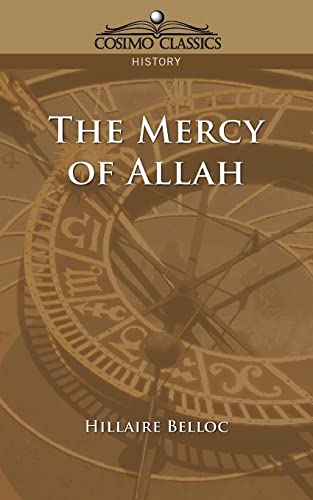
The Mercy of Allah
A wealthy merchant in Bagdad invites his seven nephews to hear how he made his fortune.
About
Spoiler notice: This overview reveals the pearl fraud, Abdullah’s death, Mahmoud’s later financial schemes and the youngest nephew’s inheritance.
Mahmoud is rich enough for his opinions to disturb the markets of the Euphrates, but he has no intention of sharing his fortune with his brother’s family. His brother, a surgeon named El-Hakim, asks instead whether the merchant will explain how he became wealthy. That request brings seven boys into Mahmoud’s magnificent rooms, where their uncle recounts his career over a succession of visits. Hilaire Belloc’s The Mercy of Allah, first published in 1922, gives the account fourteen chapters. The boys listen respectfully, ask questions and sometimes notice difficulties in his explanations. Mahmoud welcomes their admiration more readily than their curiosity, especially when a question interrupts his account of his own generosity.
His career begins with a departure that has little of the dignity surrounding him in old age. His father sends him away with a small purse and a kick, and the young Mahmoud quickly learns to obtain food and transport by deceiving strangers. A wealthy collector’s appetite for rare carpets offers a larger opportunity. Mahmoud pretends to represent a dealer whose goods are waiting at the quay, then invents a rival buyer to sharpen the collector’s anxiety. He receives cash and ornaments before disappearing. When the injured man pursues him, Mahmoud convinces two fishermen that the approaching party consists of tax officials. Their fear carries him away, and he later abandons them without returning as promised.
The next chapter makes mistaken identity profitable and then lethal. A magistrate gives Mahmoud a lost purse that belongs to another young traveller. He accepts it with a performance of gratitude, claims to be buying pearls and receives jewels from his new patron to value. After selling them, he leaves with the money rather than returning it. Outside the city he encounters the purse’s real owner, desperate to recover his property. Mahmoud sends him to the authorities with a false story that directs suspicion towards him. A hermit later reports that the pearls were counterfeit and that an innocent young stranger has been executed. Mahmoud admits he did not know the jewels were false; the lucky escape becomes another proof, to him, of divine favour.
The pottery episode moves from individual theft to control of an entire trade. In a secluded valley, Mahmoud buys a dead potter’s stock from his widow and sells cheaply while living on money he has kept hidden. He starts manufacturing, draws customers away from established sellers and presents the low prices as a public service. Rumours about incoming supplies let him send prices down before buying stock; a supposed disaster to the consignment sends them up again. His competitors struggle to understand a market whose changes he helps create. The account keeps the language of charity close to the details of calculation, allowing his explanation of each kindness to reveal what it earns him.
Abdullah, a fellow pottery merchant, asks for a partnership as his business approaches ruin. Mahmoud refuses on grounds of principle, then offers a loan secured against Abdullah’s property. Falling prices and accumulating debt end in Abdullah’s suicide. Mahmoud mourns publicly, arranges a funeral at public expense and subsequently takes over the factory through foreclosure. His remaining competitors become employees, sometimes still managing the booths they once owned. Once he controls the trade, he argues that an essential public service ought to belong to the state. The king buys it for half a million dinars, financed by taxation. Mahmoud departs amid public gratitude, having been praised both for building the monopoly and for surrendering it.
By the final chapter, his dealings reach beyond workshops and bazaars into the finances of states. Mahmoud describes receiving a continuing share of tax revenues after helping fund a war between two countries. Loans, insurance and the sale of shares provide further sources of income, while paid writers and public storytellers spread praise for his ventures. A property need not fulfil its promises for its early buyers and sellers to profit; the people left with worthless holdings have less influence than those who have already made money. His charitable foundations are equally selective, serving oddly defined groups or supporting competing doctrines. The larger his resources become, the more easily he can purchase authority for another enterprise.
Mahmoud calls the result peace of mind. His wealth allows him to tolerate the world’s evils and feel secure about tomorrow, even as the country around him grows unstable. When a stone is thrown through his banqueting-room window, he quietly begins selling his interests and moving the proceeds elsewhere. He returns to Bagdad before an invasion destroys the state in which he made his fortune. From his palace, the disaster can be remembered as another occasion on which he escaped in time. His final advice to the boys is to work hard, live carefully and struggle to retain enough of their earnings for their families; he expects the rest to reach men like himself.
The farewell gift is a dried fig for each nephew. The youngest asks for something apparently smaller still: his uncle’s dated signature as a souvenir. Next morning a large payment has emptied the immediately available cash, and Mahmoud discovers his genuine signature beneath an instruction for twenty thousand dinars written in a child’s hand. He recognises ability rather than punishing the deception. The boy becomes an unpaid office worker and develops his own methods of exploiting colleagues and customers, eventually deceiving his uncle again over a sunken ship. As death approaches, Mahmoud leaves him the whole fortune. The lessons have found their pupil, though the nephew’s first success comes from treating his teacher as another opportunity.
Book details
- Author
- Hilaire Belloc
- First published
- 1922
- Series
- No series listed
- Subgenre
- Literary fiction
- Primary genre
- Literary Fiction
- Tags
- No tags for this book.
Review
Editor profile
Baby Bat
Goodreads and social links will be added soon.
- Goodreads — link coming soon
- Social media — link coming soon