
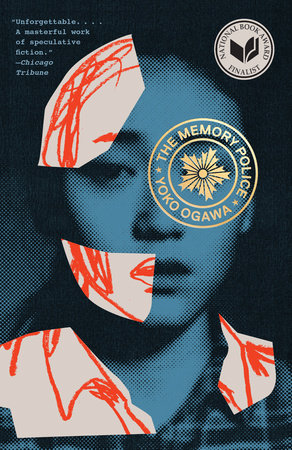
The Memory Police
On an unnamed island, familiar things begin to disappear, and most residents soon lose the memories attached to them.
About
Spoiler notice: Spoilers for the opening and major story threads follow; the ending is intentionally omitted.
The Memory Police opens on an island where people forget the same things at the same time. One morning, birds are the newest absence. The narrator, an unnamed novelist, knows that the island has changed, but her grasp of what has gone can loosen almost as soon as she notices it. The Memory Police make this loss concrete: they search for reminders, seize them, and take away people who retain memories. Everyday routines continue around the gaps, which is part of what makes the premise so unsettling. Ogawa gives no map, history lesson, or explanation for the disappearances. Instead, she follows a woman who has learned to live inside their consequences, paying attention to what the islanders can still name, keep, and feel.
Birds connect the narrator’s adult life to her childhood with her father, an ornithologist who studied them at an observatory. As a girl, she watched through his binoculars while he examined feathers, beaks, and flight. When birds disappear, the islanders let their caged pets go, one by one. The narrator tries to hold on to a bird’s appearance and sound, but the memory is already slipping away. What changes is not only the view from the hill: her father’s work and the feelings attached to it become harder to reach. That sequence gives the novel a clear measure of loss. A memory can vanish before a person has decided what it meant, and the people around her can carry on as though nothing has happened.
Earlier in the narrator’s life, her mother kept objects connected to things the island had forgotten in secret drawers. A ribbon, a bell, a stamp, an emerald, and a bottle of perfume were strange, almost unusable items to her daughter, but each one carried a story about a custom or a relationship. The mother could still remember what the objects meant, and her explanations let the girl briefly imagine the fuller world they came from. This private store of objects is not a simple escape from the island’s rules: the narrator has trouble making the memories feel real, even while she wants to believe her mother. The drawers show how fragile transmission can be. A physical object may survive, yet its meaning still needs someone able to pass it on.
The Memory Police are the force that closes this gap between forgetting and control. When officers raid the narrator’s father’s study after the birds disappear, they sift through his papers and photographs, remove material connected to birds, and bag it for disposal. Their work is calm and methodical, which sits uneasily beside the violence of what is being taken. The narrator sees the damage to her family’s records, while the officers treat it as ordinary procedure. People who retain memories can be hunted and removed, so fear reaches beyond the raid itself. When a loss is enforced by authority, keeping an object, a word, or a private recollection can become a risk.
The narrator writes novels, and Ogawa gives her writing a second story to carry. Her editor, R, is among those in danger, and she hides him beneath her floorboards. In the book she is writing, a typist is trapped by her lover and gradually loses her voice. The two strands are distinct, but both place a vulnerable person inside a confined space where another person controls what can be said or remembered. The island’s disappearances also narrow the narrator’s vocabulary for the world. Her manuscript cannot simply restore what has gone, but writing becomes a way to attend to what is happening while the ordinary means of describing it are being diminished.
A ferry offers another quiet image of the island after a disappearance. It remains moored at the dock, rusting and coated with seaweed, even though the islanders no longer remember what a ferry was for. The narrator visits the old vessel and talks with the former mechanic who now lives there. Such scenes let the novel hold two versions of a place at once: the object still occupies space, but its shared purpose has fallen out of memory. Around them, the island’s inhabitants rebuild habits without making a ceremony of every change. Their adaptation is practical, sometimes tender, and also troubling, because people can adjust to losses they are no longer able to recognize as losses.
Ogawa keeps the story’s machinery obscure. The novel does not explain who created the Memory Police, why the disappearances select particular things, or what lies beyond the island’s boundaries. That restraint keeps attention on the human scale of the changes: a parent’s stories, an emptied observatory, a friend at risk, a manuscript written one page at a time. The result belongs to speculative fiction, but its pressure comes from ordinary attachments rather than a technical account of an imagined system. As each disappearance changes both the physical landscape and the islanders’ inner lives, the reader has to notice what remains and what has become difficult to name.
Book details
- Author
- Yoko Ogawa
- First published
- 1994
- Series
- No series listed
- Subgenre
- Dystopian, Translated literary fiction
- Primary genre
- Sci-Fi, Literary Fiction
- Tags
- No tags for this book.
Review
Editor profile
Baby Bat
Goodreads and social links will be added soon.
- Goodreads — link coming soon
- Social media — link coming soon