
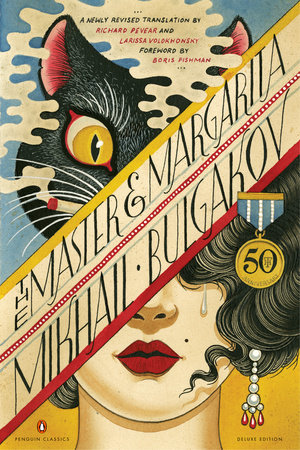
The Master and Margarita
When the mysterious Woland and his retinue arrive in 1930s Moscow, their strange visit entangles writers and city institutions in a fantastical satire.
About
Spoiler notice: Spoilers for the novel’s central characters and major choices, including Margarita’s bargain and the Master’s manuscript; the final resolution is not described.
Mikhail Bulgakov’s The Master and Margarita moves between two linked stories. In 1930s Moscow, a mysterious visitor named Woland arrives with a retinue whose supernatural presence unsettles the city’s writers and institutions. Interwoven with that modern plot is an account of ancient Jerusalem, where Pontius Pilate faces the consequences of an encounter with Jesus. The book connects these threads through the work of a writer known as the Master and through his relationship with Margarita. Political satire, fantastic comedy and questions of conscience therefore share the same imaginative space. Bulgakov wrote the novel during Stalin’s rule, and the pressure surrounding writers in its Moscow story gives the fantastic disruptions a particular historical charge.
Woland first appears in a Moscow park, where he speaks with two writers and recounts events from Pilate’s time as if he had witnessed them. His knowledge unsettles their confident assumptions about what can and cannot be real. The novel’s supernatural action then spreads through the city: a public magic show showers an audience with money and clothing that prove illusory, while Woland’s assistants cause disorder in Moscow. His company includes a trickster, a witch and a talking cat, whose antics bring slapstick into scenes shadowed by fear of arbitrary power. Bulgakov lets absurd spectacle expose the behaviour of the people watching it. The audience scrambles after the apparent gifts, and the disappearance of the money and finery leaves the public performance as a joke at the crowd’s expense. The city’s response to the impossible becomes part of the satire, as officials and onlookers try to fit bewildering events into familiar explanations and routines.
The Jerusalem narrative centres on Pilate’s encounter with Jesus, whom he has authority to judge. Pilate is presented as physically unwell and politically cautious; he is moved by Jesus’s belief in human goodness, yet fears the consequences of appearing to tolerate a challenge to imperial authority. His decision gives the ancient strand a conflict of conscience as well as a political one. Levi Matvei follows Jesus and records his sayings, though his written account does not always capture what he hears. The novel’s shifts between this story and Moscow keep the reader aware that the events are being narrated and retold. Pilate’s exercise of power, the risks of dissent and the fallibility of the record all echo the modern story without reducing the two periods to identical settings.
The Master enters the novel as a writer whose manuscript tells the Pilate story. He has been discouraged by its reception and is living in a psychiatric hospital when he meets another writer. His manuscript links the two narrative planes: what Woland has told in Moscow resembles the material the Master has written, and the Jerusalem story continues to circulate through the novel even after its author has lost confidence in it. The Master says he burned the manuscript, but Woland refuses to accept that it is gone and produces it again. This encounter joins supernatural intervention to the writer’s concern about whether art can survive rejection and suppression. Bulgakov makes authorship part of the action rather than a background theme. The Master’s experience raises a concrete question about what happens to a work when its creator is isolated and its readers or critics reject it. The answer is shaped by the same mix of practical vulnerability and supernatural possibility that governs the city around him.
Margarita’s devotion to the Master becomes a sequence of consequential choices. When she receives an opportunity to seek Woland’s help, she accepts the danger attached to it because she wants to reach the man she loves and protect his work. Before the ball, an enchanted cream changes her appearance and gives her the ability to fly; she travels over Moscow on a broomstick to reach Woland’s gathering. There she takes on the role of hostess, greeting a procession of notorious guests. These events make her an active participant in the novel’s supernatural world, rather than a figure who waits for the Master’s story to resolve itself. Her loyalty has a cost and requires courage, but Bulgakov does not make her choices merely symbolic: they move the plot and place her in direct contact with the power that has disrupted the city.
The novel’s route into print adds context to these stories without defining the selected edition. Bulgakov completed it near the end of his life and continued making changes until his death in 1940; it was not published while he was alive. The first print appearance was a censored serialization in the Soviet journal Moskva across its November 1966 and January 1967 issues. A Russian book edition appeared in Paris in 1967, and the first complete Soviet book edition followed in Moscow in 1973. The paperback represented here is a later Penguin Classics edition, ISBN 9780143108276, published in 2016 and translated by Richard Pevear and Larissa Volokhonsky from the complete, unabridged Russian text. This edition date belongs to the paperback, while 1966–67 marks the novel’s first publication.
Book details
- Author
- Mikhail Bulgakov
- First published
- 1966
- Series
- No series listed
- Subgenre
- Classic fantasy, Modern classics, Translated literary fiction
- Primary genre
- Literary Fiction
- Tags
- No tags for this book.
Review
Editor profile
Baby Bat
Goodreads and social links will be added soon.
- Goodreads — link coming soon
- Social media — link coming soon