
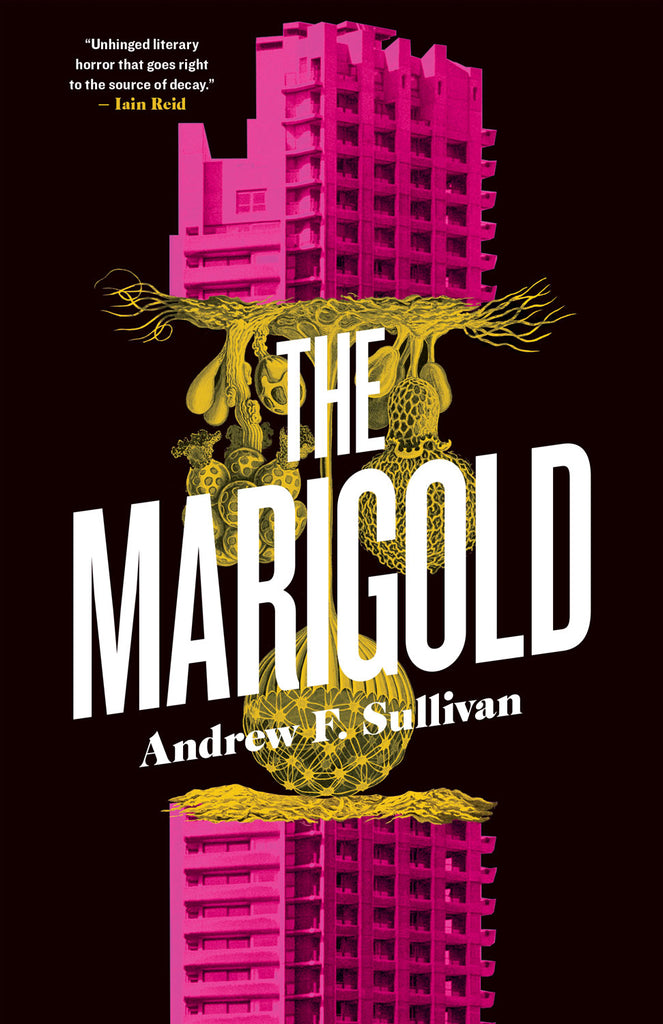
The Marigold
In near-future Toronto, a mysterious mold-like presence called the Wet spreads through a failing condominium tower and the city’s infrastructure.
About
Spoiler notice: Discusses the central threat, character setups, and the novel’s multi-perspective structure; it avoids later plot turns and the ending.
The Marigold is a near-future horror novel set across a Toronto whose familiar pressures have become impossible to ignore. Luxury development continues while the climate grows more erratic, public services struggle, and the city’s built environment begins to fail in unsettling ways. At the centre is the Marigold, a condominium tower advertised as an emblem of modern living but experienced by many residents as a shabby, half-empty building with unfinished promises. A dark sludge spreads through it and into the city’s infrastructure. The novel calls this presence the Wet: a fungus-like form that turns decay into something active, changing, and difficult to contain. Sullivan ties the uncanny threat to everyday places such as rental suites, streets, construction sites, and underground cavities, so the horror grows from the systems people already depend on.
Rather than follow one investigator from clue to solution, the book moves among people encountering different parts of the same crisis. Cathy Jin, a public health inspector, looks into the toxic growth and the damage it causes. Her work puts her in contact with a problem that crosses the boundaries between one building and the wider city. Sam “Soda” Dalipagic drives for a rideshare service, waiting for alerts and fares as he moves through Toronto; during that work he comes across a dangerous cache of data. The two threads make the city legible from different kinds of labour: official inspection and app-directed driving. Each character sees only a portion of what is happening, and their ordinary responsibilities keep going even as the conditions around them worsen.
Henrietta Brakes brings the story to a more intimate scale. The thirteen-year-old follows a friend after he is taken into a sinkhole by a creature from below, drawing her into the unstable space beneath the streets. Her search is urgent and personal, but it also connects the city’s surface to what it has buried. The sinkhole is both a physical danger and a breach in the orderly picture of urban life. Around Henrietta’s journey, other residents and tenants appear in shorter passages, giving the tower a life beyond its nameplate and its developers. Clogged garbage chutes, failing fixtures, and the dampness moving through private rooms make the building’s promise of shelter feel increasingly unreliable. The danger enters where people eat, sleep, and expect to be safe.
The fourth major strand follows Stanley Marigold, the struggling son of the developer who built the original tower. Construction on Marigold II has stalled, and Stanley wants to make that luxury project real by drawing on a hidden reserve of older power. The plan links the Wet’s emergence to the ambitions and histories attached to the Marigold name. Stanley’s choices add a corporate and political dimension to a disaster that is already affecting workers, tenants, and neighbourhoods. The tower does not stand apart from Toronto’s development boom; its fortunes reflect who gets to promise a future, who bears the cost when those promises fail, and how redevelopment can erase the past while remaining shaped by it. The novel keeps those questions within the plot rather than treating them as background commentary.
The Wet makes the book’s horror ecological and bodily at once. It spreads through infrastructure, but it also threatens to alter the people and creatures it encounters. The boundary between a city’s environment and the bodies living in it becomes less secure as the fungus grows and changes. Sullivan has described the Wet as central to the novel’s point of view, with the city close behind it; the shifting cast lets readers see its effects without giving them a single heroic figure who can master the whole event. That structure also changes the kind of suspense at work. Cathy investigates, Henrietta searches, Soda moves through a data-driven job, and Stanley tries to force a building project forward, but their aims do not resolve into one tidy mission. The story’s pressure comes from separate lives converging on a force larger than any one person.
This makes The Marigold an urban disaster story about dependence as much as destruction. People rely on housing, public health systems, digital platforms, roads, and neighbours, yet those connections can be fragile or exploitative. The book’s Toronto is recognisable in its towers and car-bound streets, but environmental disruption and the Wet push ordinary weaknesses into grotesque territory. Its body horror grows out of polluted spaces and unequal exposure; its speculative elements remain tied to work, housing, and development. The many viewpoints keep the consequences distributed across the city instead of presenting collapse as a private ordeal. The city’s condition is revealed in pieces, and the fear lies in watching those pieces touch. The threatened building is therefore more than a backdrop for the Wet: it concentrates competing ideas of shelter, investment, and belonging. A tower sold as a controlled, polished future becomes a place where tenants live with unfinished services and spreading contamination. Outside it, workers and young residents encounter other failures of the same city. The novel’s scale keeps private fear connected to shared conditions, while its horror asks what community can mean when institutions and environments no longer offer dependable protection.
Book details
- Author
- Andrew F. Sullivan
- First published
- 2023
- Series
- No series listed
- Subgenre
- Body horror, Climate fiction, Dystopian
- Tags
- No tags for this book.
Review
Editor profile
Baby Bat
Goodreads and social links will be added soon.
- Goodreads — link coming soon
- Social media — link coming soon