
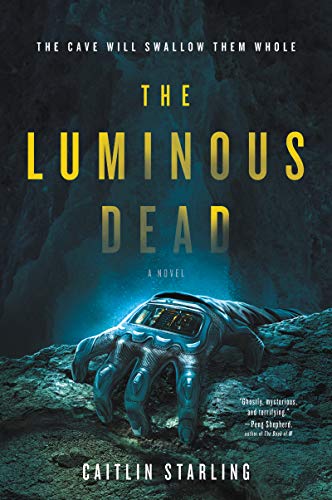
The Luminous Dead
Caving on a distant planet, Gyre Price expects to map mineral deposits with a trained surface crew monitoring her suit.
About
Spoiler notice: Spoilers for the premise and major early developments follow. This account avoids the ending; consult the novel itself for the complete story.
Caitlin Starling’s 2019 debut places a paid caving expedition on a distant planet at the meeting point of science fiction and psychological horror. Gyre Price accepts the job because its pay could take her off-world and help her search for her mother, who left when Gyre was young. The position is described as a mineral-mapping survey, but Gyre has falsified her qualifications to get it. She expects a trained surface crew to monitor her suit and keep her safe. Instead, her only contact is Em, a handler with her own reasons for sending Gyre into the cave. The setup quickly makes the expedition personal: Gyre has entered a place she does not understand, while the person responsible for her safety already knows she has lied.
The cave gives the novel a narrow physical frame with unusually high stakes. Gyre is alone below ground, dependent on the suit and the information sent from above; Em can influence the expedition by controlling what she tells her. In the author’s synopsis, small discrepancies accumulate: supplies are missing, the route changes, and Em’s motives become harder to read. A cave is already difficult to navigate because sight reaches only as far as a light can travel. Here, that ordinary limit becomes part of a larger uncertainty about whether the instruments and voice Gyre relies on can be trusted. The setting also resists becoming a neutral backdrop. Starling has described the cave as seeming to have its own agenda, so the environment presses on the characters as a presence, even though it remains inanimate and unexplained.
The suit makes survival concrete. It is the link between Gyre’s body and the remote surface, and it turns basic needs into matters that someone else can monitor or manipulate. Em’s willingness to use drugs and withhold information means that practical support carries a cost: every instruction may also reinforce her control. Gyre’s false credentials give Em leverage in return. That mutual vulnerability is not a simple contest between a capable explorer and an evil voice. Gyre needs the job and the connection; Em needs someone to continue the descent. Their unequal positions keep changing, but neither woman starts with complete freedom. The machinery of the expedition therefore does more than supply futuristic equipment. It shapes the characters’ choices and makes dependence, bodily autonomy and informed consent immediate questions rather than abstract themes.
The story’s tension grows from the gap between what Gyre experiences and what Em can explain. If a reading is wrong, a route changes unexpectedly or an unsettling shape appears, Gyre cannot easily test it against another person standing beside her. Em is both guide and gatekeeper, so doubt spreads through the channel that would normally settle it. The author’s description names the possibility that Gyre is not alone and asks why the cave’s signals sometimes contradict her senses. These details support several explanations without requiring the reader to choose one too early: dangerous terrain, fallible equipment, deliberate deception or something beyond the expedition’s ordinary model of the planet. Horror comes from how little certainty Gyre can secure, while the science-fiction frame keeps that uncertainty tied to specific systems and procedures.
Em’s history complicates the question of what the expedition is for. Starling’s synopsis says that more than two dozen cavers have died while Em pursued an obsessive search for her missing parents. Gyre is therefore not only trying to finish a job; she is trying to understand the human purpose behind it and what risks Em may be willing to impose on her. The author describes Gyre’s movement from refusing to die for Em’s grief toward wanting to help her, while also keeping escape and accountability in view. That change does not erase the original manipulation. It makes the relationship harder to reduce to victim and captor, because sympathy develops under isolation and dependence. The story can ask whether understanding another person changes what one owes them, even when the harm they caused remains real.
The novel’s confined cast and close focus support that unsettled relationship. A Publishers Weekly listing describes the book as a psychological battle of wills between Gyre and Em, and the author’s site notes that Gyre is the viewpoint through which Em is seen. Readers therefore encounter the handler through her instructions, omissions and apparent shifts in motive, rather than through a parallel account of Em’s thoughts. This limits what can be known, but it also makes each exchange consequential: a conversation may carry technical guidance, bargaining, intimidation and a chance at connection at once. The design resembles a pressure chamber. The cave restricts movement, the suit limits what Gyre can perceive, and the communication channel narrows her access to another person. Each boundary can be read as protection or confinement depending on who controls it.
That structure makes The Luminous Dead a useful choice for readers who want speculative technology and close character conflict to reinforce one another. Its central questions arise from the expedition itself: how much trust can a person place in someone who controls essential information, what counts as consent when survival depends on cooperation, and how should sympathy change after serious harm? The author’s cover essay calls the novel a two-character, one-setting horror story, a concise description of its deliberately limited stage. That small scale lets personal choices stay visible even as the cave and the unknown expand beyond Gyre’s light. The book’s science-fiction and horror elements are consequently joined by a shared problem: neither Gyre’s tools nor her relationship with Em can make the dark fully legible.
Book details
- Author
- Caitlin Starling
- First published
- 2019
- Series
- No series listed
- Subgenre
- Psychological horror
- Tags
- No tags for this book.
Review
Editor profile
Baby Bat
Goodreads and social links will be added soon.
- Goodreads — link coming soon
- Social media — link coming soon