
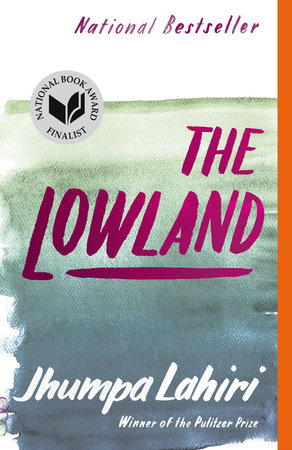
The Lowland
Born fifteen months apart, Calcutta brothers Subhash and Udayan are close in childhood but choose sharply different paths as adults.
About
Spoiler notice: Spoilers cover the brothers’ childhood, Udayan’s political involvement, and the family circumstances that bring Subhash back to India. Later revelations and the ending are not disclosed.
The Lowland begins with two brothers who grow up so close in age that people in their Calcutta neighbourhood sometimes mistake one for the other. Subhash and Udayan are born only fifteen months apart, but their temperaments pull them in different directions. Udayan is impulsive and drawn to risk; Subhash is careful, dutiful and inclined to make himself unobtrusive. Their closeness is real, yet it does not erase their rivalry or their different ideas about what a meaningful life should require. Jhumpa Lahiri builds the novel around this bond, following what happens when the brothers’ choices separate them and when an event in India brings Subhash back from the United States. The family story is personal from the outset, but it unfolds against political and geographic changes much larger than any one household.
The novel opens into the brothers’ youth in Calcutta during the 1960s, where the lowland of the title lies near their family home. Udayan becomes involved with the Naxalite movement, a radical rebellion against inequality and poverty. Subhash does not share his brother’s political commitment. He leaves India for graduate research in oceanography in Rhode Island, choosing a quieter path and a life far from the arguments and dangers shaping Udayan’s days. Lahiri presents the contrast without reducing it to a simple contest between courage and caution. Both brothers act from convictions about what is possible and what they owe themselves, and both decisions alter their relationship. Their shared childhood remains present even as their surroundings and purposes diverge.
In America, Subhash must make a life in a place whose habits and landscapes differ from those he left. His research gives him a clear pursuit, but distance does not dissolve his ties to Calcutta. News from Udayan reaches him across a gap in experience, while the brothers’ parents remain part of the obligations that bind them. The novel gives attention to the ordinary work of establishing a home abroad as well as the larger decision to leave: learning new routines, forming relationships and deciding which parts of the old life can travel. Rhode Island becomes a second setting rather than a clean break. Subhash’s independence is complicated by his continuing attachment to a family whose members are moving through sharply different circumstances.
Udayan’s marriage to Gauri adds another relationship to the brothers’ already unsettled bond. Gauri is not simply a figure between two men: the novel attends to her own perspective, her education and her place within a family structured by expectations. Her marriage draws her into the Mitra household, where loyalties and authority are shaped by age, gender and grief. Lahiri follows the pressures that can make a household feel both protective and constraining. The characters’ private decisions take place within customs and expectations that do not affect everyone in the same way. Through Gauri, the novel widens beyond the brothers’ competing paths and asks how a woman’s freedom can be shaped by marriage, family duty and the narrow space available for self-determination.
A tragedy in Calcutta changes the brothers’ story and draws Subhash back to the family home. He hopes to help a shattered family and address the wounds Udayan has left behind. His homecoming brings him into a life closely bound to his brother’s, including a relationship with Gauri that carries its own difficult history. The novel’s emotional tension grows from the collision between affection, responsibility and loss. Subhash must decide what care can mean after absence, while Gauri’s position in the household changes under the weight of what has happened. The past cannot be set aside simply because he has crossed an ocean; family obligations follow him into the future he tries to build.
The narrative stretches across generations and between India and America, allowing the consequences of choices to emerge gradually. Lahiri shifts attention among characters and periods, revisiting events as family members understand them differently. This structure makes memory part of the action: what is known, withheld or misunderstood shapes the present as strongly as events unfolding in it. Political upheaval is not merely a backdrop. The characters’ lives are altered by forces they cannot control, while their responses remain intimate and particular. The book’s broad historical frame therefore stays connected to specific ties between siblings, spouses, parents and children. Its scale comes from watching those relationships carry the effects of change across time and distance.
The Lowland is a family novel about the cost of loyalty and the limits of what one person can repair for another. Subhash’s departure and return, Udayan’s commitment to revolution, and Gauri’s effort to live within an altered family each raise a different question about duty. The story does not treat love as a guarantee of understanding: people can care for one another and still misread, injure or abandon each other. Nor does it make political conviction separate from domestic life; public choices reverberate in the home. Lahiri keeps the brothers’ relationship at the centre even as the story expands to include later generations. The result is a novel about how a family carries its past, and how far its members can move beyond the roles and losses that shaped them.
Book details
- Author
- Jhumpa Lahiri
- First published
- 2013
- Series
- No series listed
- Subgenre
- Family saga, Family novel, Immigrant fiction
- Primary genre
- Literary Fiction
- Tags
- No tags for this book.
Review
Editor profile
Baby Bat
Goodreads and social links will be added soon.
- Goodreads — link coming soon
- Social media — link coming soon