
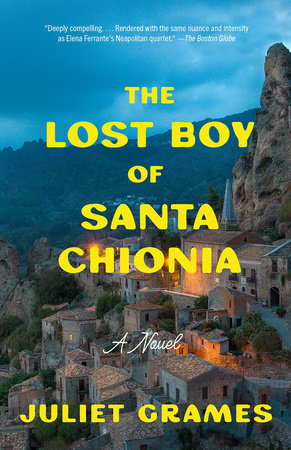
The Lost Boy of Santa Chionia
In Calabria in 1960, Francesca Loftfield, a twenty-seven-year-old American, arrives in the isolated village of Santa Chionia to open a nursery school.
About
Spoiler notice: Spoilers cover the opening setup: a flood exposes a human skeleton, the priest’s housekeeper asks Francesca to investigate whether it is her missing son, and Francesca arrives to open a nursery school. The mystery’s later revelations and ending are not disclosed.
The Lost Boy of Santa Chionia is set in Calabria in 1960, in a mountain village that is difficult to reach and strikingly short of modern infrastructure. There is no road, doctor, running water or electricity; after a flood sweeps away the post office, even the mail stops. Into this place comes Francesca Loftfield, a twenty-seven-year-old American whose idealism has brought her to open a nursery school. She expects to spend her time on a charitable project for the village’s children. Instead, the flood exposes a human skeleton, and the people around her offer incompatible explanations for who the dead person might be. From its opening arrangement, the novel places practical care and historical inquiry side by side: Francesca has a school to establish, but the village’s immediate concern is a body no one seems eager to identify.
Francesca is an outsider in more than a geographical sense. Her work gives her a reason to enter households and meet families, while her unfamiliarity with local customs makes her ask questions that residents may regard as intrusive. The priest’s housekeeper appeals to her to discover whether the remains belong to her son, who disappeared long ago. The authorities’ reluctance to investigate leaves Francesca facing a choice about how far she should involve herself. She is neither a trained detective nor an official with power; her access comes from curiosity, persistence and the relationships she forms while trying to get the nursery underway. That combination gives the mystery its particular tension. Francesca can move between people who might not otherwise confide in one another, yet being welcomed into a home does not mean she understands the rules governing it.
The village’s isolation shapes the investigation as much as the skeleton does. The publisher’s description presents a network of local families bound by silence, alongside a suspiciously charming shepherd and a landlady who takes a keen interest in Francesca. In a community where people depend on one another, information is not neutral: a question can challenge a family’s account of its past or unsettle arrangements that have helped keep daily life intact. The novel’s puzzle therefore extends beyond the identity of the dead person. It asks who is willing to speak, whose version of events carries weight and what an outsider can learn from a place where reticence may be a form of protection.
Francesca’s nursery-school mission gives her a second purpose and a distinct way into village life. She is not arriving solely to solve a crime; she has been entrusted with creating something for the children. That work asks her to consider the future of a community where material conditions are harsh and opportunities are limited. At the same time, the mystery pulls her toward earlier generations and the consequences of choices made before she arrived. The two strands put pressure on one another. Francesca’s charitable role may open doors, but it also raises the question of what she owes to the families whose trust she needs. Her wish to help cannot guarantee that her presence will be welcomed or that her questions will produce a simple good. The publisher frames her as having to choose between the mission that brought her to Santa Chionia and her own future happiness, as well as between truth and survival.
The title’s “lost boy” points toward the human history concealed in the mystery, while the fuller setup broadens the question beyond a single disappearance. The housekeeper’s plea connects the newly exposed bones to a son who went missing, but the publisher’s description also refers to three missing men. That contrast creates a puzzle with several possible histories behind it. The account does not reduce the residents to witnesses waiting for Francesca to solve everything: families have their own loyalties, and local silence has a context. The novel’s crime-story framework lets those histories surface gradually, while its attention to Francesca’s work and choices keeps the central character’s life in view. Its suspense grows from both the uncertainty surrounding the remains and the social cost of asking what happened.
Santa Chionia is presented as a specific place in southern Italy, not as a picturesque escape from the concerns of the plot. The village sits amid Calabria’s rugged landscape, with old traditions and contemporary deprivation shaping its routines. The publisher also identifies the presence of a powerful criminal syndicate in the region, an element that raises the stakes of Francesca’s questions without turning the setting into a generic danger zone. The local families, the church, village authority and the newcomer’s charitable assignment all intersect in a small social world. This lets the mystery examine power at a close scale: who can withhold an answer, who can expect to be believed and who bears the consequences when buried events are brought back into view. Francesca’s American perspective matters because she can notice the arrangements that residents take for granted, though her outsider status also limits what she can understand.
The book combines a puzzle mystery with a romance and a story about a young woman searching for a meaningful life. Those elements meet through Francesca’s growing attachment to the people and place she came to serve. Her questions may help uncover what happened, but they also alter her relationship to the village and to the future she imagined for herself. The result is a story whose suspense comes from more than the solution to a crime: it also depends on the risk of asking questions in a closed community and the uncertain value of doing good when a person does not know the full history of those she hopes to help. The Lost Boy of Santa Chionia follows Francesca as she tries to make a school, understand the skeleton’s connection to the missing men and decide what kind of life she wants, with later turns and the ending left undisclosed here.
Book details
- Author
- Juliet Grames
- First published
- 2024
- Series
- No series listed
- Subgenre
- Historical mystery, Literary historical fiction
- Primary genre
- Mystery & Thriller, Historical Fiction, Literary Fiction
- Tags
- No tags for this book.
Review
Editor profile
Baby Bat
Goodreads and social links will be added soon.
- Goodreads — link coming soon
- Social media — link coming soon