
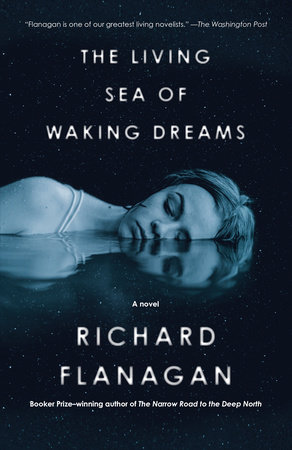
The Living Sea of Waking Dreams
As her mother Francie lies dying in hospital, Anna and her siblings struggle over how to care for her.
About
Spoiler notice: Spoilers cover Francie’s decline, her children’s disagreement over treatment, Anna’s missing finger and knee, and the widening pattern of disappearances. Later developments and the ending are withheld.
Anna’s mother, Francie, is dying in hospital, but her children’s love takes the form of repeated medical interventions that keep her alive when she is ready to let go. Their decisions turn an intimate family crisis into a question about care: what does it mean to protect someone when protection prolongs suffering? The novel begins close to the ordinary pressures of visiting, worrying and deciding, while the hospital window offers Francie another kind of attention. Beyond it is a world in which beauty and catastrophe sit side by side. Richard Flanagan keeps both scales in view: the family’s effort to hold on to one person and the wider disappearance of a natural world that the people around them struggle to notice.
The story centres on Anna and her siblings as they respond to their mother’s illness. Their different reactions shape the strain of caring for Francie, whose readiness to die conflicts with the children’s difficulty in accepting her loss. Flanagan drew the family conflict from a story about relatives refusing to let a dying person go, and the novel gives that conflict room to remain painful rather than easy to settle. Pity can become another way of overriding the person it means to help. That tension makes the hospital scenes more than a backdrop for a surreal plot: decisions about treatment, visits and attention test how well a family can listen to an older person when fear and affection are tangled together.
Anna’s own body begins to change in a way that no one around her seems able to register. First a finger disappears; later, a knee is gone. These impossible losses draw her toward the window and unsettle the boundary between what can be explained and what is happening. The people she sees around her also appear to be vanishing, but the world continues as if nothing has changed. Flanagan has described the book as a fable set in the present, using an absurd and comic premise beside the concrete experience of a mother dying in hospital and bushfires outside. The strange events do not replace reality. They give its ordinary failures of attention a visible, bodily form.
The novel’s Australia is recognizable and threatened by fire. Its ecological pressure is present in smoke, burning landscapes and the growing absence of species, including the orange-bellied parrots that the publisher names among the book’s concerns. Flanagan has spoken about writing in response to the sense that animals, birds, fish and places he loved were close to vanishing. In the story, that loss surrounds the family without turning into a separate lecture or subplot. The private and public crises meet through a shared problem of looking away. Francie’s children struggle to face the reality of her decline, while people outside Anna’s family fail to see what is disappearing around them. Attention becomes an ethical act as well as a way of seeing.
That connection gives the novel a wider frame than the family’s immediate emergency. Grief reaches beyond a single household, and the possibility of ecological loss presses on the same questions of time, care and what can still be saved. The book does not make the two situations identical: an ageing woman in hospital and species under pressure have different histories and needs. Instead, it places them within a shared atmosphere of urgency and denial. Anna’s vanished body parts are uncanny, while the fires and species loss belong to the world outside the fable. The contrast lets the novel move between the familiar and the impossible without asking readers to mistake one for the other. The effect is to make everyday life feel unstable, as if the ground of what people count as normal is already shifting.
Kindness, gratitude and the natural world also shape the book. Those ideas sit beside fear and absurdity, rather than smoothing them into reassurance. A hospital window can open onto visions of horror and delight; a family can act out of love and still hurt one another; a disappearing landscape can provoke grief while remaining beautiful. The novel allows these responses to coexist. Its title evokes a sea of dreams, yet its concern with dreams does not remove it from the present. The story’s fable-like turns make space for meanings that realistic description alone might miss, while its family and hospital settings keep the emotional stakes grounded in particular people and choices.
The result is a literary novel about mortality, family duty and attention, told through an increasingly uncanny version of contemporary Australia. It asks how people live alongside endings they cannot control, whether the ending belongs to a parent, a relationship or a changing natural world. Flanagan does not reduce the book to an answer about what hope requires. Instead, he lets comic strangeness, sorrow and tenderness rub against one another, asking what people might see if they looked more carefully at the lives and places around them. Its vanishing body parts and fable-like movement join family grief with the larger sense of a world slipping from view.
Book details
- Author
- Richard Flanagan
- First published
- 2020
- Series
- No series listed
- Subgenre
- Literary fiction, Climate fiction, Family novel
- Primary genre
- Literary Fiction
- Tags
- No tags for this book.
Review
Editor profile
Baby Bat
Goodreads and social links will be added soon.
- Goodreads — link coming soon
- Social media — link coming soon