
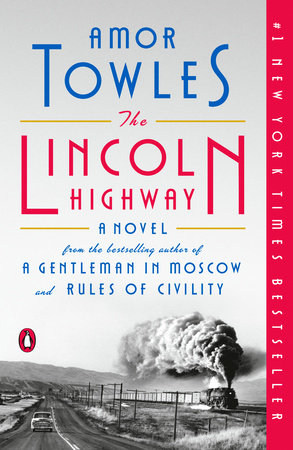
The Lincoln Highway
In June 1954, eighteen-year-old Emmett Watson returns to Nebraska after serving time on a juvenile work farm.
About
Spoiler notice: Spoilers cover the opening circumstances, the journey’s direction, and the characters’ aims; later turns and the ending are withheld.
Amor Towles begins The Lincoln Highway with a road already chosen and then immediately unsettles it. In June 1954, eighteen-year-old Emmett Watson returns to Nebraska after serving fifteen months on a juvenile work farm. His father has died, the family farm has been foreclosed, and Emmett hopes to collect his eight-year-old brother, Billy, and drive west to California. The plan sounds like a clean break from a life that has narrowed around loss and consequence. But two friends from the work farm, Duchess and Woolly, have hidden in the warden’s car and bring their own idea of where the group should go. What follows is a ten-day journey whose destination keeps changing as the four young people try to imagine futures different from the ones already prepared for them.
The change in direction gives the novel a useful tension between practical survival and the stories people tell about what comes next. Emmett is steady and capable, but responsibility for Billy makes every choice heavier: he is not simply deciding what kind of life he wants, but what kind of life he can build for someone else. Billy, younger and more observant than his age might suggest, sees the adults and their plans through a mixture of curiosity and faith. Duchess moves with confidence and theatrical instinct, while Woolly’s gentler manner and complicated circumstances make his hopes feel especially fragile. Towles gives the group distinct temperaments, so the question of the road is never only geographical. Each character understands freedom, loyalty, and a fresh start differently.
The novel’s structure turns those differences into form. Its action spans only ten days, yet chapters move among several perspectives and allow memory, expectation, and present events to sit beside one another. Towles also varies the narrative voice: some sections stay close to a character, while others give that character room to tell a story directly. The effect is less like following a single driver along a straight highway than like looking at the same landscape from several windows. Details that seem incidental to one person may carry a different weight for another. The shifting viewpoints also invite readers to notice how storytelling works inside the plot: people interpret their circumstances through inherited tales, remembered examples, and the versions of themselves they hope others will accept.
That interest in stories connects the travelers’ private ambitions to the broader American mythology of self-reliance and reinvention. Emmett’s father leaves behind an Emerson quotation, and the novel asks what independence means when people are shaped by family, debt, accident, and obligations to one another. The country the characters cross is associated with movement and possibility, but movement alone does not erase the past. The road’s promise is therefore double-edged: it can open new options while also revealing how much each person carries. Set in the mid-1950s, the book places this group on the edge of adulthood in a period whose social assumptions differ from the present. Their decisions belong to their moment, while their questions about inherited expectations and self-definition remain recognisable.
Money and moral accounting give the journey a material counterweight to its expansive language of possibility. Characters have to reckon with resources, obligations, and the consequences of earlier choices; what is owed cannot always be reduced to a sum. Towles’s reading guide points readers toward questions of debt and recompense, transgression and atonement, and toward the ways family legacies can help or constrain the next generation. The novel’s movement between misadventure, reflection, and comedy lets these concerns surface without turning the book into an abstract argument. Its scale is generous, populated by people encountered beyond the central group and by settings that widen the journey’s view of America. A short encounter can alter the meaning of a place or expose a blind spot in a character’s account of events. Such episodes broaden the social world without losing sight of the four travelers, whose different versions of what has happened complicate any single explanation. The journey is shaped as much by interpretation as by distance: people carry accounts of past choices with them, and those accounts influence what they believe they owe others. Storytelling becomes part of the book’s ethical texture, rather than ornament around the adventure. Yet its central pressure stays intimate: how should a person act when the future depends partly on decisions made before that person had much say in them?
The Lincoln Highway is the third novel by Towles, following Rules of Civility and A Gentleman in Moscow, but it gives its story a different engine: a compact span of days, an unsettled itinerary, and several young people trying to author the lives ahead of them. The title calls to mind a famous cross-country route, though the book’s road narrative is not a simple westward escape. Its title and changing course sharpen the gap between an imagined destination and the complicated trip required to reach any new beginning. Towles balances carefully arranged plotting with digressions into memory and narrated tales, creating a novel interested in both forward motion and the ways people pause to explain themselves. First published in 2021, it brings questions of chance, responsibility, family inheritance, and reinvention together in a journey whose most important turns are also choices about what kind of future can be shared.
Book details
- Author
- Amor Towles
- First published
- 2021
- Series
- No series listed
- Subgenre
- Literary fiction, Historical fiction
- Primary genre
- Literary Fiction, Historical Fiction
- Tags
- No tags for this book.
Review
Editor profile
Baby Bat
Goodreads and social links will be added soon.
- Goodreads — link coming soon
- Social media — link coming soon