
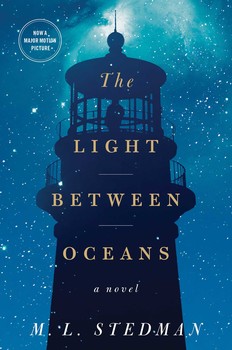
The Light Between Oceans
In 1926, former soldier Tom Sherbourne takes a lighthouse post on remote Janus Rock, where he and his wife Isabel live far from the mainland.
About
Spoiler notice: Spoilers below for the novel’s opening premise and the couple’s decision to keep Lucy; the later resolution is not disclosed.
The Light Between Oceans begins in 1926, when Tom Sherbourne returns to Australia after four years on the Western Front and accepts work as the lighthouse keeper on remote Janus Rock. The island lies nearly half a day from the coast, and its supply boat comes only once each season. Tom has reasons to value distance, routine and a place where he can do a defined job. During a stop in a coastal town, he meets Isabel, whose energy and directness draw him into a life he had not planned. They marry and make their home beside the lighthouse, where the nearest human company is far away and the sea supplies the measure of their days.
Janus is more than a scenic backdrop. Keeping the light means tending a system that must work while weather, distance and darkness press in around it. Tom approaches the island through care and responsibility: he watches, records and maintains what has been entrusted to him. Isabel makes the place intimate, mapping it with names of her own and imagining a shared world within its boundaries. Their habits fit together for a time, but their different ways of seeing the island matter. To Tom it is a post he must faithfully keep; to Isabel it is a home in which they might begin again. The remote setting gives that hope room to grow, while limiting the number of voices that could challenge it.
Years pass, and Isabel suffers two miscarriages and a stillbirth. Then a small boat comes ashore carrying a dead man and a living baby girl. Tom wants to report both immediately. Isabel, grieving and overwhelmed by the possibility of the child, asks him to wait. The couple eventually keep the baby and name her Lucy. That decision is the novel’s hinge: an act that feels like rescue inside the island’s sealed world also creates obligations beyond it. The situation is stark without being simple. A vulnerable infant needs care, the adults have different convictions about what should happen, and the absence of immediate witnesses gives the couple time to tell themselves what their choice means.
Tom’s instinct to document events and follow rules grows from more than a tidy temperament. His experience of war has left him with memories that make responsibility difficult to set aside, even when he would prefer not to revisit the past. Isabel’s grief pulls in another direction: she can see the baby as a chance to hold the family she has longed for. Their disagreement is not staged as a contest between a heartless rule follower and a selfish dreamer. Each response grows from a history the other cannot entirely share, and each is bound to love for the same child. The tension comes from seeing how care and duty can point toward different actions, and how a choice made out of need can carry costs for people outside the room.
Isolation gives the decision time to settle into daily life. On Janus Rock, the couple can return to the routines of the lighthouse and the intimate world they have built around Lucy. But routine cannot make the child’s arrival an event that belongs only to them. When Tom and Isabel eventually return to the mainland with her, their choice meets a community and a past that were absent from the island. Stedman uses that movement from the offshore station toward other people to widen the story’s moral field. What first appears to be a private solution is connected to families and losses beyond the couple. The consequences grow from a human bond that is real, even as the means of forming it remain contested.
The novel’s postwar setting shapes Tom’s sense of what can and cannot be left behind. He wants distance from the violence he witnessed, but the habits that help him keep the lighthouse also shape his response when another difficult duty appears. Isabel, too, carries a past into the island, though the story gives particular force to the future she believes may still be possible. Their marriage becomes the place where those different relationships to memory meet. The book asks what happens when two people who love one another understand an act in incompatible ways, and whether affection can make a decision right. It leaves space for sympathy without offering an easy formula for who deserves it.
Across its lighthouse, ocean and mainland settings, The Light Between Oceans links physical distance with the limits of private judgment. Light must reach beyond the keeper’s immediate view, while the people on Janus Rock can see only so much of the lives around them. That contrast gives the title a quiet structural role in a novel concerned with what is visible, what remains hidden and what changes when a private story enters public life. Readers drawn to historical fiction about marriage, grief and responsibility will find those questions joined to a sharply defined coastal world. The central dilemma is not solved by choosing one abstract principle; it asks what care requires when every available answer affects someone who matters.
Book details
- Author
- M. L. Stedman
- First published
- 2012
- Series
- No series listed
- Subgenre
- Historical fiction, Literary historical fiction
- Primary genre
- Historical Fiction, Literary Fiction
- Tags
- No tags for this book.
Review
Editor profile
Baby Bat
Goodreads and social links will be added soon.
- Goodreads — link coming soon
- Social media — link coming soon