
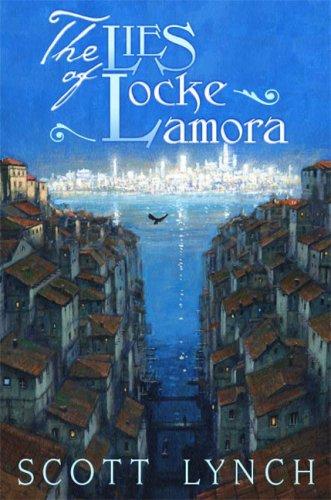
The Lies of Locke Lamora
Camorr is a canal city built on the ruins of an older civilisation, where the capa in charge keeps the peace and takes a cut of everything.
About
Spoiler notice: Full-book spoilers below, including major deaths, revelations and the ending.
Camorr is a city where an impressive view and a dangerous business proposition can be much the same thing. Canals carry its wealthy residents between entertainments, while criminals operate beneath a political order that has found ways to accommodate them. Stranger still are the Elderglass structures left by an older civilisation: the people occupying the city have inherited wonders they cannot fully explain. Scott Lynch places his thieves inside this inhabited mystery rather than sending them to solve its ancient origins. The adult Locke Lamora is already an accomplished confidence artist, surrounded by companions who can make an invented identity look thoroughly respectable. Childhood chapters interrupt the adventure, showing how this particular group learned its trade. Knowing the preparation makes their apparent improvisations more interesting, especially once somebody else begins arranging the circumstances in which they must perform.
Locke's most useful talent is understanding what another person wants to believe. He is much less equipped to survive a straightforward physical contest, which makes Jean Tannen essential to the gang without reducing Jean to hired muscle. Jean combines formidable fighting ability with a quieter temperament and an education of his own. Their relationship belongs to a household created by Father Chains, whose outward religious identity conceals service to the Crooked Warden, the thieves' god. Calo and Galdo Sanza supply their own practiced skills, and the younger Bug is learning to work alongside them. Locke's confidence often becomes arrogance, especially when abandoning a beautiful scheme would mean admitting that someone has beaten him. That weakness matters as much as his ingenuity. The criminals threatening his family are capable of using attachment and vanity with precisely the ruthlessness he usually reserves for a target's greed.
The Salvara confidence game demonstrates how much work goes into making a lie feel accidental. Locke becomes Lukas Fehrwight, a merchant whose profitable cargo supposedly needs help escaping approaching trouble in Emberlain. A staged attack lets Don Salvara rescue him, placing the nobleman in the flattering position of benefactor before business is discussed. Real political danger supplies credibility to the invented transaction. Locke then adds another disguise, visiting Salvara as a supposed secret policeman who warns him that Fehrwight is a fraud. The instruction to cooperate with the investigation includes continuing to hand over money, so even apparent discovery strengthens the swindle. Earlier chapters show where that discipline came from: Chains teaches manners, languages and practical skills, but also makes the young Locke confront the deaths caused by his own manipulation of other orphans. Cleverness already has consequences before the adult plot starts.
A rule called the Secret Peace is meant to keep that kind of trouble within limits. Capa Barsavi commands the criminal world, while nobles and the city watch receive protection from the gangs' interference. Locke's lucrative noble targets therefore make his success a concealed violation of the arrangement, not an achievement he can honestly report to his own crime boss. The Grey King attacks this supposedly stable order by killing gang leaders, and employs a Bondsmage whose scorpion hawk can watch people who think themselves unobserved. He forces Locke into a role in his confrontation with Barsavi. The pressure also exposes how vulnerable the Bastards' independence has always been: they possess money and elaborate disguises, but none of the institutional power keeping the city running. Refusing to abandon the Salvara scheme leaves Locke trying to manage two incompatible performances at once.
The childhood passages give Jean's loyalty a history rather than treating it as a convenient resource. He enters Chains's household after losing his parents, and his developing friendship with Locke includes awkwardness, cruelty and reconciliation. Training makes Jean dangerous, but those earlier scenes establish the person beneath that reputation. In the present, the Grey King's murder of Barsavi's daughter Nazca makes Locke's imposed impersonation especially perilous. He must appear at a meeting as the man Barsavi wants dead, while finding a way around Barsavi's competing demands on his attendance. The promised magical protection proves horribly inadequate: protection against certain weapons does not prevent a beating. Barsavi has Locke shut inside a filthy cask and sent into an underground channel. The elaborate playacting has ended in an immediate bodily danger that no persuasive story can make disappear.
Jean and Bug rescue Locke, but getting home does not restore the household. Calo and Galdo have been murdered, and Bug is killed during the confrontation with the men left behind. Burning their ruined home becomes an act of grief as well as concealment. Meanwhile, the Salvaras have taken their concerns to the real intelligence apparatus: the Spider, whose involvement threatens to turn Locke's false-police story into an actual arrest. The Grey King engineers another bloody spectacle, destroying Barsavi's leadership and assuming authority as Capa Raza. Camorr's entertainment and criminal government now overlap in a public transfer of power. Locke has lost the people for whom his accumulated wealth had meaning, yet still has to negotiate schemes that were already moving before the murders. The plot's shift into revenge grows out of those losses, with Jean remaining the person whose survival can still change what Locke chooses.
Raza is Luciano Anatolius, whose family was destroyed under Barsavi's protection system, and his revenge extends beyond replacing the crime boss. Statues presented to the Duke conceal Wraithstone, intended to strip the assembled nobles of their identities. Locke exposes the danger, and leaves the defeated Bondsmage alive to avoid the guild's fatal retaliation. His confrontation with Raza is far less elegant than his cons: badly outmatched, he creates an opening by pretending Jean has arrived. The deception lets him kill his opponent, but does not restore the Bastards or their home. The Spider permits the survivors to leave Camorr on condition they stay away. Locke and Jean depart with the bond between them intact and much else destroyed. Even Locke's name remains a private matter; he confides it to Jean without revealing it to the reader. Survival closes this adventure, while leaving the partnership room to continue elsewhere.
Book details
- Author
- Scott Lynch
- First published
- 2006
- Series
- Gentleman Bastard, book 1
- Subgenre
- Sword and sorcery, Epic fantasy
- Primary genre
- Fantasy
- Tags
- No tags for this book.
- Reading order
- This is the only Gentleman Bastard title on the shelf right now.
Review
Editor profile
Baby Bat
Goodreads and social links will be added soon.
- Goodreads — link coming soon
- Social media — link coming soon