
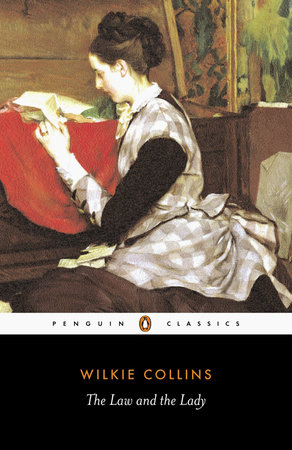
The Law and the Lady
Newly married Valeria discovers that her husband has concealed his name and a Scottish murder trial over his first wife’s death.
About
Spoiler notice: Full-plot spoilers, including Sara Macallan’s confession, the recovered letter and Eustace’s final decision.
Valeria Brinton enters marriage believing that she knows the man whose name she is taking. Almost immediately, small irregularities begin to disturb that confidence. Her husband’s behaviour during their honeymoon, and the difficulty surrounding his mother, suggest a history from which she has been excluded. Wilkie Collins’s The Law and the Lady, published in 1875, gives Valeria the task of pursuing that history herself. The discovery that Eustace Woodville has married her under an assumed surname is only the beginning. He is actually Eustace Macallan, and knowledge of his name brings her into contact with a public accusation that has already changed his life. What began as a private misunderstanding becomes an investigation into a death that occurred before she knew him.
Eustace’s first wife died by poisoning at Gleninch, his Scottish home, and he was tried for her murder. The jury returned the verdict Not Proven. Within the novel, that outcome leaves him free but burdened by suspicion, unable to feel that the proceedings have restored his standing. Valeria learns about the trial after the wedding, having been denied the opportunity to consider the history before marrying him. Eustace’s response to her discovery is withdrawal. She refuses to let that withdrawal settle their future or to accept the unresolved accusation as the final account of his life. Her determination depends on believing his innocence, but belief alone cannot answer the evidence that once brought him before a court. She has to find something the earlier investigation missed.
Reading the trial report gives Valeria a way into a household she never witnessed. Testimony records the death, the people present and the suspicions attached to Eustace, yet it also shows how much remains open to interpretation. Her inquiry moves between documents, conversations and visits, with Benjamin and the lawyer Mr Playmore offering assistance. Advice does not always encourage the course she wants to take, and she must decide when to persist against it. Gleninch becomes a physical place to examine as well as the setting of a printed account. Collins builds the investigation around the labour of returning to apparently settled information: a familiar witness may still have something unspoken, and an ordinary domestic detail may carry a significance that the trial did not establish.
Miserrimus Dexter is a particularly difficult source. He knew the first Mrs Macallan and had been Eustace’s friend, but his involvement is compromised by his own feelings and concealed conduct. The knowledge he offers cannot be separated from his wish to control what Valeria believes. Her suspicions about Mrs Beauly give him an opportunity to direct attention towards someone he dislikes. As his condition deteriorates, his speech becomes harder to interpret, yet words that seem confused provide a route towards a missing document. Benjamin’s record of those words matters because it allows others to examine them afterwards. The investigation requires more than persuading Dexter to speak: it requires recognising what his account conceals, preserving what he says and testing it against evidence beyond his control.
The search eventually reaches the dust-heap at Gleninch. An inquiry into the clearing of the bedrooms establishes that torn papers from Dexter’s room were emptied there, along with other refuse. Benjamin and his colleagues undertake the unglamorous work of finding and reconstructing the fragments. A bottle of gum, used by children during the earlier cleaning, has accidentally kept some pieces together. A skilled assistant separates and arranges the writing, while Playmore identifies the first wife’s hand. That recovery gives the mystery a concrete answer. Sara Macallan’s letter describes her decision to take poison after reading her husband’s diary, which Dexter had secretly made available to her. The document establishes suicide, overturning the accusation that Eustace administered poison to kill her, while exposing the suffering concealed beneath the trial’s account.
The discovery creates a painful difficulty for Valeria. She has worked to vindicate Eustace, but the letter also records his first wife’s anguish and his own failures of affection. Reading it could injure the man she wants to protect. In distress, she burns the copy sent to her; the original survives. Playmore’s later explanation distinguishes Dexter’s concealment from directly causing death by poisoning, and considers how his jealousy, vanity and fear affected his actions. Some of that explanation remains the lawyer’s interpretation of motives, rather than a confession covering every point. The practical decision concerns the surviving letter. It can preserve the evidence of Eustace’s innocence without requiring Valeria immediately to expose its contents to him or to the public.
After their return to England and the birth of their son, Valeria gives Eustace the choice. He knows that evidence vindicating him has been found, but the confession remains sealed. Rather than open it and pursue public vindication during his lifetime, he leaves it beneath the baby’s hand, entrusting its future to the next generation. Their reconciliation therefore closes without a new courtroom verdict. Elsewhere, the ending records Dexter’s death and the death of Ariel on his grave after she escapes the institution where she has been staying. Those losses remain part of the cost of the history Valeria uncovers. Her investigation answers the question of how Sara died, while the final family scene asks what compassion requires once the answer is known.
Book details
- Author
- Wilkie Collins
- First published
- 1875
- Series
- No series listed
- Subgenre
- Literary fiction, Modern classics
- Primary genre
- Literary Fiction
- Tags
- No tags for this book.
Review
Editor profile
Baby Bat
Goodreads and social links will be added soon.
- Goodreads — link coming soon
- Social media — link coming soon