
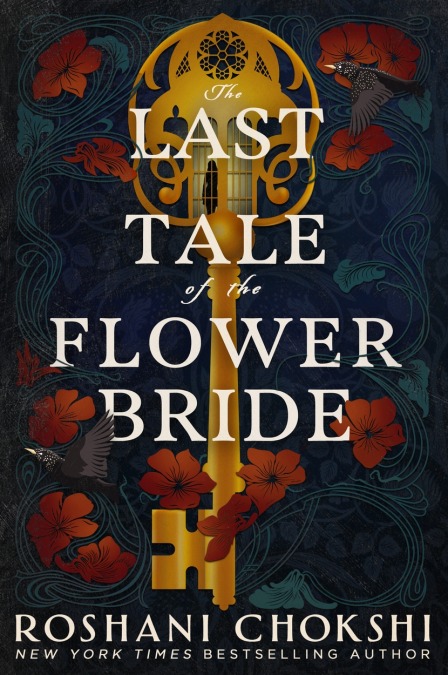
The Last Tale of the Flower Bride
A fairy-tale-loving bridegroom marries the mysterious Indigo Maxwell-Casteñada, agreeing never to pry into her past.
About
Spoiler notice: This account covers the marriage bargain, the return to the House of Dreams and the book’s opening fairy-tale framing. It does not disclose what happened to Azure or reveal the novel’s ending.
The Last Tale of the Flower Bride begins with a marriage built around a limit. The Bridegroom, a man who believes in fairy tales, agrees not to investigate the past of Indigo Maxwell-Casteñada, the mysterious woman he loves. Their arrangement sounds like a private condition between spouses until they return to Indigo’s childhood home and the absence of her friend Azure becomes impossible to ignore. Roshani Chokshi frames that movement from wedding promise to family history as a Gothic problem of knowledge: what does intimacy mean when one partner has promised not to ask? The novel keeps the question close to fairy-tale patterns, where a rule may protect a secret, test devotion, or make curiosity dangerous.
The opening excerpt gives the Bridegroom a scholarly approach to those patterns. He is preparing a speech about Melusine, a legendary woman whose husband loses her after spying on her against an agreement. The parallel is not a simple answer to the novel’s mystery; it is a story inside the story that gives the reader a way to think about looking, trust and the consequences of wanting a complete account of another person. Chokshi’s narrator does not introduce fairy tales as harmless ornaments. They are arguments about desire and power, and the Bridegroom studies them just as his own marriage begins to turn on a forbidden question.
That question becomes urgent when Indigo and the Bridegroom go back to the House of Dreams. Indigo’s aunt, the woman who raised her, has fallen ill; the journey therefore carries a family obligation as well as the pull of the past. The couple find themselves in a manor whose rooms are associated with Indigo’s childhood and with Azure, her beloved friend who disappeared. The Bridegroom has made a promise to his wife, but the house gives that promise a new pressure: his curiosity is directed at the life that formed the person beside him. The story tests whether care can be separated from investigation when the person one loves refuses to explain what came before.
The House of Dreams is more than a route back to a missing person. A family house holds versions of its inhabitants: the child Indigo was, the woman she has become, and the memories other people attach to her. Its extravagant rooms make an appropriate Gothic frame for a story in which wealth and beauty can conceal as much as they display. The house’s suggestive name also sets a threshold between ordinary recollection and the fairy-tale way the characters understand what happened there, without requiring the reader to decide that every uncanny feeling is literal magic. That setting makes the Bridegroom’s wish to know Indigo feel less like an abstract principle and more like an intrusion into a place she has kept from him.
Azure’s disappearance links the marriage plot to the girls’ earlier lives. She was Indigo’s beloved childhood friend, and their bond is one of the novel’s central relationships. The book moves between the Bridegroom’s present-day effort to understand his wife and the friendship that preceded him; that structure lets the same person appear in different contexts without turning either version into the final authority. Indigo’s adult silence matters, but so does the fact that her past involves another girl with her own place in the story. The mystery asks what is missing from the Bridegroom’s knowledge while also asking how childhood stories change when their tellers grow older.
The girls’ friendship carries the intensity of adolescence: closeness can blur boundaries, while growing up threatens a shared sense that an imagined world is real. Neither girl fits neatly into a contrast between an innocent child and a dangerous one. Affection can be protective and possessive at once; imagination can provide a private language but also reinforce a version of events that excludes outsiders. The missing friend is therefore not only a clue in a marital mystery. Azure’s absence presses the characters to reckon with the unequal memories and identities that remain after a bond has changed. The past belongs to both girls, yet each might tell it differently.
The novel’s fairy-tale material works through human behavior as well as allusion. In a world recognizably like our own, charisma, manipulation, imagination, faith and desire can seem magical without resolving every uncertainty into a supernatural rulebook. Ordinary acts of withholding, persuasion and belief feel enchanted because they shape what another person is able to know. The Gothic atmosphere gathers around those acts. Even before the Bridegroom decides whether to keep his promise, the story has shown how a relationship can be organized by what is said, what is withheld, and which version of the past becomes persuasive. That uncertainty gives the fairy-tale language its force: the characters may live in the ordinary world, but their choices carry the weight of a spell.
Bluebeard’s familiar forbidden-room pattern has been turned around: Indigo controls the knowledge, while the Bridegroom faces the temptation to break the rule. He remains unnamed, like the wives whose identities often disappear behind Bluebeard’s more famous name. This frame shifts attention toward the person usually left without a name, while preserving the danger of a spouse who wants to enter a locked past. The result is a Gothic fairy tale about marriage and friendship whose central tension is not simply whether a secret will be exposed. It is whether knowing someone can ever be the same as possessing the whole story.
Book details
- Author
- Roshani Chokshi
- First published
- 2023
- Series
- No series listed
- Subgenre
- Gothic horror, Psychological thriller, Fairytale retelling
- Primary genre
- Horror, Mystery & Thriller
- Tags
- No tags for this book.
Review
Editor profile
Baby Bat
Goodreads and social links will be added soon.
- Goodreads — link coming soon
- Social media — link coming soon