
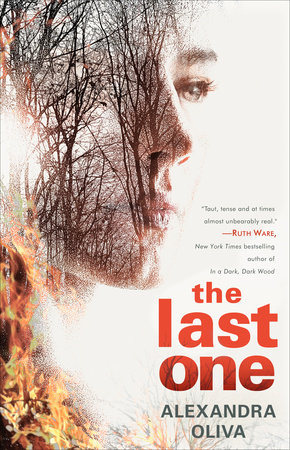
The Last One
Zoo joins a wilderness reality show for one last adventure before beginning a new life with her husband.
About
Spoiler notice: Spoilers for the reality-show premise, Zoo’s discovery of apparent devastation, and the novel’s central survival situation; the ending and final outcome are not disclosed.
Alexandra Oliva builds The Last One around a problem of interpretation: what does a person believe when the world keeps offering explanations that may be false? The novel opens with a television production designed to make wilderness survival entertaining. Twelve contestants enter a remote setting for a sequence of physical and psychological challenges, and the show gives each participant a name that can be shaped into a character for viewers. Zoo, the central figure, receives her label because she works with animals. It is a neat shorthand for television, but also an early reminder that people can be reduced to whatever detail makes them easiest to recognize. The production has rules, cameras, prizes and an audience beyond the contestants’ immediate world. Those familiar parts of reality programming make the later uncertainty feel unsettling rather than abstract.
Zoo joins the show for reasons that are more personal than a simple appetite for competition. She wants one last adventure before the future she has imagined with her husband begins, and the decision carries doubts about the life she is preparing to enter. The premise makes that private uncertainty part of the wider survival question. At first, Zoo and the other contestants understand their hardship as a controlled experience: tasks have goals, the production crew can intervene, and what happens in the woods is still entertainment. Oliva’s alternating structure places this televised strand beside Zoo alone on what she believes is an extended solo challenge. Readers see the group’s early days and the solitary journey in separate pieces, which encourages comparison without immediately resolving the gap between them.
The show’s challenges are concrete and bodily. Contestants track animals, filter water, manage hunger and test what they can tolerate, while prizes and competition give those tasks a performative edge. The wilderness is both a real environment and a set chosen for an audience. Zoo’s work at a wildlife sanctuary gives her some familiarity with animals, yet that background cannot turn the experience into something fully predictable. A contest can reward ingenuity, but it also frames discomfort as a test someone has chosen to accept. The book uses that frame to ask what happens when its boundaries become unreliable. If a person believes the cameras are still recording, a strange sight can be interpreted as a producer’s trick; the same sight means something very different if the world outside has changed.
During Zoo’s solo journey, she encounters signs of devastation and tries to fit them into the show’s logic. The towns she passes appear emptied, and what looks like death can be mistaken for carefully arranged props. Rather than immediately recognizing a catastrophe, she imagines the production team has constructed an elaborate scenario. That response is not presented as simple foolishness: the show has trained her to expect artificiality, hidden planning and a reveal. Meanwhile, the reader has more information about the scale of events than Zoo does, so dramatic irony gathers with each new discrepancy. Oliva makes uncertainty a survival hazard. Zoo must decide whether to trust her senses, the explanation supplied by the game, or the possibility that neither is enough.
The novel’s form supports this tension. The narrative shifts between the contestants’ time on the program and Zoo’s later isolation, while other material widens the perspective beyond her immediate experience. That structure makes the story’s account of events feel mediated, as if it has passed through several versions before reaching the reader. Reality television is already a process of selection: people behave in front of cameras, editors shape footage, and viewers form judgments from what they are shown. Oliva carries that concern into the post-apocalyptic setting. What is recorded, omitted or discussed online can influence how people understand both the contestants and the crisis. A Reddit-like forum, noted by Kirkus, adds a public layer in which spectators interpret what they can see, with incomplete context.
Zoo’s physical route and emotional direction are tied together. As her strength declines, she continues east toward home, holding onto the possibility of returning to her husband. The journey requires practical decisions about movement and survival, but it also forces her to reconsider what she has left behind and what she can still rely on. Her identity has already been filtered through a nickname assigned by producers; isolation gives her room to act outside the role, though it does not erase the role’s influence. The novel’s use of survival is therefore not limited to finding food or crossing distance. It includes maintaining judgment under pressure and revising assumptions when evidence no longer fits the story one has been given.
The Last One sits between wilderness-survival thriller and speculative catastrophe, using each mode to complicate the other. The apocalyptic danger gives the television premise consequences beyond ratings, while the show’s artificial conventions make it harder for Zoo to recognize what is real. Oliva also turns the setup toward identity and relationships: how people are presented, how spectators decide who they are, and how a person understands herself when familiar social structures disappear. The result is a story in which suspense comes from more than the question of what happened outside the production. It comes from watching Zoo interpret each clue without the full context available to the reader. The novel’s central tension remains sharply human: survival depends on what she can perceive, but perception itself has been shaped by a game.
Book details
- Author
- Alexandra Oliva
- First published
- 2016
- Series
- No series listed
- Subgenre
- Post-apocalyptic, Psychological thriller, Survival fiction
- Primary genre
- Sci-Fi, Mystery & Thriller
- Tags
- No tags for this book.
Review
Editor profile
Baby Bat
Goodreads and social links will be added soon.
- Goodreads — link coming soon
- Social media — link coming soon