
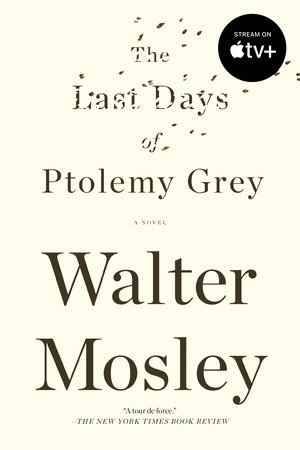
The Last Days of Ptolemy Grey
Ninety-one-year-old Ptolemy Grey lives alone in Los Angeles, surrounded by belongings that hold pieces of a past he can no longer readily reach.
About
Spoiler notice: Spoilers cover the opening caregiving change and the experimental treatment’s premise and cost. Later developments, the identity behind the family crisis, and the ending are withheld.
Walter Mosley’s The Last Days of Ptolemy Grey begins with an old man whose world has narrowed to one apartment and an uncertain present. Ptolemy is ninety-one and increasingly unable to rely on his memory. His rooms are crowded with objects from earlier parts of his life, but their presence does not make the past easy to retrieve. He has become nearly invisible to the wider world, and even familiar relatives can be difficult to place. The novel’s opening therefore makes domestic disorder more than a backdrop: it shows the distance between the long life Ptolemy has lived and the fragments of it he can reach from one moment to the next.
The apartment is in Los Angeles, and the story’s scale remains close to Ptolemy’s immediate surroundings. Everyday tasks and neglected repairs reveal how far his ability to manage alone has slipped. A radio and television keep him company, while old photographs and possessions carry histories that are not always available to him. The contrast between a crowded home and an increasingly isolated person gives the setting its particular tension. Memory is not presented as a simple storehouse that Ptolemy can open at will; his recollections arrive unevenly, and people around him may see the practical consequences before they understand what he is trying to remember.
For a time, Reggie is the relative who checks on Ptolemy and helps him navigate ordinary needs. When that support disappears, Ptolemy is left exposed to the uneven attention of an extended family. The change becomes a turning point in his daily life, but Mosley does not treat care as a problem with an easy answer. Help can restore a measure of order while also placing decisions in other people’s hands. Ptolemy’s uncertainty makes him vulnerable, yet the novel keeps his own preferences and judgments in view. His struggle is not only to receive assistance; it is to remain a person whose history and wishes still matter.
Robyn Small enters this unsettled arrangement as a teenager connected to Ptolemy’s wider family circle. She offers to look after him, and her first practical task is to make his home more livable. Cleaning brings her into contact with the accumulated evidence of Ptolemy’s past, while his attention to the work shows how closely he watches what is kept or discarded. Their relationship develops through care offered in concrete ways rather than through grand declarations. Robyn has her own limited position and uncertain prospects; Ptolemy is an older man who has become dependent on others. Their bond crosses age and circumstance without erasing those differences, and each has something to learn about what the other needs.
A doctor’s experimental treatment gives Ptolemy a difficult possibility: a return of mental clarity for a limited period, paired with a serious shortening of his life. The offer turns memory into an immediate choice rather than an abstract theme. What would a person do with a short interval in which the past becomes accessible again? For Ptolemy, the chance bears on relationships he has lost, responsibilities he still feels, and the unresolved questions attached to his family. The treatment does not restore an untouched earlier self. It creates a narrow window in which Ptolemy must decide what deserves his attention and what actions he can still take.
Mosley has described drawing on his experience of caring for his mother as she lived with dementia. In an interview about the novel, he spoke about the difficulty of communicating when a person’s knowledge and personality remain present but are harder to reach. That perspective helps frame the book’s attention to the gap between what Ptolemy understands and what he can express at a given time. The novel is fiction, not a clinical account, and its experimental drug belongs to its imagined plot. Its emotional concern lies in how other people respond to Ptolemy: whether they make room for his communication, respect his agency, and recognize a life that cannot be reduced to its current impairment.
The title points toward mortality, but the narrative’s interest extends beyond the question of how much time Ptolemy has left. His relationship with Robyn, the weight of family history, and the possibility of making a consequential choice all press on what it means to use the present. Mosley brings together intimate caregiving and suspense: Ptolemy’s revived memories connect personal feeling to unfinished matters that have consequences outside his apartment. The story asks what a person owes to the past, and what responsibility can still be accepted when time and memory are both uncertain. It keeps Ptolemy’s vulnerability visible while giving his decisions moral weight, making care and agency central to the novel’s portrait of age, memory and family. That focus makes the novel's suspense inseparable from its account of being seen and remembered. As Ptolemy tries to sort present obligations from older injuries, the people who offer help also shape which choices remain available to him. The novel gives that imbalance ethical force without making his age a shorthand for helplessness.
Book details
- Author
- Walter Mosley
- First published
- 2010
- Series
- No series listed
- Subgenre
- Literary fiction, Crime thriller
- Primary genre
- Literary Fiction, Mystery & Thriller
- Tags
- No tags for this book.
Review
Editor profile
Baby Bat
Goodreads and social links will be added soon.
- Goodreads — link coming soon
- Social media — link coming soon