
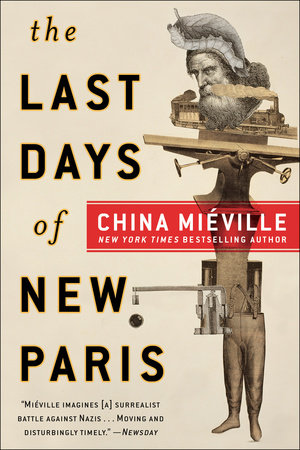
The Last Days of New Paris
In an alternate 1941, American engineer Jack Parsons encounters André Breton and a Surrealist anti-Nazi circle in Marseille; the forces Parsons helps unleash reshape the war.
About
Spoiler notice: This overview names the 1941 Marseille and 1950 Paris settings, central characters, and the S-Blast premise. It does not reveal the novella’s later discoveries, character outcomes, or ending.
The Last Days of New Paris is an alternate-history novella built around a question about art under occupation: what if Surrealist images could leave the page and enter the streets as physical forces? China Miéville sets two strands nine years apart. In 1941, American engineer Jack Parsons arrives in wartime Marseille and encounters a clandestine anti-Nazi circle that includes Surrealist theorist André Breton. In 1950, Paris remains occupied and locked in an extended war. A supernatural event called the S-Blast has changed the city, bringing “manifs”—embodied images and texts—into its streets. This is not a single continuous frontline narrative. The earlier strand shows a chain of events that helps make the later world possible, while the Paris strand follows people trying to move through the consequences.
The two periods also give the novella different kinds of pressure. Parsons’s 1941 story grows from meetings among artists, dissidents, revolutionaries, and other displaced people in Marseille. He is an outsider entering a political and artistic community whose members are responding to fascism in their own ways. The story’s occult machinery links his engineering work and interests to Surrealist practice, but the consequences exceed anyone’s control. The 1950 chapters begin after the transformation has already happened. Paris is both a city under Nazi occupation and a landscape shaped by strange living works and infernal presences. The book makes its counterfactual premise concrete by letting a change in art and imagination alter the material conditions of war.
Thibaut, the central figure in the later strand, is a Surrealist fighter associated with the Main à plume, a real historical Surrealist group that Miéville places within his invented wartime chronology. He moves through the changed city alongside Sam, an American photographer intent on recording its ruins. Their aims and loyalties do not automatically align, and Sam is being hunted. Their effort to escape takes them into a landscape where familiar distinctions—between artwork and creature, beauty and threat, political resistance and survival—are repeatedly unsettled. An exquisite corpse, at once a Surrealist collaborative practice and a figure within the story, becomes part of their uneasy company. The novella leaves room for uncertainty about what cooperation can accomplish when both the city and reality have become unstable.
The “manifs” give the alternate history its distinctive visual logic. They are not generic monsters: the book connects them to particular works by Surrealist artists and writers, and its endnotes identify many of those references. Christopher Priest’s discussion of the novella, for example, identifies appearances linked to Leonora Carrington’s drawing “I am an Amateur of Velocipedes,” Max Ernst’s “Celebes,” and the collaborative collage “Exquisite Corpse.” The source works do not all function in the same way, and recognition is not required to follow the broad premise. Still, the references make the book’s city feel like a gallery whose images have acquired agency. A familiar artwork can appear newly strange when it is no longer safely contained by a frame or a page.
That movement from image to action connects the novella’s surreal fantasy to its political setting. Miéville has described the historical Surrealists as artists and activists whose aesthetic work and opposition to fascism were bound together. In the fictional Paris, creative forms become literal participants in the conflict, but the book does not reduce art to a simple weapon with predictable results. The manifs can empower people and threaten them; they are capable of disrupting a military order without restoring ordinary life. Their presence unsettles the idea that imagination is a private retreat from politics. It also complicates the language of necessity: the characters face urgent material danger, yet the story asks what kinds of possibility remain available when cultural life is treated as expendable.
The novella’s form reflects its concern with reference and interpretation. Its two time periods fit together through cause and aftermath, while its notes point outward toward the real artworks and historical figures that feed the imagined city. Readers can follow the action without researching every allusion, but the apparatus makes looking things up part of the experience the book invites. Miéville has said he first shaped the setting with the open-world structure of a possible video game in mind; the novella retains a sense of moving through an environment full of discoveries, encounters, and dangers. Surrealist chance is important to this design: the exquisite corpse itself is associated with collaborative creation whose results no single participant fully controls. The story’s collage-like references therefore serve its ideas as well as its scenery.
The Last Days of New Paris is a compact fantasy of occupied streets, contested art, and altered history. Its central contrast is between Marseille before the S-Blast and Paris after it, not between two versions of a conventional military campaign. The 1941 strand gives the transformation its context; the 1950 strand asks how people live amid its continuing effects. Jack Parsons, Breton and the artists around them are part of the earlier setting, while Thibaut and Sam carry the later search for a way out. Across both periods, Miéville joins documented names and artworks to invented events, without presenting the result as historical fact. The book’s invitation is to consider what happens when the forms people make—poems, images, shared games—are no longer observers of conflict but forces within it.
Book details
- Author
- China Miéville
- First published
- 2016
- Series
- No series listed
- Subgenre
- Historical fantasy, Weird fiction
- Primary genre
- Fantasy
- Tags
- No tags for this book.
Review
Editor profile
Baby Bat
Goodreads and social links will be added soon.
- Goodreads — link coming soon
- Social media — link coming soon