
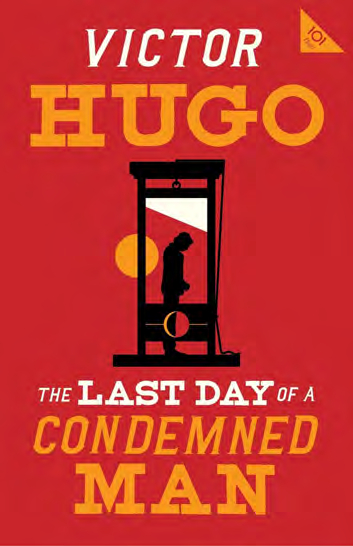
The Last Day of a Condemned Man
An unnamed prisoner records his thoughts after a court sentences him to death.
About
Spoiler notice: Spoilers: this About describes the prisoner's final day, Marie's visit, and the novella's ending at the scaffold.
Victor Hugo’s The Last Day of a Condemned Man begins after the decisive event has already taken place: an unnamed prisoner has been sentenced to death, and the knowledge of that sentence now governs every hour he records. The novel gives no name to the condemned man and never identifies the crime for which he was convicted. This deliberate absence keeps the reader outside the legal case and close to the person who must live with its result. In the opening, the narrator contrasts his former freedom of thought—memories of theatres, walks, imagined futures and ordinary pleasures—with the single thought that has taken possession of him. Five weeks have passed since his conviction, yet each new moment seems to renew the shock. Hugo makes the question of punishment immediate by restricting the story to the consciousness of someone who cannot look beyond the day fixed for his execution.
The entries move through a changing sequence of confinement and waiting. At Bicêtre, the prisoner observes the stone cell, its narrow opening, the sentinel’s watchful eyes and the routines of the gaol. He notices visitors who come to stare at him, warders whose ordinary kindness reminds him of the scaffold, and prisoners who speak in the slang of the courtyard. When a convoy of galley-slaves leaves the prison, he watches the chains, carts and armed escort, then recoils from the possibility of a sentence to the galleys: continued life under another form of punishment seems more dreadful to him than death. These episodes place the condemned man among other people while showing how completely his attention is drawn back to his own fate. The prison is not only a setting but a system of doors, corridors, procedures and officials that carries him from one stage of the sentence to the next.
Hugo gives the diary its structure through short, separately numbered chapters that shift between present observation, memory, argument, dream and imagined escape. The narrator tries to reason about the appeal process, but each possibility becomes another form of suspense: he imagines a reprieve, then recognizes that hope can prolong the fear it is meant to relieve. He pictures routes out of Bicêtre and immediately tests them against walls, guards, passports and geography. Elsewhere he recalls childhood visits to the prison and dreams of his home, where a disturbance turns a familiar domestic scene into another threat. Such changes of mental direction make the account feel less like a measured memoir than a record written under pressure. The narrator can describe the sounds of keys, the movement of a carriage or a detail in the room, then break away into a question about time, justice, God or what his family will face after he is gone.
His family gives those thoughts a particular focus. The prisoner imagines the effect of his death on his mother and invalid wife, but his deepest fear concerns his young daughter, Marie. When the appeal is rejected, the story’s geography narrows from Bicêtre to the Conciergerie and then toward the execution site in Paris. The chaplain accompanies him, offering religious consolation that the narrator struggles to accept from someone whose work has made executions routine. Their exchanges register both the prisoner’s anger and his longing for a human response that feels personal. On the final day, Marie is brought to see him. She has not seen her father for almost a year and does not recognize the bearded man in prison clothes. When she reads the beginning of his death sentence from a scrap of paper, the public judgment enters this private meeting in a form she cannot understand. The prisoner sends her away, feeling that the last bond tying him to life has been broken.
The last movement follows the condemned man from his preparation for execution through the streets to the Place de Grève. His hair is cut, his hands and feet are bound, and the executioner asks whether he has been hurt. From a room in the Hôtel de Ville, he looks back on the journey already made and sees the waiting crowd and the guillotine between the quay’s lamp-posts. The journey through Paris turns spectatorship into part of the punishment. People crowd windows, bridges and public houses for a view; flower-sellers leave their stalls, and some spectators cheer as the cart passes. The narrator notices the Tower of Saint-Jacques and a tower of Notre-Dame along the route. On seeing the scaffold he asks to make a final declaration and begs the magistrate for a pardon or even a few more minutes, still imagining that clemency might arrive in time. The narrative breaks off as he is carried onward, followed by the words “Four O’Clock Strikes.” It does not describe the blade falling.
First published in French in 1829 as Le Dernier Jour d’un condamné, the book is an intimate account of state punishment rather than a mystery about guilt. Its unnamed speaker gives the reader no courtroom record with which to weigh the verdict. Instead, the account follows the memories, bodily reactions and interrupted thoughts through which a sentence is experienced. Hugo’s 1832 preface makes explicit the work’s argument against capital punishment, while the narrative develops that concern through the prison’s routines, the rejected appeal, the child’s failure to recognize her father and the crowd’s appetite for an execution. Even his wish to leave Marie an explanation of his life is cut short. A chapter headed as his history is followed by an editorial note saying that the promised manuscript could not be found. The accusation remains unexplained even when the narrator has a personal reason to tell it. His account cannot become a complete defence or a finished legacy for his daughter. The abrupt final boundary leaves the reader with his plea and the clock, at the point where the authorities’ procedure is about to reach its end.
Book details
- Author
- Victor Hugo
- First published
- 1829
- Series
- No series listed
- Subgenre
- Modern classics, Translated literary fiction, Epistolary novel
- Primary genre
- Literary Fiction
- Tags
- No tags for this book.
Review
Editor profile
Baby Bat
Goodreads and social links will be added soon.
- Goodreads — link coming soon
- Social media — link coming soon