
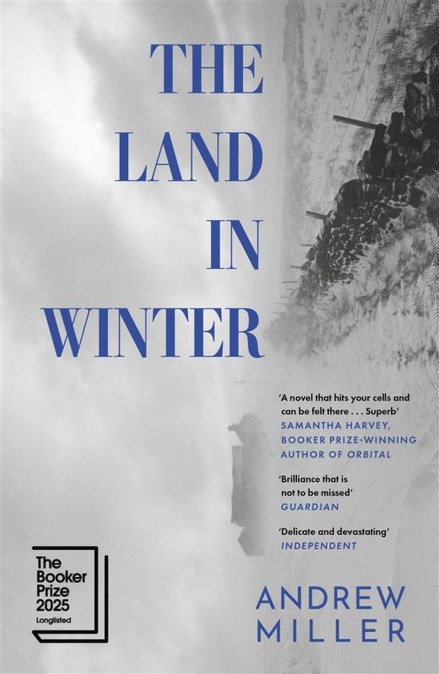
The Land in Winter
In December 1962, local doctor Eric Parry sets out on his rounds while his pregnant wife Irene sleeps at home.
About
Spoiler notice: This About describes the opening situation, both marriages and the blizzard that isolates the village. It avoids later developments and the ending.
The Land in Winter begins in the West Country in December 1962, as a severe cold settles over a small rural community. Andrew Miller places two young married couples at its centre: Eric Parry, a local doctor, and his pregnant wife Irene; and dairy farmer Bill Simmons and his wife Rita. The households are close enough to look across a field, yet each has its own work, private history and strain. At first, the weather belongs to the ordinary seasonal background of life. Eric sets out on his rounds, Bill tends the farm, and the women are at home. When the cold intensifies into violent blizzards, familiar routines become harder to maintain and physical separation begins to shape what these neighbours can do for one another.
The two households are established through different kinds of daily responsibility. Eric’s work takes him away from the cottage and into the surrounding community, while Irene remains pregnant and asleep when the novel’s opening day begins. Across the field, Bill has been up tending a small dairy farm that he bought in the hope of making a new life for himself. That project is already faltering. Rita, whom the publisher describes as funny and troubled, sleeps while images of an earlier life occupy her thoughts; her husband would rather not attend to that past. The details create an uneven domestic landscape: care and labour continue, but the people sharing a home do not necessarily share an understanding of what weighs on them.
Miller’s opening description gives each marriage affection and possibility without presenting either as settled or simple. The couples are newly married, and their relationships still hold promise, but the publisher’s synopsis also signals secrets and the distance between what a person remembers and what a partner is willing to acknowledge. The book follows these four inner lives rather than making the village a backdrop for a single external adventure. Work, pregnancy, intimacy and private thought all matter because they determine how each person experiences a crisis. The arrangement also lets the narrative set one household beside another: two couples live near each other, encounter the same worsening conditions and yet bring different hopes and vulnerabilities to them.
The approaching blizzard changes the scale of the story. Snow and cold do not merely decorate the setting; they threaten movement and make home feel both sheltering and confining. The publisher frames the central question as what a person can do when leaving home is no longer easy. As the storm cuts through ordinary plans, the couples find their lives beginning to unravel. The available synopsis keeps the later sequence of events private, but it makes clear that environmental pressure works together with the relationships’ existing tensions. A farm that is already a difficult undertaking, a doctor’s rounds and the needs of a household take on new urgency when travel and connection are disrupted. Weather becomes a force that tests the practical arrangements on which rural life depends.
The date also places the novel in a country still living with the consequences of the Second World War and nearing the social changes associated with the 1960s. The setting is not treated as a museum display: Eric and Bill have jobs to do, the women inhabit the daily demands of marriage and home, and each person has a private account of the past. The publisher’s description points to the uneasy overlap between these ordinary tasks and histories that remain difficult to face. Through two households rather than a public panorama, Miller can consider how expectations about gender, work and marriage are lived from inside. The weather further narrows the characters’ world, drawing attention to the thoughts and choices that persist when familiar movement across the landscape is curtailed.
The Land in Winter is historical and literary fiction built around domestic life under pressure. Its central contrast is between the apparent modesty of daily routines and the private complexity those routines can conceal. Eric’s medical rounds, Bill’s dairy work, Irene’s pregnancy and Rita’s memories give the story a grounded set of concerns; the winter then alters how the four people can inhabit their homes and relate to one another. The novel’s focus on neighbouring marriages allows its landscape to connect rather than simply isolate its characters: what happens in one household is close to, but not identical with, what happens in the other. The result is a portrait of people trying to make lives together while history, circumstance and weather press on the limits of what they understand about themselves and each other.
The paired households also give the narrative a way to examine contrasting responses without reducing the characters to examples of a single social rule. The four people are linked by place and marriage, yet each has a different relation to work, memory and the future. As snow makes the local geography harder to cross, proximity can no longer be taken for granted as a source of support. That pressure sharpens the gap between living beside someone and knowing what that person carries. The novel’s historical setting therefore operates at both a broad and intimate scale: postwar England is changing, while its characters face immediate questions about care, privacy and whether a shared life can accommodate experiences that have remained unspoken.
Book details
- Author
- Andrew Miller
- First published
- 2024
- Series
- No series listed
- Subgenre
- Historical fiction, Literary fiction
- Primary genre
- Literary Fiction
- Tags
- No tags for this book.
Review
Editor profile
Baby Bat
Goodreads and social links will be added soon.
- Goodreads — link coming soon
- Social media — link coming soon