
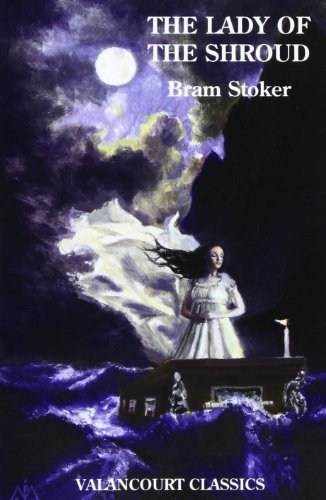
The Lady of the Shroud
A conditional inheritance sends Rupert Sent Leger to the Castle of Vissarion in the fictional Land of the Blue Mountains.
About
Spoiler notice: This overview reveals the shrouded woman’s identity and apparent death, and discusses the rescues, kingship and Federation at the ending.
The Lady of the Shroud opens with a report from an occult journal about a white figure drifting off an Adriatic headland in what appears to be a coffin. The witness, Peter Caulfield, supplies the kind of confident testimony that makes a strange sight seem both documented and difficult to explain. Bram Stoker then turns to family records, legal documents, letters and diaries, building a story through people who possess different pieces of its meaning. Published in 1909, the novel begins with an atmosphere familiar from a ghost story, but its eventual scale extends far beyond the question of whether a mysterious woman is dead. Inheritance, marriage and the future of an imagined country gradually become parts of the same adventure.
Roger Melton’s will provides the mechanism that moves Rupert Sent Leger into this world. The fortune comes through staged arrangements involving a trust, the acceptance of further conditions, residence at the Castle of Vissarion and an eventual report to the executors. Rupert must initially reside there for at least six months, beginning within the specified period, with further obligations before the estate becomes absolutely his. These details give the bequest a purpose beyond rewarding a favoured relative. Money is to place him in particular surroundings and expose him to responsibilities he has not simply chosen from a distance. Other family voices help introduce the contrast between the people who see an inheritance through their own expectations and the person who must discover what its conditions will require.
Vissarion stands in the fictional Land of the Blue Mountains, whose position near the Adriatic makes its independence and security matters of immediate concern. Rupert’s observations connect the castle, the people around it and the possibilities opened by his resources. Fortification and military readiness enter a narrative that still seems to be preparing an encounter with the supernatural. The country’s leaders have reasons to guard information carefully, and rumours can carry political consequences that an outsider initially fails to recognize. Stoker makes the newcomer’s generosity and willingness to act central to his acceptance there. His arrival is therefore a double education: he must learn the significance of local events while the people around him decide what kind of ally the wealthy Englishman may become.
The shrouded woman first makes that uncertainty intimate. She arrives wet and cold, asks for warmth and leaves Rupert unable to settle whether he has sheltered a living person or something outside ordinary life. Her subsequent appearances awaken love alongside fear. When he finds the woman apparently lifeless in a tomb, the evidence seems to confirm the interpretation he most dreads. The narrative lets the reader share his incomplete knowledge rather than immediately supplying a view from outside it. His willingness to bind himself to her culminates in a secret marriage before he knows her name. Documents that had seemed to promise reliable information instead record how intensely a person can feel while still misunderstanding the circumstances that make an encounter possible.
The later explanation reveals her as Teuta, daughter of Voivode Peter Vissarion. A prolonged trance had been mistaken for death, and her return to consciousness created difficulties beyond the shock of waking in a tomb. The leaders feared that competing interpretations of her survival could divide the country at a dangerous moment. Teuta herself proposed preserving the belief in her death until her father returned and matters could be explained effectively. What Rupert understood through the language of vampirism consequently belongs to a concealed human situation. The revelation also changes Teuta’s place in the story. Her endurance and decisions are part of the country’s struggle over its future, and the woman who appeared as a frightening mystery has been carrying knowledge and obligations her visitor could not yet see.
As the private mystery opens out, threats to Teuta and her father produce armed rescues and a broader conflict over the country’s safety. Rupert’s wealth can now be put to uses that link personal loyalty with public defence. Ships, weapons and aeroplanes become increasingly important, giving the later adventure a conspicuously technological character. The movement from tombs and night visits to military organization is one of the novel’s defining changes of scale. The same documentary form that recorded uncertainty about the visitor records decisions, operations and public responses. Stoker’s fictional politics praise courage, service and national unity, while presenting force as essential to maintaining independence. These are the values through which the adventure imagines a secure future, rather than an account of an actual Balkan state.
The concluding records follow the offer of a crown, Peter Vissarion’s decision and Rupert’s emergence as king with Teuta beside him as queen. Coronation reports and later family documents carry the story towards the Federation called Balka. The final spectacle brings aircraft, warships, ceremonial honours and the Crown Prince together, making national continuity visible through both a child and an impressive capacity for defence. Even a gesture that resembles delivering letters is understood in relation to the ability to drop bombs. The shroud itself has acquired another meaning as a dress of honour, and an editorial footnote promises a further account of Teuta’s story. By then the object that first suggested death belongs to a public narrative of survival, while the book’s imagined peace remains inseparable from organized power.
Book details
- Author
- Bram Stoker
- First published
- 1909
- Series
- No series listed
- Subgenre
- Gothic horror, Classic adventure, Epistolary novel
- Tags
- No tags for this book.
Review
Editor profile
Baby Bat
Goodreads and social links will be added soon.
- Goodreads — link coming soon
- Social media — link coming soon