
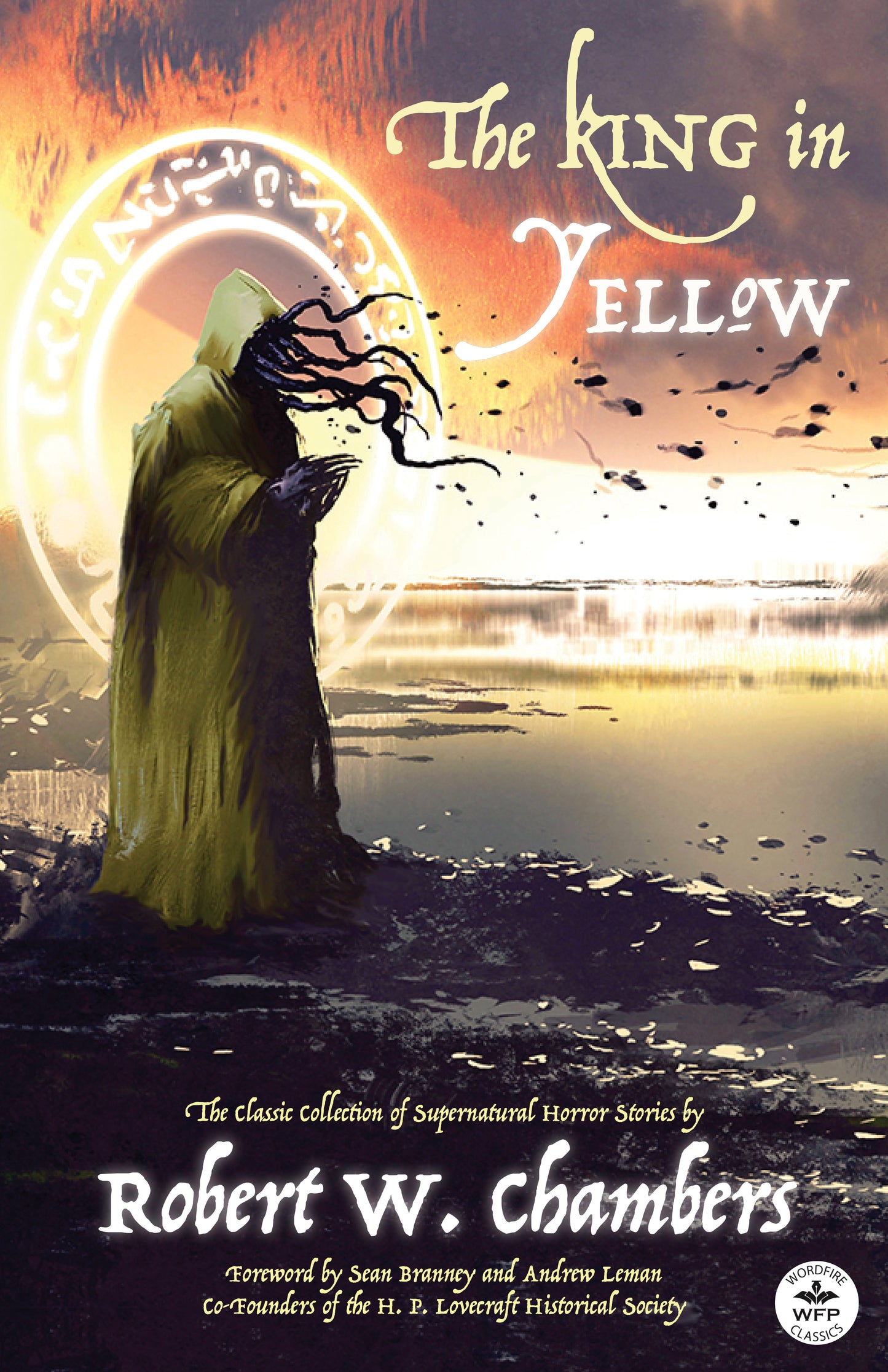
The King in Yellow
Robert W.
About
Spoiler notice: Spoilers for the premises, relationships, supernatural turns and endings of stories across the collection, including The Repairer of Reputations, The Mask, In the Court of the Dragon, The Yellow Sign and The Demoiselle d’Ys.
The King in Yellow is a collection of ten stories first published in 1895, not a single continuous novel. Its title also belongs to a play that exists only within several of the stories: characters hear of its acts, fear its second part, and imagine what it might reveal, but Chambers never supplies a complete script. That distinction shapes the book. The play is a recurring object and threat, while each story has its own narrator, cast and action. The contents move from uncanny tales linked by the play to shorter pieces set among artists and streets in Paris. The collection therefore changes its kind of unease as it goes, rather than carrying one protagonist through a unified plot.
The opening story, The Repairer of Reputations, places its narrator Hildred Castaigne in a speculative New York whose public life has changed along with its architecture and laws. A government lethal chamber stands on Washington Square, while old neighbourhoods have been cleared for a civic garden. Hildred recounts an accident and treatment in an asylum, then describes how the writings and prophecies of the enigmatic Mr Wilde have altered his understanding of himself. He believes he is destined to rule and interprets ordinary conversations as evidence of a hidden succession. The story keeps close to his confident first-person account, letting his assertions and the responses of people around him pull against each other.
The Mask shifts to a Paris studio and a different kind of impossible event. Sculptor Boris Yvain has found a process that turns living things to marble; his friend Alec and Boris’s companion, Geneviève, become caught in the consequences of the discovery. The narrative begins with a glimpse of the result, then lets Alec tell how the experiment entered their domestic and artistic lives. Marble forms, fresh flowers and living bodies share the same rooms, so the material experiment repeatedly crosses from studio work into personal loss. The play appears as an object of dread in this story too, but it does not turn Boris’s experiment into another chapter of Hildred’s New York plot.
In The Court of the Dragon, a church service in Paris becomes the frame for a narrator’s pursuit through the narrow passage named in the title. The man believes an adversary has followed him from the church; the passage’s gates, stairways and closed archways give that fear a physical route through the city. The story cuts between the ordinary congregation and the narrator’s imagined or supernatural flight, until the church music and the passage seem to open onto the same vision. The Yellow Sign uses another pair of artists, the painter Jack Scott and his model Tessie, and a recurring hearse that unnerves them. The sign, the concealed play and the visitor from the hearse all enter their workroom and their relationship, bringing the collection’s literary threat into ordinary studio life.
The fifth story, The Demoiselle d’Ys, leaves the play’s immediate orbit for a Breton setting. Philip, lost while hunting, meets Jeanne d’Ys and enters a household whose routines and language make the encounter feel like a romance from another time. Their exchanges include falconry, courtship and the customs of the place where she lives. When Philip returns to the landscape after the spell of that companionship breaks, a memorial identifies Jeanne as a young woman who died centuries earlier. The story’s turn depends on the contrast between a present-tense meeting and the historical inscription that reframes it. Its supernatural effect is quieter than the pursuit and apparitions of the earlier stories, but it is no less decisive for the characters.
The short sequence called The Prophets’ Paradise is made of brief prose pieces, each with its own scene, voice or image, rather than one plot that links a stable cast. It acts as a formal pause between the Breton story and the later Paris narratives. Those later stories pay close attention to named streets, rented rooms, studios and the people who pass between them. In The Street of the Four Winds, the painter Severn encounters a cat wearing a garter with a woman’s name engraved on its clasp; his search leads through the Latin Quarter toward a figure from his past. Domestic details and the cat’s movements guide the story as carefully as any human conversation, until recognition turns the search into grief.
The Street of the First Shell begins with Sylvia sewing a baby garment while her partner, the American artist Jack Trent, cleans his palette. Shells pass above their cold room in besieged Paris, and his cheerful assurances fail to reassure her. The story takes Trent out into the city and eventually into battle, wearing borrowed uniform and carrying a rifle. The Street of Our Lady of the Fields returns to peacetime anxieties: a visiting clergyman helps the young artist Hastings find respectable lodgings, fearful of the temptations around him. Its opening maps those prejudices onto a street claimed fully by neither the Montparnasse nor the Latin Quarter. Between them, the stories show how war and moral supervision enter lives otherwise built around painting, rented rooms and relationships.
Rue Barrée closes the collection with a lighter social comedy among young artists and their acquaintances. Selby arrives in the Latin Quarter and hears the witty, competitive talk of studio companions; the woman known as Rue Barrée becomes the subject of several men’s attention. Clifford’s pursuit, Selby’s jealousy and Rue Barrée’s own choices complicate the group’s confident talk about romance. The story uses recurring meetings, misunderstandings and changes in confidence rather than an escalating supernatural mystery. Together, the final Paris pieces broaden the collection beyond its famous play-haunted opening: there are ghostly recognitions, urban observation, romance and comic embarrassment alongside horror.
Book details
- Author
- Robert W. Chambers
- First published
- 1895
- Series
- No series listed
- Subgenre
- Classic horror, Weird fiction, Gothic horror
- Primary genre
- Horror, Literary Fiction
- Tags
- No tags for this book.
Review
Editor profile
Baby Bat
Goodreads and social links will be added soon.
- Goodreads — link coming soon
- Social media — link coming soon