
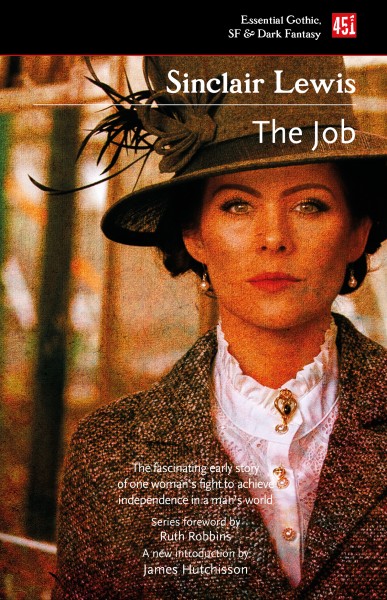
The Job
Una Golden wants to earn a living and put her abilities to use, but the expectations of respectable life in Panama, Pennsylvania, leave few acceptable choices.
About
Spoiler notice: This overview includes Una's marriage, return to work and the novel's unresolved final proposal.
Una Golden has ability before she has anywhere useful to put it. Growing up in Panama, Pennsylvania, she manages a respectable household whose limited money and strong assumptions leave little room for her ambitions. College is unaffordable, while many available jobs are considered unsuitable for someone of her position. She dislikes teaching and recognizes that she is poorly suited to it, but practical alternatives are hard to find. Sinclair Lewis's 1917 novel gives this predicament to an ordinary woman rather than an exceptional genius waiting to be discovered. Una wants to learn, earn and participate in a larger life. The small town can imagine her as a teacher, wife or dutiful daughter more readily than it can recognize her capacity to organize work and make decisions.
New York opens possibilities without making them straightforward. Una and her mother move there, and commercial training gives her stenography and typing as means of entering the office world. The skills are practical, but the excitement surrounding business encourages hopes much larger than an initial wage. Her fellow students offer competing ideas about advancement, loyalty to employers and the distribution of profits. Una's own judgments are sometimes provincial and unfair; learning the city requires revising those assumptions as well as mastering exercises. Meanwhile, responsibility for her mother travels with her. Paid work does not release her from the emotional and domestic claims of their shared life, and her mother's death leaves grief that no improvement in employment can simply compensate for. Independence is something she needs, rather than an uncomplicated state she has already achieved.
The offices expose different ways of undervaluing that need. Troy Wilkins can present himself as generously concerned for Una while insisting that her position can never be worth more than fifteen dollars a week. When she decides to leave, he suddenly suggests the higher wage he was supposedly preparing to offer. His reliance on her becomes clearer as a replacement struggles with work he had taken for granted. Pemberton's, where she becomes secretary to S. Herbert Ross, offers a larger organization and another kind of strain. Appointments, telephone calls, memoranda and the expectation that she will remain late make constant demands on her attention. Ross can absent himself while leaving her to answer for his whereabouts. Greater scale has not automatically produced better judgment or a fairer division of responsibility.
Friendship with other working women gives Una a less isolated view of these experiences. At the Temperance Home Club, Mrs. Esther Lawrence speaks sharply about employers who offer courtesy in place of adequate wages and expect women's conscientiousness to cover their own disorganization. Mamie Magen provides a different example of ambition and intelligence. Their conversations, outings and disagreements make the city more inhabitable, even as the institution housing them imposes intrusive rules. Later Una shares a flat with Mrs. Lawrence, but companionship does not remove her exhaustion at Pemberton's. Hearing another employee celebrate marriage as an escape from the office helps make that possibility attractive. Schwirtz appears to offer strength and protection at the moment she feels least able to continue. The marriage follows a need for relief that affection alone has not created.
The relief proves illusory. Schwirtz's version of a good time does not accommodate Una's need for rest, consideration or privacy, and their honeymoon begins a domestic life in which his confidence repeatedly overrides her discomfort. When money becomes scarce and his employment fails, he resents her desire to return to work as an insult to his ability to provide. Una increasingly sees that remaining dependent does not preserve the dignity either partner claims to value. Her eventual return to business at Truax and Fein therefore means more than another wage. Ordinary tasks can feel worthwhile again because they contribute to something and place her among people who take her seriously as a worker. The office still contains routine, fatigue and inequality, but she no longer confuses those difficulties with proof that she should abandon her own capacity to act.
Responsibility grows through property sales and management. At Crosshampton Hill Gardens she supervises work, deals with prospective buyers and gains the record that supports a more senior position. As a manager, she tries to replace arbitrary rules with explanations and to improve the pay of the women working under her. She then recognizes another commercial opening in the shortcomings of smaller hotels. Travelling to inspect them, questioning guests and employees and studying supplies, she develops concrete proposals for better food, service and accommodation. The White Line Hotels become interested, though negotiations are slow. Una does not simply wait to be discovered: she presents her knowledge, sets boundaries and bargains over salary. Acceptance brings the pleasure of having created an opportunity, followed almost immediately by the wish for someone with whom to share it.
Walter Babson reappears as the assistant and publicity man at her new workplace, reversing their earlier relative positions. He finds taking orders from Una uncomfortable, particularly because he remembers her before she advanced beyond him. His proposal imagines a different arrangement in which they could both remain employed and pay for domestic help. Yet the novel does not show a completed divorce from Schwirtz or a wedding to Walter. Una asks for time to think, and her last reflections hold together the demands she refuses to abandon: she intends to keep her job and treat her clerks decently, while also wanting love and a child. The child is a hope, not a birth in the closing pages. Lewis leaves the practical settlement ahead of her. Her achievement is the refusal to regard work and affection as futures from which she must choose only one.
Book details
- Author
- Sinclair Lewis
- First published
- 1917
- Series
- No series listed
- Subgenre
- Literary fiction, Modern classics
- Primary genre
- Literary Fiction
- Tags
- No tags for this book.
Review
Editor profile
Baby Bat
Goodreads and social links will be added soon.
- Goodreads — link coming soon
- Social media — link coming soon