
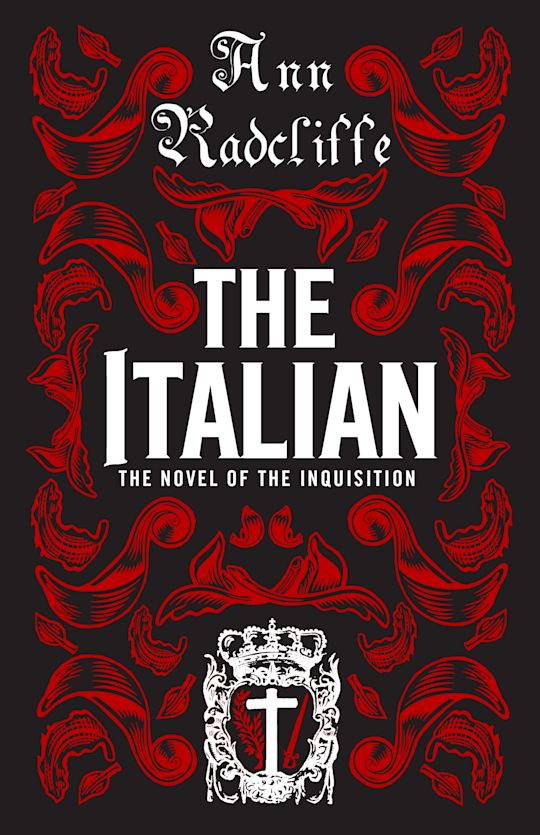
The Italian, or the Confessional of the Black Penitents
Vincentio di Vivaldi falls in love with Ellena Rosalba in Naples, but his powerful family opposes the match.
About
Spoiler notice: Full-plot spoilers, including the attempted murder, Schedoni's mistaken parentage claim, the confessions and poison deaths, Ellena's true family and the final marriage.
A church near Naples provides the unsettling entrance to Ann Radcliffe's The Italian. English travellers admire its architecture and discover that a man moving through its shadows is an assassin protected by sanctuary. Their questions lead to the story of a confession associated with the building, a story delivered as a written account. The frame asks the reader to consider how places dedicated to spiritual protection can also shelter violence and conceal its history. The main narrative then moves back to 1758, when Vincentio di Vivaldi hears Ellena Rosalba singing at San Lorenzo. His fascination begins with her voice, before he has properly seen her face or learned her circumstances. The beauty that draws him toward her leads into a world where other people are already prepared to decide whether the attachment may continue.
Vivaldi belongs to an influential noble family, while Ellena lives quietly with her aunt, Signora Bianchi, at Villa Altieri. Her position appears modest, and the work by which she helps support the household is carefully concealed: embroidery and singing bring money without being allowed to define her public identity. Her fear of contempt matters as much as poverty itself. Vivaldi's mother, the Marchesa, regards family distinction as something to defend, and her son's interest threatens the future she imagines for him. Their courtship is therefore surrounded by unequal power from the beginning. A hooded monk's warning that Vivaldi is being watched adds another pressure. He cannot tell whether he has encountered a rival, an adviser or an agent of something more dangerous, and the uncertainty makes ordinary movement toward Ellena feel like an approach to a trap.
Ellena's confinement at San Stefano gives that threat an institutional form. The abbess presents two alternatives as though offering mercy: she may take the veil or accept a husband chosen by the Marchesa. Either would dispose of her future for someone else's convenience. Ellena refuses both, insisting that her own voice will not sanction the injury being done to her. Her resistance does not open the locked door, but it denies her captors the claim that she has willingly submitted. Radcliffe follows the deprivation through small physical experiences, including the pleasure of fresh air when Ellena is eventually permitted to attend vespers. There she notices the sorrowful voice and appearance of Olivia, a nun whose evident capacity for sympathy offers a human connection within the place that has become her prison.
The danger takes its most intimate form when the confessor Schedoni prepares to have Ellena killed. His ambition and his service to the Marchesa have brought him to a remote house where another man, Spalatro, is expected to carry out the act. Spalatro recoils, arguing over the work and recalling earlier violence that still torments him. Schedoni ultimately approaches the sleeping Ellena himself, struggling to master his reluctance as he raises the dagger. A miniature portrait stops him. His questions about its owner and her family lead him to believe that she is his own daughter, transforming the intended victim into someone whose death would strike directly at him. Ellena responds to the apparent discovery with tenderness, unaware of the full intention behind his presence. The reader knows enough to feel how dangerously incomplete her new sense of protection remains.
Vivaldi's imprisonment adds another layer of manufactured authority. Schedoni has anonymously accused him of heresy and has also forged an arrest document concerning elopement with a nun, enabling impostor officers to seize Ellena. The two devices work through the fear attached to the Inquisition, even though the men who first present the forged order are not its genuine officers. Later disclosures force characters to distinguish between those inventions and the powers that really hold Vivaldi captive. In the dungeon scene where Schedoni finally makes his formal declarations, Nicola acknowledges his part in slandering Ellena, while Schedoni admits the false accusation and forgery. Vindication requires testimony, witnesses and recorded depositions; it does not immediately make every prison door open. Even proof of innocence must pass through the institution that has made it so difficult to establish.
Schedoni's confession also refuses to become a simple scene of redemption. He continues to identify Ellena as his daughter, and the revelation horrifies Vivaldi because it appears to bind the woman he loves to the history of her persecutor. Meanwhile the hatred between Schedoni and Nicola reaches its conclusion. Both men are poisoned; Nicola dies first, and Schedoni briefly recovers enough to admit administering the poison to Nicola and himself. He then dies in the same chamber where he has helped clear Vivaldi's name. The mixture of disclosure and vengeance leaves his final actions morally divided. His evidence can undo part of the harm he caused, while his last violence demonstrates that the wish to control another person's fate has not disappeared. Vivaldi's release follows within days, on an order issued after the dying confession.
Reunion with Ellena brings the correction that Schedoni's account could not supply. Olivia is her mother, and her father was the respectable Count di Bruno; she is not Schedoni's child. Yet maternal recognition does more than remove an obstacle to an aristocratic marriage. Olivia will consent only if Vivaldi's father also acknowledges Ellena's worth and seeks the union himself. After verifying Olivia's identity, the Marchese does so, and the couple marry on May 20, Ellena's eighteenth birthday. The final celebration returns to the beauty of the Bay of Naples, with illuminated gardens, tenants sharing the festivities and the devoted servant Paulo dancing in delight at their freedom. The landscape that once framed surveillance and fear now accommodates an openly recognised household. Paulo's exuberance closes the story by making release from confinement something bodily and communal: people can move, speak, dance and enjoy one another's company again.
Book details
- Author
- Ann Radcliffe
- First published
- 1797
- Series
- No series listed
- Subgenre
- Gothic horror, Historical romance, Classic adventure
- Primary genre
- Romance, Historical Fiction, Literary Fiction
- Tags
- No tags for this book.
Review
Editor profile
Baby Bat
Goodreads and social links will be added soon.
- Goodreads — link coming soon
- Social media — link coming soon