
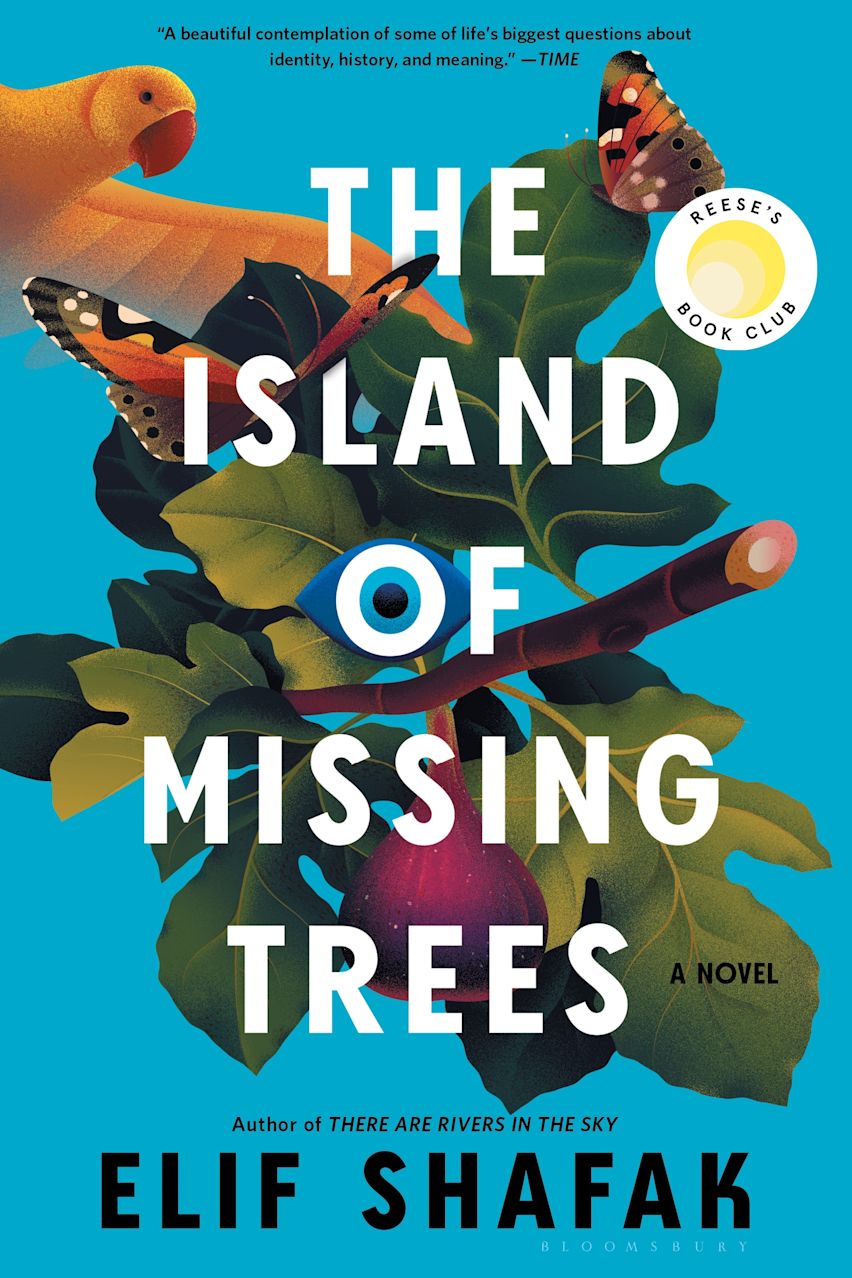
The Island of Missing Trees
In 1974 Cyprus, teenagers Kostas and Defne meet at a taverna beneath a fig tree as conflict deepens around them.
About
Spoiler notice: This overview discusses Ada’s search for family history, the reunion with her aunt, and the novel’s parallel Cyprus and London timelines. It avoids later revelations and the ending.
Cyprus in 1974 is the starting point for The Island of Missing Trees, but Elif Shafak frames the story through more than one kind of witness. Kostas and Defne are teenagers from Greek Cypriot and Turkish Cypriot families who meet at a taverna where a fig tree grows through the roof. Their relationship takes shape in a place where people can gather across the lines that divide them, even as the surrounding island becomes less safe. The tree sees their meetings and their departures; years later, its presence in a London garden links that earlier world to the life of their daughter, Ada. The book’s interwoven perspectives make family history feel like something carried across distance in bodies, memories, and living things.
The London strand begins with Ada at sixteen, living with her father, Kostas, and the quiet that has gathered around her mother Defne’s death. Ada has grown up with little direct access to the Cyprus her parents left behind. Her identity is shaped by what is present at home and by what remains unspoken, so the island is both part of her inheritance and a place she has never seen. Her father’s reserve leaves her trying to interpret the gaps herself. When her aunt Meryem arrives from Cyprus, the visit brings a relative into the household but does not instantly make the past easier to approach. Ada’s guarded response and Meryem’s different sense of what can be discussed set two generations of family feeling into the same room.
The earlier timeline follows Kostas and Defne in Cyprus, where a secret romance crosses a communal boundary that neither teenager can simply wish away. At the taverna, the fig tree offers a shared point of shelter, while the human world around it grows more dangerous. Their private hopes unfold alongside a period of real political violence and division on the island. Shafak’s characters and their love story are fictional; the history that bears on them is not reducible to their family’s experience. The United Nations describes Cyprus as divided after 1974, with Greek Cypriots and Turkish Cypriots living largely in separate regions divided by a UN-controlled buffer zone. That context gives the novel’s separations weight, while the family’s particular choices remain part of the author’s imagined narrative.
A third voice comes from the fig tree itself. The tree is not a documentary witness or a claim about what real trees know; it is a deliberately imaginative narrator with access to a life that outlasts individual human scenes. Its attention moves among roots, seasons, other plants and animals, and the people who pass beneath its branches. This perspective changes the scale of the novel. A political event may divide a street or scatter a family, while a tree records time through growth, damage, fruiting, and the conditions of its surroundings. The tree’s voice can hold details the human characters cannot see, but it is also a literary device, shaped to connect ecology, memory, and storytelling.
In London, the transplanted fig becomes a material link between the island and Ada’s home. It belongs to a family history she is still trying to understand, yet it is not a simple substitute for knowledge of Cyprus or for her mother. The novel lets the tree’s movement echo the family’s displacement without claiming that migration feels the same for a plant and a person. Kostas’s botanical work and the tree’s own narration keep attention on species and habitats as well as human inheritance. The garden gives the story a domestic setting for questions that reach outward: what survives a change of place, what is altered by it, and how can anyone learn about a home from fragments?
The book moves between intimacy and public history rather than treating one as a backdrop for the other. Kostas and Defne’s bond is personal, but the conditions around it are collective and political; Ada’s questions are individual, but they arise from a history that precedes her. Meryem’s visit brings another way of remembering into the same household, and the fig tree supplies a perspective outside the family’s human generations. These strands do not make the past tidy. They show how silence can protect people for a time and also leave those who come later to make sense of what was withheld. The novel’s attention to nature extends that concern, asking what human conflict does to places and living communities that have no part in the decisions.
The Island of Missing Trees is a work of literary and historical fiction with an ecological imagination. Its real setting and historical reference points should be kept distinct from the invented family and the fig tree’s human-like narration. Shafak uses those inventions to explore belonging, grief, migration, and the limits of inherited knowledge, while Ada’s perspective gives the search a present-tense urgency. The title points toward absences that are larger than one tree: lost places, interrupted ties, and histories that cannot be recovered in full. The novel’s central movement is from separation toward the possibility of understanding, carried by several voices whose experiences overlap without becoming interchangeable.
Book details
- Author
- Elif Shafak
- First published
- 2021
- Series
- No series listed
- Subgenre
- Historical fiction, Immigrant fiction
- Primary genre
- Literary Fiction, Historical Fiction
- Tags
- No tags for this book.
Review
Editor profile
Baby Bat
Goodreads and social links will be added soon.
- Goodreads — link coming soon
- Social media — link coming soon