
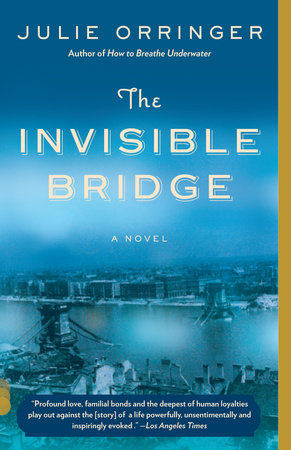
The Invisible Bridge
In 1937, Hungarian-Jewish architecture student Andras Lévi leaves Budapest for Paris on scholarship, carrying a mysterious letter.
About
Spoiler notice: Spoilers cover Andras's departure for Paris, his relationship with Klara, and the brothers' wartime conscription into forced labor; later outcomes and the ending are withheld.
The Invisible Bridge begins in September 1937 with Andras Lévi leaving Hungary for an architecture scholarship in Paris. He leaves his brother Tibor behind and carries a letter whose recipient soon becomes entangled with his own future. At the École Spéciale, Andras enters a new city while remaining marked by his background: he is a Hungarian Jew, one of a small number of Jewish students at the school. The gap between the life he hopes to build and the limits imposed on him supplies an early tension. Paris offers the chance to study and work, but it does not erase the antisemitism he has already encountered at home or shield him from it abroad.
Architecture shapes the way Andras meets Paris. His training asks him to look at buildings as designed spaces, made from choices about structure and use; the book threads his lessons and models through his changing circumstances. At school, discussion of what an architect owes society makes his profession more than a private ambition. The streets and institutions around him also have their own histories, and his place in them is never fully secure. This contrast gives the title a useful resonance without reducing it to a single symbol: the bridges between people, cities and possible futures can seem durable, yet political power can close the routes that once appeared open.
The letter he has promised to deliver pulls Andras into a relationship with Klara Morgenstern, a Hungarian émigré whose past she keeps guarded. Their connection develops in the unsettled space between attraction and uncertainty, as each tries to understand the other while political conditions keep changing. Andras also finds work at a Paris theater, bringing him into a world of performance alongside his architectural studies. Theater and ballet matter to several characters, and these arts provide another way to consider how people make roles, preserve forms and imagine lives beyond their immediate surroundings. The novel lets romance and art grow inside practical pressures: money, family obligations, work and the risk of being Jewish in Europe.
Andras is one of three brothers, and the story follows how their separate plans remain tied to their family in Hungary. Tibor is preparing for medical study in Italy; the youngest brother, Mátyás, stays closer to home. Their different paths keep the book from treating Andras’s move to Paris as an isolated coming-of-age story. News, visits and changing circumstances link the brothers across borders, while parents and other relatives give their choices a larger context. A scholarship or a visa can redirect one life, but the family’s security depends on events that no one sibling can control. The novel’s scale comes partly from this movement between individual hopes and the shared consequences of history.
Persecution enters the characters’ ordinary ambitions before the full catastrophe of war. Andras has already faced antisemitism in Hungary; in Paris he encounters it in the school environment as well. A Hungarian law that bars Jews from receiving scholarships for study abroad turns his opportunity into something explicitly vulnerable to state policy. These pressures change the meaning of education, work and belonging. The young people around Andras must decide what dangers they can name, what they can endure and how much they trust institutions that claim to represent them. The book follows a narrowing horizon rather than a sudden switch from peace to danger, showing how exclusion can become part of daily life before it becomes unmistakable violence.
Family life and Jewish identity remain present through rituals, relationships and small routines, not only through declarations about belief. Weddings, holidays, prayer and meals connect people to one another and to inherited traditions. They also create moments of continuity when public life is becoming more hostile. The novel places these practices beside disagreement, courtship, work and changing political loyalties, so that a community is never just a single response to danger. People may share a background and still judge events differently or take different risks. That attention to ordinary life matters because persecution targets more than individual bodies: it tries to break the social ties, customs and futures through which people understand themselves.
As the Second World War advances, the brothers are drafted into the Hungarian Labor Service, and the family’s choices are increasingly shaped by coercion and fear. Forced labor is one of the novel’s central historical realities, not simply a distant backdrop to a love story. Andras and the people close to him face work, deprivation and separation under systems designed to control Jewish men and communities. At the same time, the book retains the scale of particular lives: a brother’s absence, an uncertain return, work that must still be done and a relationship tested by events outside the couple’s making. The perspective keeps historical catastrophe legible through changes in the family rather than through statistics alone.
Orringer has said that the novel began after she learned of her Hungarian Jewish grandfather’s scholarship to study architecture in Paris and his later conscription into Hungarian labor service. She drew on family conversations, travel in Paris and Budapest, archival research and accounts from survivors, but she has also explained that the novel does not reproduce her grandfather’s experience exactly. That distinction helps frame the book: it is historical fiction informed by a family story, built to hold invented characters within researched conditions. The result moves between architecture, theater, love and the history of Hungary’s Jews, keeping its attention on what people try to make while the world around them changes. That distinction keeps the novel’s fictional family its own creation while situating it in researched histories.
Book details
- Author
- Julie Orringer
- First published
- 2010
- Series
- No series listed
- Subgenre
- Literary historical fiction, World War II fiction, Family saga
- Primary genre
- Literary Fiction, Historical Fiction
- Tags
- No tags for this book.
Review
Editor profile
Baby Bat
Goodreads and social links will be added soon.
- Goodreads — link coming soon
- Social media — link coming soon