
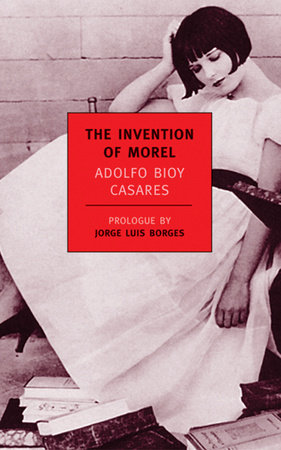
The Invention of Morel
An unnamed fugitive takes refuge on an island he believes deserted, until a group of holidaymakers appears at its hotel.
About
Spoiler notice: Full-story spoilers below, including the explanation of Morel's invention and the narrator's final plan.
Bioy Casares frames the novella as the diary of an unnamed fugitive who has reached an island while trying to stay beyond the law. The editor's footnotes interrupt this account from the outset, correcting or questioning details and making the diary feel less secure than a straightforward adventure. The narrator believes the island is deserted and tries to make a life there, but the place is difficult to inhabit: a marsh is associated with disease, while a hotel and other buildings stand empty. This opening places practical survival alongside a more puzzling problem. The narrator has escaped human society, yet he is not certain what kind of danger the island holds or whether his own account can be trusted.
The solitude breaks when a group of visitors appears at the hotel. They behave as if they have arrived for a holiday, gathering in the building and spending time around its grounds. Faustine, a woman among them, repeatedly watches the sunset. The narrator becomes absorbed by her and tries to approach, but she never acknowledges him. He explains her silence in different ways and watches from the marsh to avoid being discovered. The scene is unsettling because the visitors seem entirely ordinary: their clothes, conversations, leisure and habits are specific enough to make the narrator's invisibility harder to explain. His love for Faustine grows from observation, while the gap between what he sees and what she seems able to perceive keeps widening.
The diary turns that gap into a series of investigations. The narrator notices repeated patterns in the visitors' conversations and movements, yet initially treats each return as a fresh event. The island's landscape supplies stranger evidence: a second sun and moon appear, and the water, weather and light behave in ways that challenge his ordinary explanations. He searches the hotel, museum, chapel and other structures, and his account moves between careful observation and anxious speculation. The editor's notes add another layer, sometimes correcting the narrator and sometimes appearing mistaken themselves. Even the book's form begins to echo the mystery: repeated scenes and phrases that first look like errors acquire a different weight once their cause is known. The puzzle asks how much a witness can infer from an image that never answers back.
The explanation arrives through Morel, who gathers the visitors and tells them about his invention. He has built a machine capable of recording people and their surroundings with such completeness that the recorded scene includes not only appearances but sound and other sensations. Morel intends the recording to preserve a week of life so it can recur without end. The group has been made part of that record, and the apparent visitors are projections repeating the same moments rather than living people moving through the hotel. Their failure to respond to the narrator is not coyness or hostility: the recording cannot perceive someone standing outside it. Details that looked supernatural, including the doubled celestial bodies and the visitors' repetitions, become effects of the apparatus and the island's conditions.
Morel's account does not make the invention a simple triumph. The recording process has a fatal cost for the people who enter it, so the preserved scene depends on the loss of the original lives. Morel presents this as a way to defeat death, but his decision also turns the others into material for his project. Faustine's place in the recording becomes especially painful for the narrator: he has treated her as a possible partner, but she is an image repeating a week from which he was absent. Morel's own desire for a lasting image complicates the narrator's longing. Both men want Faustine, and both seek some form of permanence, but neither can make a recorded person freely answer a living admirer. The machine preserves gestures and presence while removing the mutuality that gives a relationship life.
After learning what happened, the narrator returns to the rooms that house Morel's apparatus and studies how it works. He imagines ways to change the sequence so that his own image will appear with Faustine's. The blue-tiled room that contains the machinery has an almost otherworldly beauty for him, but it is also the place where Morel's idea becomes concrete and dangerous. The narrator writes about the machine in the diary, making his manuscript a second attempt at preservation: if the images fail, his words may still explain what they were. Yet the diary cannot solve the problem that matters to him. It can record his love and his reasoning, but it cannot make Faustine see or hear him.
The ending follows the narrator as he stops looking for a way to meet Faustine in ordinary life and instead prepares to enter the repeating scene. He studies her recorded gestures and plans a part for himself, arranging his words and movements as if he could answer her within the performance. Bioy Casares leaves the success of that intervention uncertain; the narrator's plan is clear, but the diary cannot prove that Faustine's image will truly respond. This final choice brings the book's doubled structure into focus. The narrator and Morel both pursue immortality through images, and the diary mirrors the machine by trying to hold a disappearing life in fixed form. The difference is that the narrator knows the cost and chooses it for love, leaving the reader to weigh preservation against the living person's freedom.
Book details
- Author
- Adolfo Bioy Casares
- First published
- 1940
- Series
- No series listed
- Subgenre
- Classic science fiction, Experimental fiction
- Primary genre
- Sci-Fi, Literary Fiction
- Tags
- No tags for this book.
Review
Editor profile
Baby Bat
Goodreads and social links will be added soon.
- Goodreads — link coming soon
- Social media — link coming soon