
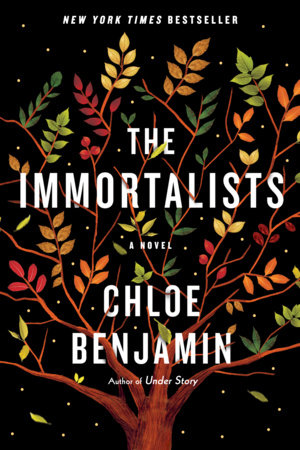
The Immortalists
In 1969, four Gold siblings from New York’s Lower East Side visit a traveling psychic who claims she can tell them the dates of their deaths.
About
Spoiler notice: This overview covers the 1969 psychic visit, the four siblings’ distinct adult paths, and the novel’s questions about belief, family, and mortality. It withholds the predicted dates, later character fates, and the ending.
The Immortalists begins with a question that is simple to ask and difficult to live with: what would change if you believed you knew when your life would end? In 1969, the four Gold children leave their Lower East Side home to consult a traveling psychic who claims she can predict each person’s death. Chloe Benjamin builds the novel around the long space between hearing a prediction and deciding what it means. The children do not respond as one unit. Their temperaments, ambitions, fears, and attachments guide them toward different ways of carrying the knowledge. The premise sets up a family story as much as a mystery about foreknowledge, because its consequences unfold through people who heard the same claim but must live with it separately.
The siblings are Simon, Klara, Daniel, and Varya, from youngest to eldest. Simon’s path takes him to San Francisco, where he seeks love and a life of his own. His section places him amid the city’s gay community in the late twentieth century, during years marked by cultural possibility and the AIDS crisis. Benjamin has described Simon’s story as personally important, situating it in a specific historical period rather than using the city as an interchangeable backdrop. The focus remains on Simon as a person making choices, forming relationships, and looking for belonging. The prediction hangs over that search, but does not reduce him to a symbol or make his life only a countdown.
Klara, Simon’s older sister, is drawn to magic and performance. Her work moves from San Francisco toward Las Vegas, where theatrical illusion becomes a way to explore questions she finds difficult to settle through ordinary explanations. In Benjamin’s account of Klara, performance can also expose how uncertain the borders between reality and illusion feel. Klara has her own ambitions and ideas, and her relationship with her siblings reflects their shared history and the lives they have made separately. Her strand gives the novel a stage on which belief can be tested in public and private.
Daniel, the second-oldest Gold, becomes a doctor in the U.S. Army. His professional role places him near decisions about health, military service, and who is considered fit to serve. The author’s Q&A notes that she wanted to examine how a person who feels powerless can turn that feeling outward and oppress others. Daniel’s work and circumstances give his beliefs practical effects for other people. As the siblings age, their shared past meets new pressures, including the political climate after September 11. Daniel seeks security within an institution, yet the novel makes clear that stability and moral certainty are not the same. His section asks how private fear can shape public judgment and how professional authority can complicate a person’s sense of control.
Varya, the eldest, pursues scientific research into longevity. Her work places her near questions that echo the psychic’s promise from another direction: if people can study aging and extend life, what can knowledge actually promise about mortality? The scientific setting is not proof that death can be mastered. Instead, Varya’s career gives the novel a grounded counterpoint to Klara’s performance and the siblings’ childhood encounter with a supernatural claim. The publisher describes Varya as testing the boundary between science and immortality, while Benjamin discusses the uncertainty about what the Gold children know and what they believe they know. Varya’s disciplined work does not settle that uncertainty. It shows how a search for measurable answers can coexist with emotional questions and a family history that cannot be reduced to data.
The structure follows the four siblings through separate stretches of a half-century, changing place and period as their lives unfold. Each section gives one Gold a distinct environment and set of concerns, but the novel does not discard the family when attention shifts. The psychic visit remains a common reference point, and the siblings’ bond carries the effects of decisions made apart. Their parents and shared childhood link the story’s movements without making the four characters interchangeable. Similar knowledge can produce different forms of urgency, avoidance, ambition, or care, depending on who receives it and what else that person is facing.
The central tension is not simply whether the fortune-teller is right. Benjamin has explained that expectation, chance, and fate interact in shaping how people live, and the book leaves room to consider those forces without reducing them to one answer. A prediction can alter someone’s choices even if its truth remains uncertain: it may sharpen an appetite for experience, encourage caution, or become part of the story a person tells about the self. The Immortalists places that response beside broader changes in American life, including shifts in family, community, medicine, and politics. Its title points toward the desire to outlast ordinary limits, while its family focus keeps the question intimate. The Golds’ careers and attachments show mortality as a pressure that shapes how people imagine the future and remain connected.
By following four lives rather than one, Benjamin keeps the premise open across different personalities and decades. Simon’s search for love, Klara’s experiments with performance, Daniel’s military medicine, and Varya’s longevity research offer distinct ways of confronting uncertainty. The siblings continue to matter to one another even when their paths pull them into separate cities and concerns. An extraordinary claim made in childhood becomes an enduring presence in ordinary decisions, while family ties provide another force that can comfort, burden, and redirect. The Immortalists asks how much of a life belongs to choice, how much to circumstances outside one’s control, and what knowing—or believing one knows—can change.
Book details
- Author
- Chloe Benjamin
- First published
- 2018
- Series
- No series listed
- Subgenre
- Family novel, Literary fiction
- Primary genre
- Literary Fiction
- Tags
- No tags for this book.
Review
Editor profile
Baby Bat
Goodreads and social links will be added soon.
- Goodreads — link coming soon
- Social media — link coming soon