
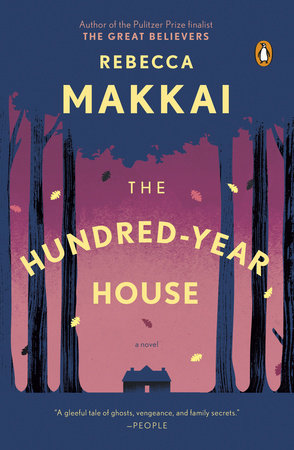
The Hundred-Year House
In 1999, Zee Devohr and her husband Doug live in the coach house at Laurelfield, her family’s estate north of Chicago.
About
Spoiler notice: Spoilers cover the premise and the novel’s three historical sections at Laurelfield, including the Devohr family, the arts colony, Violet’s portrait and Doug’s search for Edwin Parfitt records. Later revelations and the ending are withheld.
Laurelfield has been a family estate and an artists’ colony, and its rooms hold more than one version of the Devohrs’ past. In 1999, Zee and her husband Doug move into the coach house on the grounds. Zee is a literary scholar whose politics sit uneasily beside her family’s wealth; Doug is an unemployed academic trying to finish a biography of Edwin Parfitt, a poet who once lived at Laurelfield. The property’s old colony records might give his book the material it needs, but Zee’s mother, Gracie, keeps the attic files out of reach. Doug’s research soon becomes a way into the larger mystery of what the house remembers and what the family has chosen to keep quiet.
The story starts at the end of Laurelfield’s century and moves backward, from 1999 to 1955 and then 1929. Each shift changes whose lives occupy the house and what it means to belong there. The novel’s shape turns a family saga into a kind of reverse investigation: later generations inherit rooms, portraits, stories and habits, while earlier sections show how some of those things began. It is useful to know this structure before starting, since each section rewinds the calendar rather than carrying the same cast forward in the usual order. A detail that first seems like atmosphere can acquire a different weight when the book returns to an earlier household.
In the 1999 section, the present-day Devohrs bring their own comic frictions to Laurelfield. Gracie has a peculiar certainty about people and their prospects; her second husband, Bruce, is preparing for the Y2K computer problem while trying to keep up with his leisure routines. Zee resists the privilege that surrounds her, even as she has moved back onto the family property. Doug, meanwhile, is anxious about his stalled career and the manuscript he hopes will rescue it. His interest in Parfitt begins as an academic problem, but Gracie’s insistence that the colony records stay closed gives the archive a family dimension. The attic is both a practical obstacle and a boundary around what Zee’s family is willing to say.
Violet Devohr is present in the first section as a story told about the past and as a large oil portrait in the dining room. She is said to have died by suicide somewhere in the house, and the portrait has unsettled the artists who later lived there. Makkai lets the painting work as a physical object, a family inheritance and a source of uneasy folklore. The book does not need a conventional ghost to make Laurelfield feel haunted: the residents carry old assumptions, silences and competing versions of events into ordinary rooms. The effect is part gothic mystery and part domestic comedy, with a family home that keeps making its occupants negotiate between what they can see and what they think they know.
When the novel reaches 1955, the focus turns to Zee’s mother, Grace, and the household around her. Laurelfield no longer functions as the artists’ colony at its height, and the old estate brings a different set of constraints to the people living in it. The history behind the later family’s stories becomes less abstract as the reader sees people making choices inside the house. Staff and family members have their own interests, and the apparent division between those who own Laurelfield and those who serve it does not guarantee that the owners understand what is happening around them. This middle section makes the house feel less like a backdrop than a system of relationships that can outlast any single occupant.
The final section travels to 1929, when Laurelfield is a busy artists’ community facing an uncertain future. Parfitt belongs to this period, which is why his papers matter so much to Doug decades later. The residents are trying to sustain the colony as its circumstances change, and their work, ambitions and personal attachments intersect with the estate’s owners. Seen from this earlier point, the archives Doug wants are not neutral boxes of documents. They are traces of people who made art and plans there, and whose lives did not necessarily fit the orderly record a scholar hopes to find. Moving backward lets the book place those ambitions beside the later family’s inherited stories without reducing either period to a simple explanation of the other.
Across all three sections, the novel keeps returning to questions of reinvention: who gets to define a family’s past, how a person can change their place in it, and what remains when a house changes use. Art is part of that question through the colony and Doug’s work on Parfitt, while the Devohrs’ wealth complicates the idea that Laurelfield can ever be left behind. The tone shifts between dry humor, romance, melancholy and Gothic unease, but the house holds the pieces together. First published in 2014, The Hundred-Year House is built for readers who enjoy a story that asks them to revise their picture of a place as they learn more about the people who lived there. Its mysteries accumulate through changing perspectives, and the backward chronology makes the past feel active in the present rather than safely settled.
Book details
- Author
- Rebecca Makkai
- First published
- 2014
- Series
- No series listed
- Subgenre
- Literary historical fiction, Family saga
- Primary genre
- Historical Fiction, Literary Fiction
- Tags
- No tags for this book.
Review
Editor profile
Baby Bat
Goodreads and social links will be added soon.
- Goodreads — link coming soon
- Social media — link coming soon