
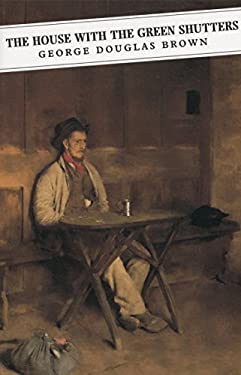
The House with the Green Shutters
In the Scottish town of Barbie, proud businessman John Gourlay's house and status draw both admiration and envy.
About
Spoiler notice: This overview discusses domestic violence, the killing of Gourlay and the suicides at the ending.
John Gourlay likes to stand at his gate in the morning and look down on Barbie. The small Scottish town gives him a view of his own importance: his house occupies a commanding position, his carts carry goods through the streets, and the business below seems to confirm that he is its greatest man. The House with the Green Shutters begins by showing how closely his prosperity and self-regard depend on being seen. He despises the townspeople's opinion while arranging displays meant to impress them. His pleasure in the scene is therefore less an appreciation of its beauty than a rehearsal of possession. The house gives that feeling a visible shape, making his success something neighbours cannot pass without noticing.
Barbie does notice, but attention does not become affection. Its conversations are full of resentment, speculation and satisfaction at the possibility of someone else's humiliation. Gourlay's pride has helped make enemies who are ready to interpret a setback as the beginning of his fall. The same temperament also governs his household. His wife and children live with anger that makes the difference between his public strength and their private vulnerability painfully clear. Brown does not offer the small town as a refuge of simple kindness. Familiarity can give people accurate knowledge of one another's weaknesses without encouraging compassion, and gossip allows them to enjoy consequences they do not have to endure inside the house.
Business rivalry gradually changes the balance Gourlay considers secure. Wilson's Emporium attracts trade, while new arrangements and opportunities weaken the advantage of the established carrier. Losing the quarry contract exposes another limit to Gourlay's authority: someone whose custom he needs can refuse to continue on his terms. His effort to restrain himself in that confrontation leaves the anger looking for an outlet at home. He strikes his wife rather than acknowledge how little his rage can repair the commercial loss. The decline is consequently both financial and personal. Decisions that might call for adaptation become insults he cannot bear, and the people least able to protect themselves receive the force of his humiliation.
Young John Gourlay carries a different weakness into the same struggle over status. His father wants education to extend the family's importance, but the boy's performance cannot fulfil that ambition. Comparisons with Wilson's son turn schooling into another public measure by which the two families can be ranked. University offers young John neither a secure identity nor a successful departure from home. Drinking becomes part of the pattern through which he evades what he cannot manage, and his return supplies his father with further grounds for contempt. The novel follows how anxiety and degradation feed each other. The son's failure matters to the father as an injury to the family name, while the son's fear makes it harder to act beyond the identity imposed upon him.
Their confrontation eventually becomes fatal. After humiliation and threats, young John strikes his father with a poker and is horrified by what he has done. Janet recognises that her father's heart has stopped; their mother then invents a fall from a ladder to conceal the killing. That immediate attempt to protect her son does not release the family from the event. The death remains inside the house as something that must be remembered and hidden, while the circumstances of the business continue to worsen. Mortgage arrears reveal how little security the outwardly substantial property now provides. The same building that once proclaimed Gourlay's ability to dominate Barbie becomes the place in which his survivors discover the extent of their exposure.
Young John's suicide leaves his mother and Janet confronting another loss while their own illnesses and fear of destitution close around them. Mrs. Gourlay discloses suffering she has concealed for years after her husband's violence; Janet has been told that her lung disease will be fatal. Their conversation makes the final decision grow from accumulated misery rather than a sudden unexplained turn. The novel depicts the two women deciding to die together, then withdraws from them as they enter the parlour. It does not transform the moment into a release that repairs the life preceding it. The failure of the household has become complete, with nobody inside it able to imagine help arriving from the community beyond the gate.
That community enters in the person of the postman, who has already been discussing the family's impending financial disgrace. His curiosity brings him through a door once guarded by Gourlay's hostility, and ordinary signs of silence initially provoke contempt rather than concern. The discovery of the bodies finally breaks through the pleasure of gossip. He runs back to the men outside, unable at first to describe what he has seen, and their talk gives way to horror. The house remains dark beneath a radiant dawn. Brown ends with that contrast, offering no later settlement of debts or official inquiry to put the disaster at a comfortable distance. The town that watched the family's position so closely is left looking at the consequences it had never truly understood.
Book details
- Author
- George Douglas Brown
- First published
- 1901
- Series
- No series listed
- Subgenre
- Social realism, Family novel, Literary fiction
- Primary genre
- Literary Fiction
- Tags
- No tags for this book.
Review
Editor profile
Baby Bat
Goodreads and social links will be added soon.
- Goodreads — link coming soon
- Social media — link coming soon